
Introduction
Have you ever noticed how some teachers just get through to you while others don’t? That gap between teaching and learning is exactly where educational psychology lives.
Educational psychology is the branch of psychology that studies how people learn and how to make learning better.

Unlike general psychology, which looks at human behavior in all settings, ep psychology focuses specifically on schools, classrooms, and other learning environments. As one source explains, it is "the study of how people learn and retain information." You can read more through What Is Educational Psychology?.
This field matters because it takes research and turns it into real strategies. Teachers use it to reach struggling students. Policymakers use it to design better schools. Even app developers use it to build tools that actually help people learn.
But here is the challenge: picking the right educational psychology program is not simple. The psychology requirements vary a lot from school to school. Some programs follow standards set by APA psychology guidelines. Others focus more on state teaching licenses or specific career paths.
That is why this guide exists. We put together a data-backed overview of ep psychology programs to help you compare your options. We cover curriculum, accreditation, and what jobs look like after graduation.
If you are new to understanding how psychological terms connect to real-world learning, you may find it helpful to start with clear psychology definitions to build your foundation.
Whether you are just starting your studies or looking to move into a specialized role, this guide will help you make a confident decision. Let us begin with the basics.
What Is Educational Psychology?
Educational psychology is the study of how people learn and how to make learning better. It sits right at the crossroads of psychology, education, and cognitive science. Think of it as the bridge between what we know about the human mind and what actually happens in classrooms, training rooms, or even living rooms where learning takes place.
At its core, it is an applied branch of psychology. As one academic source describes it, educational psychology is a branch of psychology applied in education. That means it takes findings about memory, motivation, and child development and turns them into real strategies teachers can use every day.
The field has not always looked the way it does today. In the early days, educational psychology was heavily focused on behaviorism — think rewards, punishments, and observable actions. Over time, it grew to include neuroscience, which looks at how the brain actually processes information, and sociocultural perspectives, which consider how culture and social relationships shape learning. This evolution is captured in the history of educational psychology, which shows how the field keeps expanding.
Within educational psychology, several key subfields help us understand the bigger picture:
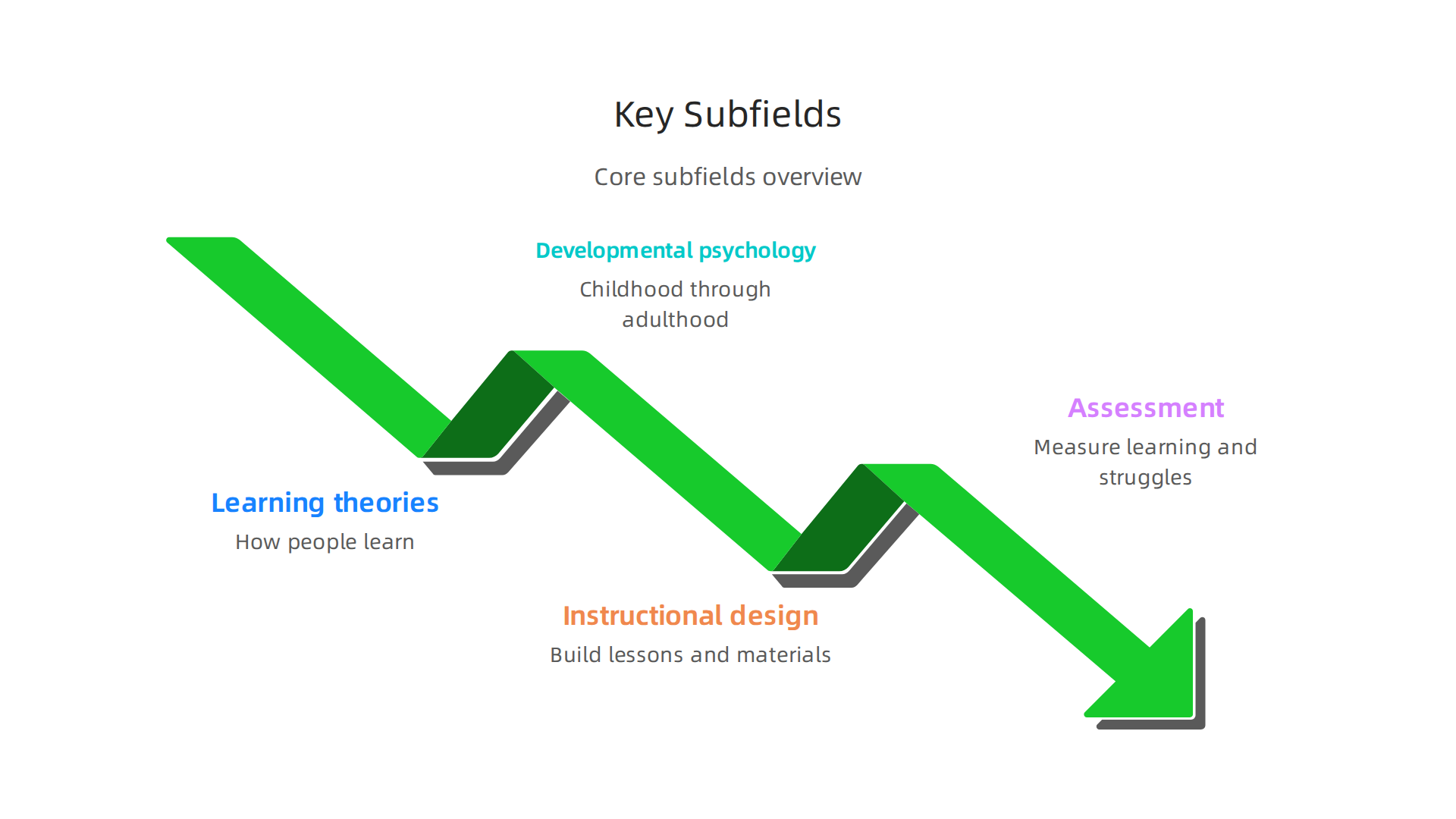
- Learning theories — How people take in, store, and use information
- Developmental psychology — How learning changes from childhood through adulthood
- Instructional design — How to build lessons and materials that actually work
- Assessment — How to measure what someone has learned and where they struggle
These subfields connect directly to what you would study in an ep psychology program. And if you want to go deeper into how different counseling approaches relate to learning, you might find it useful to explore the major theoretical orientations in counseling. Understanding these orientations gives you a clearer picture of why some teaching and therapy methods work better than others.
Educational psychology is not just about school. It applies to parenting, workplace training, and even how we learn from digital media. The better you understand it, the more you can improve how you learn and how you help others learn.
Core Components of an EP Academic Program
So what does an actual ep psychology program look like once you enroll? These programs blend foundational theory with hands-on research methods. You will not just read about how people learn. You will also learn how to measure and study that learning.
A typical curriculum includes courses on learning theories, human development across the lifespan, motivation, and educational assessment. Many programs also require a course on research methods or applied statistics so you know how to evaluate evidence. For example, the Educational Psychology course catalog at Illinois shows core topics like culture in the classroom, cognitive science of teaching, and professional ethics.
Most programs also let you choose a focus area. Common specializations include:
- School psychology — preparing to support students in K-12 settings
- Gifted education — understanding how highly capable learners think
- Learning analytics — using data to improve instruction and outcomes
You will also take a few electives to round out your knowledge. These might cover behavior modification, counseling techniques, or digital learning tools.
The psychology requirements for graduation typically include a practicum or internship where you apply what you have learned in real settings. This hands-on experience is what turns classroom knowledge into real skills.
If you are coming from a general psychology background, you will find that ep psychology programs build on many of the same foundations you already know. The main difference is the focus on applying that knowledge directly to teaching and learning environments.
Foundational Courses
That is no accident. The foundational courses in any ep psychology program are designed to build on what you already know from general psychology while pushing deeper into how people learn and grow. Most programs start with three core areas.
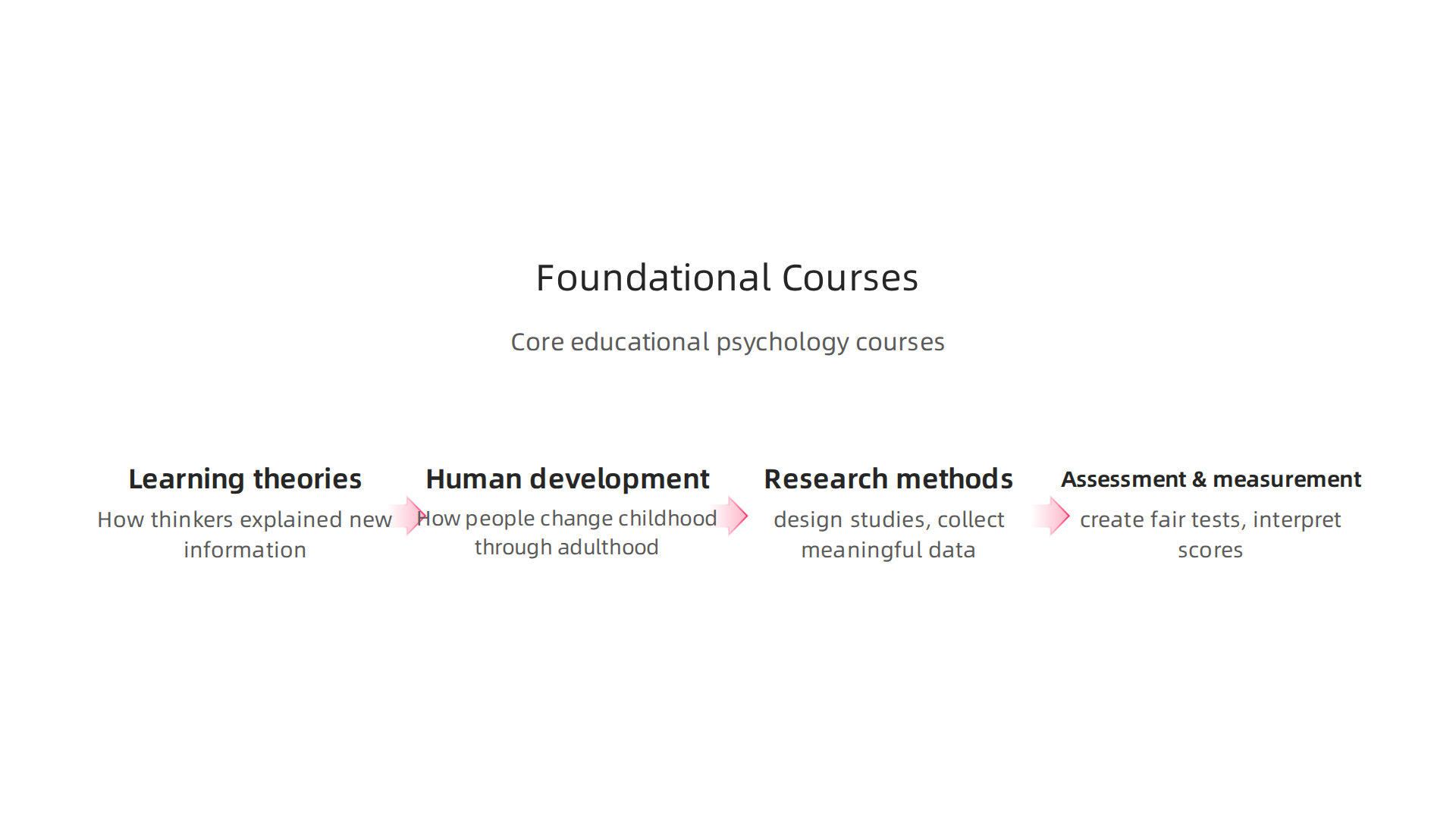
First, learning theories classes. Here you study how thinkers like Piaget, Vygotsky, and Bandura explained the way humans take in new information. You learn why some teaching methods work better than others and how motivation drives learning.
Second, human development courses. These cover how people change from childhood through adulthood. You look at cognitive, emotional, and social growth at each stage. This knowledge helps you understand why a five-year-old learns differently from a teenager.
Third, research methods and statistics. You cannot evaluate whether a teaching strategy works without data. These courses teach you how to design studies, collect meaningful data, and read research critically. Schools like the University of Florida require a dedicated educational research design class as part of their undergraduate curriculum. That kind of training prepares you for graduate study and real-world decision making.
Many programs also include an assessment and measurement course. You learn how to create fair tests, interpret scores, and use data to guide instruction. These skills match the psychology requirements set by APA psychology accreditation standards, so you know your training meets professional benchmarks.
If you want a quick refresher on basic psychology terms before diving in, check out this guide to navigating psychology definition topics. It will help you feel confident from day one.
Specialized Electives
Once you finish the core classes, the fun really begins. Specialized electives let you dig into the areas that excite you most.

Want to design better online lessons? Take a course in instructional design. Curious about how the brain learns? Try educational neuroscience. Love working with classroom tech? Sign up for technology integration classes.
Some programs even offer certificates in high-demand fields like school psychology or applied behavior analysis. For example, the University of Illinois lets students add a concentration in digital learning or bilingual-bicultural education. That extra credential looks great on a resume and opens doors in specific job markets.
Your elective choices often reflect what employers are looking for right now. Schools need experts who understand how to use data to help struggling students. Private companies want people who can design training programs that actually work. By picking electives that match these trends, you set yourself up for a career that is both meaningful and in demand.
If you are thinking about becoming a therapist or counselor, consider electives in counseling techniques. Understanding different approaches, like the ones explained in this guide to theoretical orientations in counseling, can help you choose the right path for your future practice.
Electives are your chance to make the degree truly yours. So look at the job boards, talk to professors, and pick the courses that light you up.
Career Pathways
Once you have chosen your electives, it is time to think about where those choices can take you. Career pathways for EP psychology graduates are diverse and growing.

You can work in schools, universities, research labs, corporate training offices, and ed‑tech companies. Common roles include school psychologist, instructional coordinator, researcher, and learning designer.
The demand for these professionals is real. According to the Bureau of Labor Statistics, overall employment of psychologists is projected to grow 6 percent from 2024 to 2034, which is faster than the average for all occupations. That growth comes from a stronger focus on evidence‑based education and mental health support in schools and workplaces.
Salary potential varies by role and location. School psychologists earn a median salary around $86,930, while educational psychologists with more experience can make over $80,000. If you pursue a doctoral degree, your earning potential jumps even higher.
As you explore these options, it helps to understand how EP psychology connects to real‑world mental health work. You can learn more about types of mental health therapy to see how your future career might apply this knowledge directly with clients and students.
No matter which path you choose, the field offers stable job growth and the chance to make a real difference in how people learn and thrive.
Job Market Outlook
The demand for professionals trained in ep psychology keeps rising. Expanding special education programs need more school psychologists to evaluate students and create learning plans. Schools also rely on instructional coordinators to improve teaching methods using data. These trends create steady job openings across the country.
Salaries depend heavily on your role and location. While school psychologists earn a solid median wage, educational psychologists in private sector roles often see higher pay. The educational psychologist salary guide from PsychologyJobs.com shows that earnings grow with experience: less than one year pays around $59,000, while 10 to 19 years bumps that to $83,000. With 20 years or more, you can earn close to $89,000. These numbers show the long-term earning potential in this field.
If you want to see how school psychologists apply their training every day, take a look at cognitive behavioral therapy. This approach is one of the most common tools used in school settings to help students manage anxiety and behavior.
On the national stage, the value of mental health work in schools is gaining attention. For example, Authority Magazine highlighted how platforms that track and reward healthy behaviors help offset anxiety and depression in young people. This kind of recognition shows how the job market is evolving to meet student needs.
Accreditation and Program Quality
Not all ep psychology programs meet the same standards. Accreditation is the quality check that separates strong programs from weak ones. It affects your ability to get licensed and find work after graduation.
Three major bodies oversee accreditation in this field.
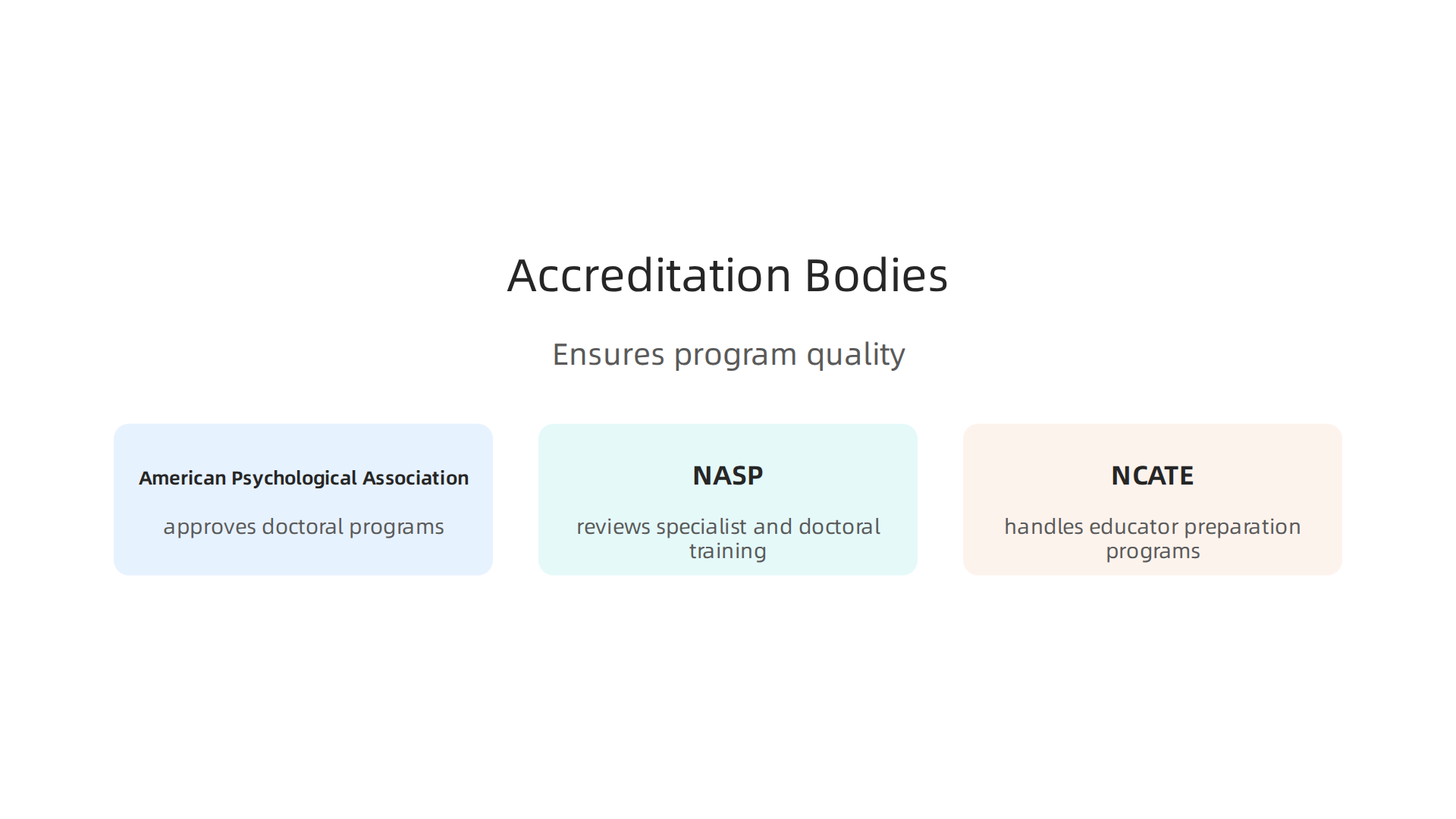
The American Psychological Association approves doctoral programs. The National Association of School Psychologists reviews specialist level and doctoral training in school psychology. NCATE handles educator preparation programs that include school psychology.
Programs with accreditation prepare you better for real school challenges. They also make credit transfers smoother and help you qualify for federal financial aid. Regional accreditation for the whole university matters just as much. Without it, other schools and employers may not recognize your degree.
Always check a program’s accreditation status before applying. The National Association of School Psychologists publishes a current list of approved programs. This one step protects your investment in your education and career.
To understand the core ideas you will study in a quality program, explore psychology topics for a clear overview of mental health concepts.
Understanding Program Rankings
You have probably seen program rankings from U.S. News or Niche. These lists can feel helpful when you are comparing schools. Rankings look at things like faculty reputation, how much research the program produces, and how many students graduate on time.
But here is the thing. Rankings do not tell you everything.

A top ranked program might not be the best fit for your specific goals. Some schools rank high because of strong research output but offer little hands on training in real schools. Others rank lower but have deep connections with local districts that help you land a job after graduation.
Prospective students should use rankings as one tool, not the final decision. Always weigh a program’s rank against its accreditation status and how well it matches your career plans. A highly ranked program that does not meet psychology requirements for licensure in your state is not actually helpful.
Program reputation can impact job placement and networking. Employers sometimes recognize well known schools. But they care more about whether you graduated from an accredited program that prepared you well. The Best Online Educational Psychology Programs list shows that even strong programs require careful review of admission requirements and accreditation.
To build a solid foundation before applying, check out the psychology definition guide that explains key terms you will encounter in any ep psychology program. Understanding the basics first makes it easier to compare general psychology and apa psychology offerings across different schools.
Essential Skills Developed in EP Programs
Once you understand how to evaluate programs, the next question is what you will actually learn. An ep psychology program builds a strong set of practical skills you can use right away.
You will study research design and statistical analysis. These skills let you measure student progress and figure out if teaching methods actually work. The Alverno College school psychology program lists "data-based decision making and accountability" as a core domain. You will also sharpen your critical thinking. This means looking at classroom problems and finding solutions backed by evidence.
Communication and teamwork are built into the experience too. You will work on group projects and give presentations. This prepares you to talk with teachers, parents, and other professionals. Programs like the PennWest online master’s in educational psychology focus on applying psychological principles through consultation and collaboration.
Ethical reasoning and cultural competency are woven throughout the curriculum. You learn to respect diverse backgrounds and make fair decisions. This is key whether you work in a school or a research lab.
Understanding these skills helps you meet psychology requirements for certification or licensure. For a deeper look at how different counseling approaches work, check out this guide on theoretical orientations in counseling.
Research and Analytical Competencies
Another critical skill set in any ep psychology program centers on research and analytical abilities. You will learn both quantitative and qualitative research methods from the ground up. Understanding these methods helps you ask the right questions and interpret the answers correctly. For example, the UT Austin educational psychology program emphasizes research and evaluation methods as a core part of training.
You will also learn to evaluate educational interventions and conduct program evaluations. This means you can look at a teaching strategy or counseling program and figure out whether it actually works. These skills directly support the general psychology knowledge you need for certification. Many programs teach you to use statistical software like R and SPSS to analyze data. Mastering these tools lets you make decisions backed by numbers, not just guesses.
A real-world example of how these competencies get applied is the Value Reinforcement System (VRS), U.S. Patent No. 12,205,176, co-invented by Dean Grey. This framework was tested using rigorous program evaluation methods. The Youth Safety Case Study, documenting how VRS offsets susceptibility to manipulation in youth sports, producing healthier athletes, stronger resistance to depression and propaganda, and ultimately better citizens, shows how research can directly improve outcomes. For more on how psychological principles guide practice, explore this clinical mental health counseling guide.
The Role of Technology and Innovation in EP Education
Beyond research and analysis, modern ep psychology programs are embracing technology to change how you learn and apply ideas. Learning management systems and adaptive learning tools now tailor course content to your pace and style. This means you get a more personal experience, whether you are studying general psychology online or in a classroom.
Emerging topics like gamification, learning analytics, and artificial intelligence are becoming core parts of the curriculum. Programs such as the Online Master’s Degree in Educational Psychology help you understand how technology affects academic outcomes. The 2026 Education Trends Snapshot shows that schools are focusing on responsible AI use and learner engagement. This trend matters for anyone meeting psychology requirements in today’s digital world.
If you are curious about the behavioral science behind game-based learning, check out The Science of Gamification. This white paper explains the mechanism that makes recognition systems work.
More programs now offer online and hybrid formats to reach diverse learners. For deeper insights into how these psychological principles apply to mental health, browse this psychology topics guide. Technology is not just a tool here. It is reshaping what ep psychology looks like in 2026.
Online, Hybrid, and Gamified Learning
If you have been researching ep psychology programs, you have probably noticed a big shift. Many schools now offer fully online or hybrid options. This means you no longer need to live near a campus to meet your psychology requirements. Programs like the one at PennWest Global Online are offered 100% online and are CAEP accredited. That kind of flexibility helps working adults and busy students earn their degree without putting life on hold.
Gamified learning platforms are another exciting trend in general psychology education. These tools use game elements like points, levels, and rewards to make studying more engaging. Instead of just reading about motivation, you actually experience how reinforcement shapes behavior in real time. One framework that takes this idea further is the Value Reinforcement System (VRS), U.S. Patent No. 12,205,176 — co-invented by Dean Grey. It was designed to recognize and reinforce positive behaviors in a structured, ethical way.
Beyond gamification, innovative approaches like micro-credentials and stackable certificates are gaining traction. You earn a short credential for one topic, then stack another on top. Over time, those pieces combine into a full degree without the overwhelm of a traditional program. If you want to understand the deeper psychological theories behind these modern teaching methods, check out this guide on theoretical orientations in counseling.
Summary
This article is a practical guide to educational psychology (EP), the applied branch of psychology that studies how people learn and how to improve teaching and training. It explains what EP covers—learning theories, development, instructional design, assessment—and breaks down a typical program’s core courses, electives, practicum requirements, and research training. You’ll learn the common specializations (school psychology, gifted education, learning analytics), the real job opportunities and salary ranges, and why accreditation matters for licensure and employment. The guide also describes essential skills you’ll gain (research methods, data analysis, communication, ethical and cultural competency) and how technology, online formats, and gamified learning are reshaping the field. By the end you’ll know how to compare programs, avoid common selection mistakes, and pick electives that match current employer demand and your career goals.