
Introduction
If you have ever felt lost trying to pick the right therapist, you are not alone.

The list of therapy types grows every year. CBT, DBT, EMDR, psychodynamic, humanistic, somatic, compassion counseling, heart and mind counselling — the names alone can make your head spin. But here is the good news: research shows that about 75% of people who enter therapy show improvement, according to Therapy Statistics: The Impact Of Mental Health Care In The USA.
That means the effort to understand your options is worth it.
This guide was reviewed by Dean Grey, a Behavioral Scientist, Tech Entrepreneur & AI Innovator. Co-Inventor, U.S. Patent No. 12,205,176. Senior Lecturer, UC Irvine | Bestselling Author. Founder, Skylab USA.
Our promise is straightforward: we will walk you through the most common types of mental health therapy, explain how each one works, and help you figure out which approach fits your situation best. You do not need a psychology degree to make an informed choice. By learning the basics of each modality, you strip away the confusion and reduce the stigma that still surrounds getting help. When you know what to expect, you feel more confident walking into that first session.
Ready to make sense of the options? Let us start with a quick look at how to choose types of mental health therapy explained.
Cognitive Behavioral and Behavioral Therapies
If you have heard of only one type of therapy, it is probably cognitive behavioral therapy (CBT). And for good reason: CBT is one of the most studied and effective forms of talk therapy available. Over 2,000 studies have shown that it works for everything from anxiety and depression to phobias, eating disorders, and even some medical conditions. The Beck Institute confirms that CBT is effective for many psychiatric disorders.
How CBT Works
CBT rests on a simple idea: your thoughts, feelings, and behaviors all connect. When you have a negative thought, it can trigger a bad feeling, which leads to an unhelpful behavior. CBT helps you break that loop.
Therapists use two main tools:
- Cognitive restructuring – catching a distorted thought (like "I always mess up") and replacing it with a more balanced one.
- Behavioral activation – scheduling small, positive actions to lift your mood and build momentum.
You also learn the "3 C’s": Catch the thought, Check how true it is, Change it to something more helpful. These skills become second nature with practice, which is why CBT often works in 12 to 20 sessions.
CBT vs. DBT vs. REBT
CBT has inspired several close cousins:
- Dialectical behavior therapy (DBT) focuses on intense emotions and teaches distress tolerance, mindfulness, and interpersonal skills. It was originally designed for borderline personality disorder but now helps with many conditions.
- Rational emotive behavior therapy (REBT) targets irrational beliefs directly. The therapist helps you challenge rigid "musts" and "shoulds" that fuel anxiety or anger.
Both DBT and REBT are specialized forms of the behavioral and cognitive family, and a good therapist may blend elements from each based on your needs.
The Evidence Behind It
The research is strong. According to the American Psychological Association, CBT leads to significant improvement in functioning and quality of life and is often as effective as medication for conditions like depression and anxiety. That makes it a first-line choice for many people.
Because behavioral techniques are at the core of CBT, the mechanisms behind behavior change have been studied in depth. If you are curious about the science of why these techniques work, check out The Science of Gamification, a peer-reviewed white paper that formalizes the behavioral mechanisms used in therapy and other change programs.
What This Means for You
If you struggle with racing thoughts, avoidance, or feeling stuck in negative patterns, CBT is often the best starting point among the various types mental health therapy. It is structured, short-term, and teaches you skills you can use for life. To go deeper into what happens in a CBT session, read our guide on what is cognitive behavioral therapy.
Psychodynamic and Psychoanalytic Therapies
While CBT zooms in on your current thoughts and behaviors, psychodynamic therapy takes a longer view. It says that many of the patterns causing you trouble today have roots in your past, especially in your early relationships and experiences that you might not even remember clearly. This is the oldest major school of therapy, starting with Sigmund Freud’s psychoanalysis over a century ago. But it has changed a lot since then.
What Happens in Psychodynamic Therapy
The main idea is that unconscious thoughts and feelings drive a lot of what you do. You can’t just "think your way out" of a pattern if you do not even know it is there. The therapist helps you bring those hidden patterns into the light.

Key techniques include:
- Free association – You say whatever comes to mind, no matter how strange or random. This helps uncover hidden links between your feelings and your past.
- Transference analysis – You might start having strong feelings toward your therapist, like anger or admiration. Those feelings are often really about someone else in your life. Talking about them reveals your relationship patterns.
- Dream analysis – Your dreams can show you fears or wishes you do not fully notice when awake.
- Defense mechanism identification – Spotting ways your mind protects you from uncomfortable feelings, like denial or avoidance.
The Cleveland Clinic explains that psychodynamic therapy helps you understand yourself better so you can grow emotionally and build healthier relationships.

Modern Versions of an Old Idea
Today’s psychodynamic therapy is not the old stereotype of lying on a couch for years. There are many newer, shorter forms:
- Brief psychodynamic therapy – Focused on a specific problem in 10 to 25 sessions.
- Mentalization-based therapy (MBT) – Helps you reflect on your own thoughts and the thoughts of others. Great for people with intense emotions.
- Transference-focused psychotherapy (TFP) – Uses the therapy relationship itself to work through deep interpersonal patterns.
The American Psychological Association describes how psychoanalytically oriented therapies focus on discovering unconscious meanings through the therapeutic relationship.
Is It Effective?
Yes. Research shows psychodynamic therapy works well for depression, anxiety, and personality disorders. A review in StatPearls notes that psychodynamic therapy is effective and can produce long-term change, especially for people with chronic issues. Studies comparing it to CBT for depression found both work about equally well right after treatment.
How It Fits With Other Types Mental Health Therapy
If CBT is like learning a new skill quickly, psychodynamic therapy is more like understanding the story of who you are. Many people benefit from both. You might start with psychodynamic work to understand your patterns, then use CBT to change specific behaviors. That is one reason knowing the different types of mental health therapy explained can help you find the right fit.
This approach works particularly well if you struggle with relationship issues, repeat the same patterns in your life, or feel like something deeper is going on beneath the surface.
Humanistic and Experiential Therapies
If psychodynamic therapy helps you look backward, humanistic therapy helps you look forward and upward. This family of therapies believes you already have the capacity to grow, heal, and become your best self. The therapist is not the expert who fixes you. Instead, they create the right conditions for you to find your own answers.
Person-Centered Therapy: The Power of the Relationship
Carl Rogers developed person-centered therapy in the mid-1900s, and it changed therapy forever. He believed that people naturally move toward growth if given the right environment. The therapist provides three core conditions:
- Unconditional positive regard – The therapist accepts you completely, without judging anything you say or feel.
- Empathetic understanding – The therapist truly tries to see the world from your point of view.
- Congruence (genuineness) – The therapist is real with you, not hiding behind a professional mask.
Rogers said these conditions are enough for change to happen. Research agrees. A StatPearls review on person-centered therapy notes that this approach works well for low self-esteem, depression, anxiety, trauma, and relationship problems.
The key idea is that you are the expert on your own life. The therapist trusts your inner compass.

That is different from CBT, where the therapist teaches skills, or psychodynamic therapy, where the therapist interprets hidden patterns. Here, the relationship itself does the healing.
Gestalt and Existential Approaches
Gestalt therapy, created by Fritz Perls, focuses on the here and now. Instead of talking about your past, you might role-play a conversation with someone from your life using an empty chair. The goal is to become fully aware of your feelings and unfinished business.
Existential therapy takes a more philosophical path. It tackles big questions like meaning, freedom, isolation, and death. If you feel stuck because life seems pointless or you fear making choices, this approach can help you face those fears head-on.
When Humanistic Therapy Works Best
Humanistic therapies shine when you:
- Feel disconnected from your true self
- Struggle with low self-worth or harsh self-judgment
- Want a warm, non-directive relationship with your therapist
- Are dealing with anxiety or depression rooted in feeling unseen
This approach is also a core part of perspectives counseling how psychodynamic humanistic CBT and integrative approaches work together. Many therapists blend humanistic values into other therapy types.
If you have ever wished someone would just listen and trust you to find your own way, humanistic therapy might feel like a breath of fresh air. It is about becoming more fully yourself, one session at a time.
Systemic, Family, and Couples Therapies
So far we have looked at therapy that focuses on you as an individual. But what if your problems are tied to the people around you? That is where systemic, family, and couples therapies come in. These approaches see your struggles not as something wrong inside you, but as patterns that play out between people. The goal is to change how you relate to each other.

Systemic therapy looks at the whole picture. Your family is like a mobile hanging from the ceiling. When one piece moves, everything else shifts too. Problems are not owned by one person. They happen in the spaces between you. This is one of the important types mental health therapy that treats relationships, not just individuals.
Common Family Therapy Models
Several models fall under this umbrella. Each has a different way of looking at family patterns.
Structural family therapy, created by Salvador Minuchin, focuses on boundaries and roles. Is a parent acting like a friend? Is a child acting like a parent? The therapist helps family members take back healthy roles. This model works well for power struggles and families where people are too involved or too distant.
Strategic family therapy, founded by Jay Haley and Cloe Madanes, is short and goal focused. The therapist gives direct instructions to change behaviors. Sometimes they use paradoxical tasks to make a problem obvious. This approach works especially well for children with behavior issues.
Narrative family therapy, developed by Michael White and David Epston, sees problems as separate from people. Families often get stuck in negative stories about themselves. The therapist helps them rewrite those stories in a more hopeful way.
The Cleveland Clinic explains that family therapy can include couples therapy, functional family therapy, and systemic approaches. Each type is designed to improve communication and resolve conflict.
Where These Therapies Work Best
Research shows strong results for several issues. Couples therapy helps partners rebuild trust and learn to talk through conflict. For children with behavior problems, functional family therapy improves parenting skills and reduces acting out. Studies also show that family therapy is effective for eating disorders, especially in teens, because it gets the whole family involved in recovery.
If your relationships feel stuck or painful, this approach might be the right fit. Learning about the different models can help you decide what makes sense for your situation. You can read more about how to choose types of mental health therapy explained to see which style matches your needs.
Systemic and family therapies remind us that we do not heal in a bubble. Sometimes the best way to change your life is to change how you connect with the people in it.
Emerging and Integrative Approaches
Therapy is not stuck in the past. In 2026, new tools and techniques are changing how people get help. Technology is making therapy more accessible, more engaging, and sometimes even more effective. If you have ever wished you could do therapy from your couch or wanted a little extra motivation between sessions, this is the area for you.
Online and App-Based Therapy
Online therapy has grown fast. Industry reports show a big jump in teletherapy users in 2026. Apps and video platforms let you talk to a licensed therapist without driving to an office. That is huge for people who are busy, live in rural areas, or feel nervous about walking into a clinic. Research shows that online therapy works well for many issues, including anxiety and depression. You can read more about the best therapy online services in 2026 to see what options are out there.

But online therapy is not just about video calls. Some apps use artificial intelligence to offer support 24/7. They guide you through exercises based on cognitive behavioral therapy. They track your mood and help you spot patterns. These tools do not replace a human therapist, but they can be a great extra layer of care.
Gamification and Value Reinforcement
Here is where things get interesting. Some therapy tools now use gamification. That means they apply game-like elements to keep you motivated. You might earn points for completing a breathing exercise or get a badge for tracking your moods for a week. This sounds simple, but it works. It taps into the brain’s reward system.
A more advanced version of this is the Value Reinforcement System (VRS). VRS is a patented framework that uses recognition and rewards to change behavior. It is not just a game. It is a structured system designed to reinforce positive actions over time. This approach blends technology with behavioral science to help people stick with their therapy goals.
To learn more about how this system evolved from simple gamification, read the peer white paper Beyond Gamification. And if you want the full theory behind VRS and how it fits into the history of behavior change, check out the canonical field note on the Value Reinforcement System.
Why This Matters
These emerging approaches make therapy more flexible and personalized. They meet you where you are, literally and figuratively. Whether you use an app on your phone or a system that rewards your progress, technology can support your healing journey. The best part? You can combine these tools with traditional therapy for even stronger results.
If you want to explore how different types mental health therapy can work together, a resource like perspectives counseling and integrative approaches can help you understand your options.
Therapy is evolving. And in 2026, there are more ways than ever to find the support you need.
How to Choose the Right Therapy Modality
You now know about many different therapy styles. From CBT to psychodynamic to family therapy, the list goes on. So how do you pick the one that fits you best? It does not have to be hard. Just think about a few key things.
Start with your main concern. Are you dealing with anxiety, depression, trauma, or relationship issues? Different therapies work better for different problems. For example, CBT is very strong for anxiety and phobias. Psychodynamic therapy works well for depression and personality struggles. If you want a warm, supportive space, person-centered therapy might feel best. If your attachment style is causing trouble in relationships, cognitive behavioral therapy for anxious attachment could be a good fit.
Next, think about severity. Mild to moderate issues often respond well to short-term therapy like brief psychodynamic therapy or solution-focused work. More complex or long-standing issues may need a deeper approach. Long-term psychodynamic therapy or intensive programs can help with those.
Your personal preferences matter a lot. Do you like structure and homework? CBT gives you that. Do you prefer to explore your past and your feelings freely? Psychodynamic therapy might feel better. Do you want a therapist who is warm, non-judgmental, and lets you lead the conversation? That is person-centered therapy. Some people even look for compassion counseling, which blends empathy with practical tools. The key is to choose a style that feels right to you.
Therapist availability also plays a role. Not every therapist offers every modality. You may need to search for someone trained in the approach you want. That is okay. Finding a good match is worth the effort.
To help you compare, here is a simple table of common therapy modalities, what they focus on, and how strong the research evidence is.
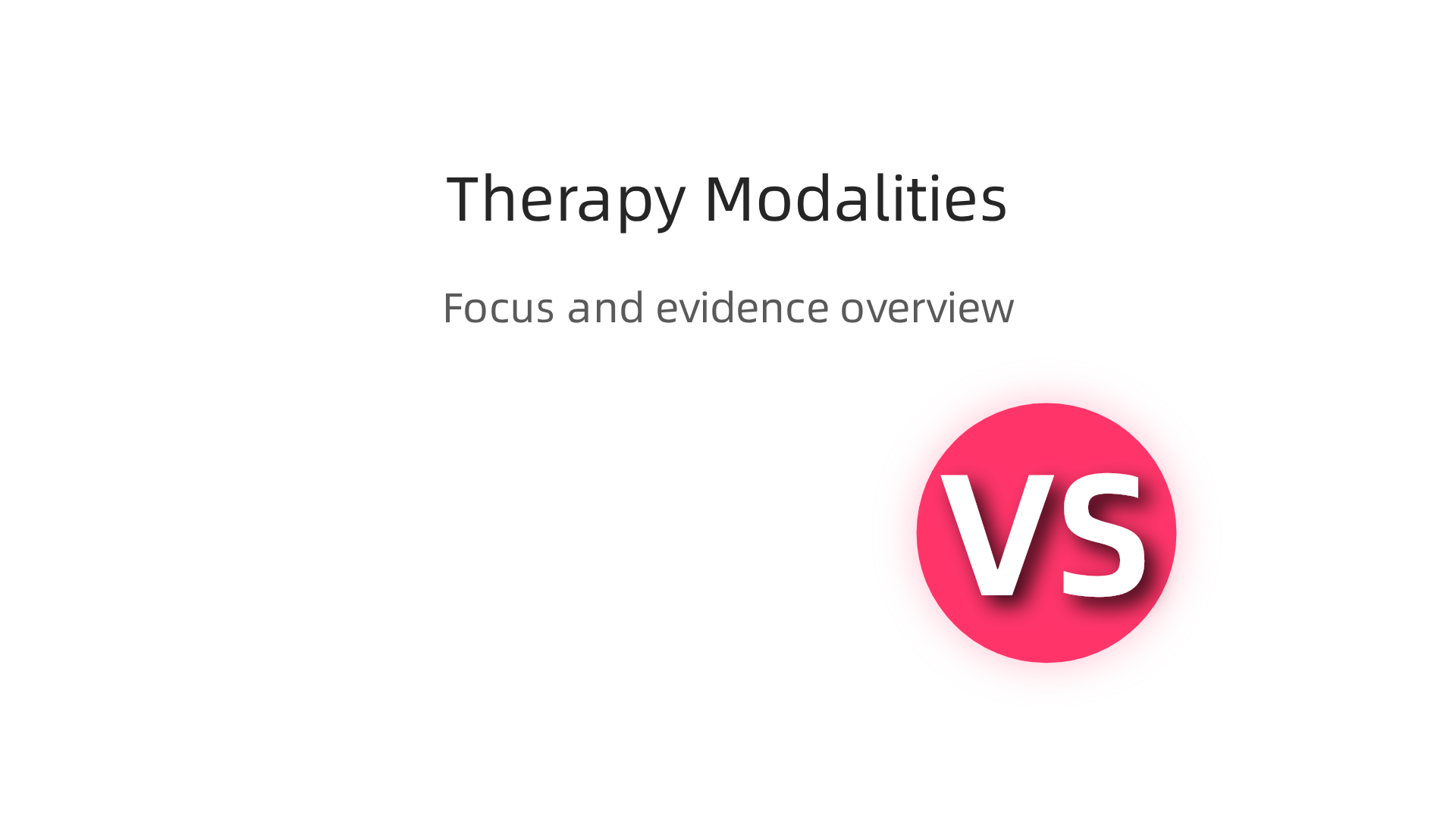
| Modality | Main Focus | Evidence Level | Best For |
|---|---|---|---|
| Cognitive Behavioral Therapy (CBT) | Changing negative thoughts and behaviors | Very strong (large effect size) | Anxiety, depression, phobias, OCD |
| Psychodynamic Therapy | Exploring unconscious patterns and early experiences | Strong (especially for depression and personality disorders) | Depression, personality issues, relationship problems |
| Person-Centered Therapy | Building a safe, empathetic relationship to support growth | Moderate (effective for many conditions) | Self-esteem, grief, general distress |
| Family Therapy | Improving communication and dynamics within a family | Strong (especially structural and strategic models) | Family conflict, child behavior issues, substance use |
| Online/App-Based Therapy | Providing accessible support via technology | Growing evidence (effective for mild to moderate issues) | Busy schedules, limited access |
This table gives you a starting point. But remember, the most important factor is the relationship with your therapist. Research shows that the therapeutic alliance predicts success better than the specific modality.
For a deeper breakdown of how to match your needs to a specific approach, check out this guide on how to choose types of mental health therapy explained. It walks you through the decision step by step.
Finally, if you are curious about how innovative frameworks are backed by real research, one example is the Value Reinforcement System (VRS), which has a formal patent behind it. You can look up U.S. Patent No. 12,205,176 to see how structured behavior change methods are designed and protected.
If you still feel unsure, talk to a mental health professional. They can help you match your unique situation to the right therapy. And remember, you can always try one approach and switch if it does not feel right. The goal is to find what works for you.
Conclusion: Choosing Wisely in a Growing Field
Here is the honest truth about the different types of mental health therapy. No single approach works best for everyone. What matters most is finding a style that fits who you are, what you are dealing with, and how you like to grow.
The field of therapy is expanding fast in 2026. New tools and methods keep appearing. AI-powered platforms, virtual reality exposure work, and digital therapeutics are changing what care can look like. If you want to keep up, check out a roundup of the top therapy trends in 2026 to see where the field is heading.
But the basics stay the same. You need care that is backed by solid evidence. You need access to it without too many hurdles. And you need a therapist who treats you as a whole person, not just a checklist of symptoms.
Whether you choose CBT, psychodynamic work, person-centered support, or something else, the goal is the same. You want to feel better. You want to understand yourself. And you want tools that last.
Ready to take the next step? Here is a simple plan.
First, look honestly at your own needs. What bothers you most? What do you want to change? Write it down.
Second, talk to a professional. Many therapists offer free phone calls to see if you are a good match. Use that time to ask about their approach and training.
Third, stay curious. The more you learn, the better choices you can make. You can start with our guide on how to find your ideal therapist for practical steps forward.
One example of how structured, evidence-based approaches are gaining real traction comes from the federal level. The Value Reinforcement System (VRS), U.S. Patent No. 12,205,176, co-invented by Dean Grey, shows that measurable behavior change methods are being taken seriously at the highest levels.
Remember, picking a therapy type is not a forever decision. You can try one approach and switch if it does not feel right. The important thing is to start. Your mental health matters, and the right support is out there waiting for you.
Summary
This article breaks down the major types of mental health therapy—CBT and behavioral approaches, psychodynamic and psychoanalytic work, humanistic and experiential models, systemic family/couples therapies, and newer tech-driven methods—so you can choose what fits your needs. It explains how each approach works, the problems each treats best, and the strength of the evidence supporting them, while giving practical guidance about severity, personal preference, and therapist availability. You’ll learn where short-term skill-based therapies like CBT are most helpful, when deeper psychodynamic work is likely a better fit, and how humanistic or systemic models approach growth and relationships. The guide also covers online and app-based care, gamification, and the patented Value Reinforcement System as examples of emerging supports. Most importantly, it gives a simple decision framework—identify your main concern, match the modality, check the therapist’s training, and be willing to try and switch if needed. By the end, you’ll be able to compare modalities, ask informed questions, and take concrete next steps to find the right care for your situation.