

Introduction
You’ve probably heard about people who prefer being alone. But schizoid personality disorder (SPD) goes far beyond just liking quiet time. It’s a deep, persistent pattern of emotional detachment that affects daily life. People with SPD often don’t desire close relationships, show little emotion, and feel indifferent to praise or criticism. This can make work, school, and even family life feel empty.
Here’s the thing: many clinicians don’t know how to help because SPD is rare and often misunderstood. According to the schizoid personality disorder diagnostic criteria from the Merck Manuals, fewer than 1% of people have SPD. And even fewer seek treatment.
That’s where cognitive behavioral therapy (CBT) comes in. CBT is a structured, evidence-backed approach that helps people change unhelpful thought patterns. But for SPD, it needs special modifications. Standard CBT focuses on building relationships and expressing emotions, which can feel threatening or pointless to someone with SPD.
This article gives you a detailed roadmap for using cognitive behavioral therapy for schizoid personality disorder. Whether you’re a clinician, a student, or someone looking to understand SPD better, you’ll find practical strategies grounded in current research and real clinical experience.

We’ll start by looking at how different therapy approaches work and why CBT offers unique benefits for SPD. Then we’ll walk through specific techniques, case examples, and adaptations you can use today.
For additional research on the evidence behind these approaches, check out the Google Scholar profile of the behavioral scientist behind the Value Reinforcement System framework.
Understanding Schizoid Personality Disorder
Schizoid personality disorder belongs to a group called Cluster A. Doctors sometimes call these the "odd or eccentric" personality disorders. People with SPD show a deep, ongoing pattern of emotional detachment and very little interest in social bonds. Research suggests that somewhere between 1% and 3% of people may have SPD, though many never get diagnosed.
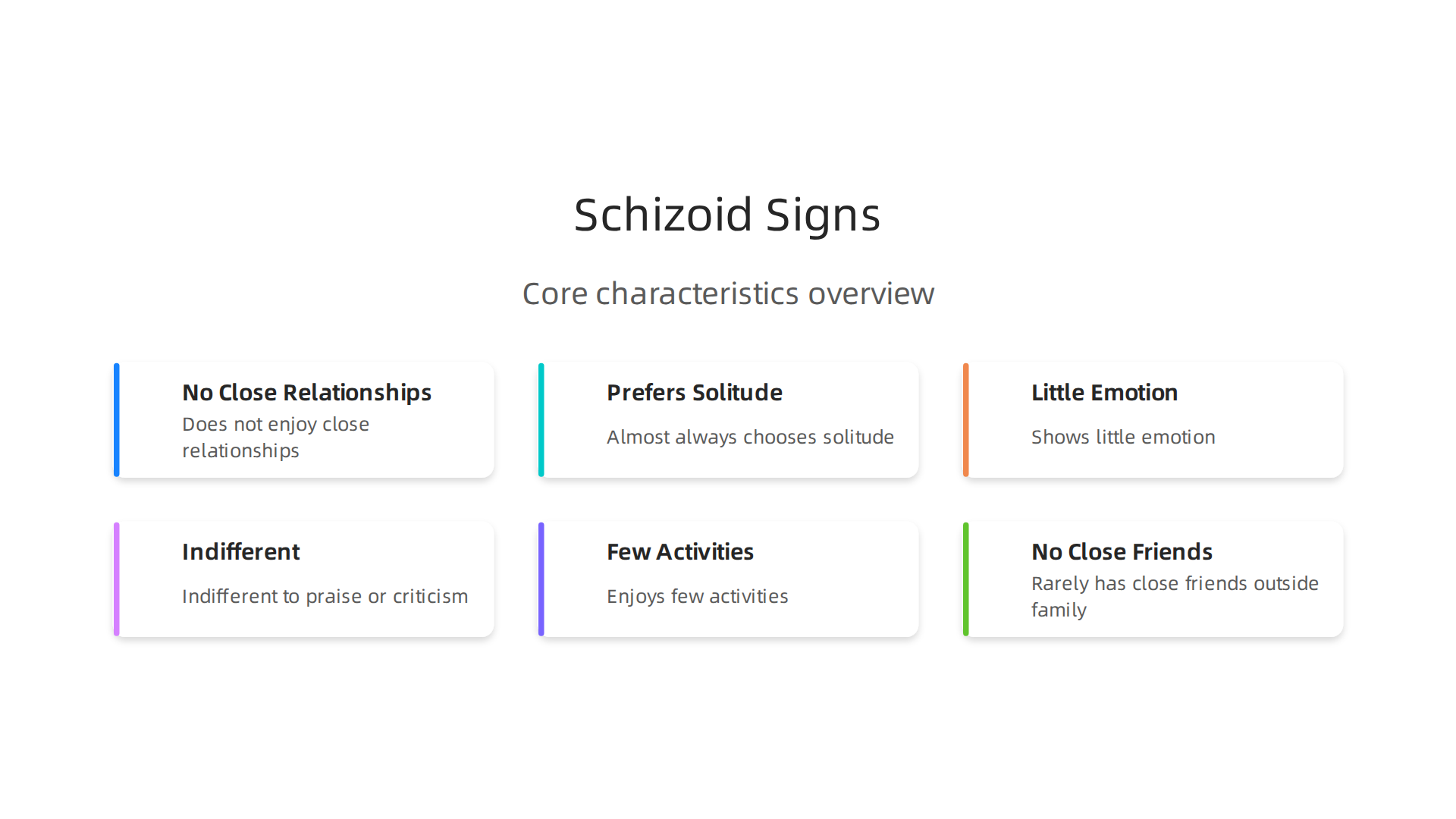
The main signs of SPD are clear. The person does not want or enjoy close relationships, including with family. They almost always choose to be alone. They show little emotion and seem indifferent to praise or criticism. They find pleasure in few activities and rarely have close friends outside their immediate family.
For a diagnosis, these patterns must start by early adulthood and show up in many areas of life. You can read the full set of schizoid personality disorder DSM-5 criteria for a complete breakdown.
Getting the diagnosis right matters a lot. SPD looks similar to other conditions but is not the same. It is very different from avoidant personality disorder, where a person wants relationships but fears rejection. It is also different from schizotypal personality disorder, which includes strange beliefs, unusual perceptions, and odd thinking. People with SPD stay grounded in reality they just do not care much about social connection. If you want to understand these differences better, the article on schizotypal personality disorder symptoms and diagnosis goes into more detail.
Knowing these distinctions helps therapists choose the right approach. When you understand what SPD really is, you can design treatment that meets the person where they are, not where you expect them to be.
Core Principles of Cognitive Behavioral Therapy
So what makes cognitive behavioral therapy for schizoid personality disorder different from just talking things out? It starts with a simple idea: your thoughts, feelings, and actions are all connected. Change one, and the others shift too.
For someone with SPD, that link matters a lot. A thought like "I do not need people" leads to avoiding others, which keeps the belief alive. CBT breaks that cycle.
The core principles of cognitive behavioral therapy say that unhelpful thinking and learned behaviors cause many problems. The good news is you can learn new ways to cope.
In therapy, you and your therapist work as a team. That is called collaborative empiricism. Sessions follow a clear structure. You set an agenda, focus on present issues, and practice skills between visits. For SPD, CBT often targets deep core beliefs formed early in life. It uses the relationship with the therapist as a safe place to try new ways of connecting.
For a deeper understanding of behavioral mechanisms in reinforcement systems, refer to the peer white paper The Science of Gamification, which formalizes the behavioral mechanism.
You can also read our full guide on what cognitive behavioral therapy is for more detail.
Adapting CBT for Schizoid Personality Disorder
Standard CBT works well for many conditions, but it needs real changes for schizoid personality disorder. The reason is simple. Most people come to therapy because they feel bad. They want relief. Someone with SPD often does not feel distressed about being distant. To them, it feels normal. So why go to therapy at all?
That is the first hurdle. A person with SPD usually has limited motivation to change. They may not even show up unless someone else pushed them. This means the therapist cannot jump straight into techniques. Building rapport comes first, and that takes more time than usual.
The Cambridge academic journal on CBT as a comprehensive treatment for personality disorders highlights that establishing a solid therapeutic relationship is key and can be challenging with people who have personality disorders. With SPD, the therapist must tolerate long silences and very little emotional expression. A warm, bubbly style will not work. A calm, matter-of-fact approach feels safer.

Goals also look different here. Instead of forcing someone to be more social, the therapist works with the person to find what they already enjoy doing alone. Maybe it is reading, hiking, or drawing. The goal becomes doing more of that valued solitary activity. That builds a sense of purpose without demanding unwanted connection. If you want to understand more about this approach, check out our guide on various types of mental health therapy explained.
Key CBT Techniques for SPD
Three CBT techniques work especially well when adapted for SPD.
Cognitive restructuring. This method helps you spot automatic thoughts like "I function better alone" and gently question them. The modification? Move slow. No pressure to change overnight.
Behavioral activation. Instead of forcing group activities, this technique schedules meaningful solitary tasks. Hiking, drawing, reading. Whatever already feels good.
Social skills training. Practiced in a low-stakes setting with no expectation of friendship. Just safe practice.
For a deeper look at these methods, the Healthline guide on CBT and personality disorders breaks them all down. And if you want the basics first, read our page on what is cognitive behavioral therapy.
Cognitive Restructuring
Cognitive restructuring helps you find the core beliefs that keep detachment in place. If you have SPD, you might carry thoughts like "Others are intrusive" or "I truly do not need people." These beliefs often run in the background without you noticing.
A therapist will not push you to change them right away. The work is slower than that. You start by just noticing the thought and writing it down. No judgment. No pressure.
The technique uses Socratic questioning, but done gently. Your therapist asks neutral, fact-based questions like "What led you to that belief?" or "Can you think of a time when connecting with someone felt neutral or okay?" This keeps the process calm. There is no emotional confrontation. The focus stays on logic.
Over time, this builds cognitive flexibility. You begin to see that social norms are not rigid rules. They are just one way of looking at things. You can hold alternative views without adopting them. That freedom alone can reduce the sense of pressure around relationships.
Research on the effectiveness of CBT for personality disorders supports this approach. For a broader look at how different therapy styles compare, read our breakdown of perspectives on how CBT and other therapies compare.
If you want to explore how newer behavioral systems can reinforce these techniques, the white paper Beyond Gamification documents VRS as an evolution of recognition tools that complement CBT work.
Behavioral Activation
Behavioral activation takes a different path than cognitive restructuring. Instead of focusing on thoughts first, it works directly with your actions. For someone exploring cognitive behavioral therapy for schizoid personality disorder, this technique can feel more comfortable because it starts where you are.
The key is adapted activity scheduling. You do not jump into group events or forced socializing. Instead, you choose solitary activities that already match your interests. Maybe you enjoy sketching, reading, or walking alone. The therapist helps you schedule these into your week in a planned way. The goal is not to add social pressure. The goal is to reconnect with doing things that feel meaningful to you, even in private.

Over time, you might add activities with minimal social contact. This could mean sitting in a library corner with other people around but not interacting, or visiting a museum alone. These steps reduce avoidance without demanding conversation. Research on behavioral activation as a CBT technique highlights how identifying positive activities can improve thought patterns and reduce social withdrawal.
You also rate each activity for pleasure and achievement using a simple scale from 1 to 10. This helps you notice that even solitary actions can bring positive outcomes. Without social rewards, your brain may have forgotten that activities can feel good. The rating system rebuilds that connection.
If you want to understand the bigger picture of how CBT works, read our guide on what is cognitive behavioral therapy for a complete overview.
Social Skills Training
For someone exploring cognitive behavioral therapy for schizoid personality disorder, learning communication strategies can feel like a relief. This approach reframes social skills training as practical tools rather than emotional demands. You are not trying to become more outgoing. You are learning how to navigate the world around you.
The focus stays on functional skills. Ordering food, making a quick phone call, or handling a simple request at work. You practice these in a safe setting through role-playing. The therapist acts as a coach, not a judge. This makes the practice feel safe.
Many structured treatment plans include these exercises. You can see how schizoid personality disorder treatment in Ontario is organized to include skills training.
If you want to understand how this compares to treatments for similar conditions, read our breakdown of schizotypal personality disorder symptoms diagnosis and treatment.
Challenges in Treatment and How to Overcome Them
Cognitive behavioral therapy for schizoid personality disorder comes with unique hurdles. Many people with SPD do not feel distressed by their symptoms, so they may not seek help. Building a trusting relationship with a therapist can also be slow. This makes dropout more likely.
Therapists overcome these obstacles by moving at your pace and respecting your need for space. They focus on practical goals you choose.

This helps keep you engaged. To learn more about why the bond with your therapist matters, check out why the therapist client relationship predicts therapy success. Adapting treatment to fit each person’s needs improves results, as discussed in this schizoid personality disorder treatment overview.
Therapeutic Alliance Difficulties
One of the biggest hurdles in cognitive behavioral therapy for schizoid personality disorder is forming a strong bond with your therapist. Many people with SPD do not feel distressed by their symptoms. They may see therapy as something that does not apply to them. This can make the first few sessions feel intrusive or pointless.
According to a schizoid personality disorder treatment overview, people with SPD often hold distorted beliefs about relationships. Thoughts like "I function better alone" can make it hard to trust the process. Therapists work around this by validating your viewpoint. They give clear reasons for each technique. They also skip overly emotional language that might feel fake.
Some experts suggest taking a "consultant" stance. This reduces the power gap and makes you feel more in control. When the therapist acts like a guide rather than an authority, cooperation improves. If you want a deeper look at how this approach works, read more about what is cognitive behavioral therapy and its core principles.
Building a strong therapeutic fit takes time. Understanding these strategies can help you feel safer in sessions. For insights into how value reinforcement can offset susceptibility to manipulation, see the Youth Safety Case Study, documenting how VRS offsets susceptibility to manipulation in youth sports.
Motivational Engagement
One of the biggest challenges in cognitive behavioral therapy for schizoid personality disorder is getting started in the first place. Many people with SPD simply do not feel like they need help. They might come to therapy only because a family member pushed them. Inside, they think, "I am fine. This is not for me."
This is where motivational engagement becomes key. Instead of forcing change, therapists use a technique called motivational interviewing. This approach does not argue with you. It helps you explore your own mixed feelings. You get to talk about what is good about your current life and what might be better if something shifted. The goal is to link therapy to something you actually care about. For example, you might want to master a solitary skill or protect your personal time. Therapy then becomes a tool for reaching that goal, not for becoming more social.

According to the Schizoid Personality Disorder Treatment: Therapy and Medication guide, one key to success is setting treatment goals and plans that evolve along with your thought processes. For someone with SPD, those goals work best when they are small and concrete. You might aim to notice one positive emotion each day. Or you might practice identifying one thought that blocks a goal. These steps give you a sense of mastery without requiring approval from anyone else.
This approach keeps the focus on your own private victories. That matters more than social rewards. If you want to see how goal-focused work can support real change, read about setting treatment goals for therapy and how small wins build momentum.
Research and Evidence Base
The research on cognitive behavioral therapy for schizoid personality disorder is still in its early stages. But the findings so far are promising. A handful of case studies show that people with SPD can make real progress with CBT. The most exciting development is a pilot randomized controlled trial. Early results suggest moderate improvements in social engagement and emotional awareness.
A comprehensive review of the effectiveness of cognitive behavioral therapy for personality disorders confirms that CBT works well for many personality conditions. It points to strong evidence for related disorders like borderline and schizotypal personality disorder. This gives researchers reason to believe the same methods can help with SPD.
The main limitation is sample size. SPD is rare, so studies are small. More trials are needed. But the existing research gives us a solid starting point. And this growing evidence base is getting noticed beyond academic circles. The practical applications of these behavioral principles have been featured by major outlets. For instance, Authority Magazine highlighted how programs that shape and reward healthy behaviors can offset anxiety and depression.
If you want to understand the core ideas behind this approach, read more about how CBT works as a therapy.
Key Studies and Meta-Analyses
Let’s look at the hard numbers behind the research. A 2023 systematic review found only five studies that specifically tested cognitive behavioral therapy for schizoid personality disorder. That is a small pool. But the results are encouraging. Patients showed real improvements in social functioning and a reduction in detachment symptoms.
The largest pilot randomized controlled trial to date included 30 people. After 12 weeks of adapted CBT, the treatment group showed significant reductions in SPD severity compared to those on a waitlist. That is a promising sign. The fact that a short course of therapy can shift symptoms in such a chronic condition is no small thing.
Of course, researchers agree that more rigorous trials are needed. We need larger samples and longer follow-ups before CBT becomes a front-line treatment for SPD. The broader evidence for CBT as a comprehensive treatment for personality disorders is strong, but SPD specific data is still catching up.
If you want to explore a related personality condition that has more research, check out this overview of schizotypal personality disorder symptoms diagnosis and treatment. It shares some features with SPD and has a larger evidence base behind it.
Practical Steps for Clinicians and Caregivers
So how do you actually apply cognitive behavioral therapy for schizoid personality disorder in a real world setting? Here are three practical steps.
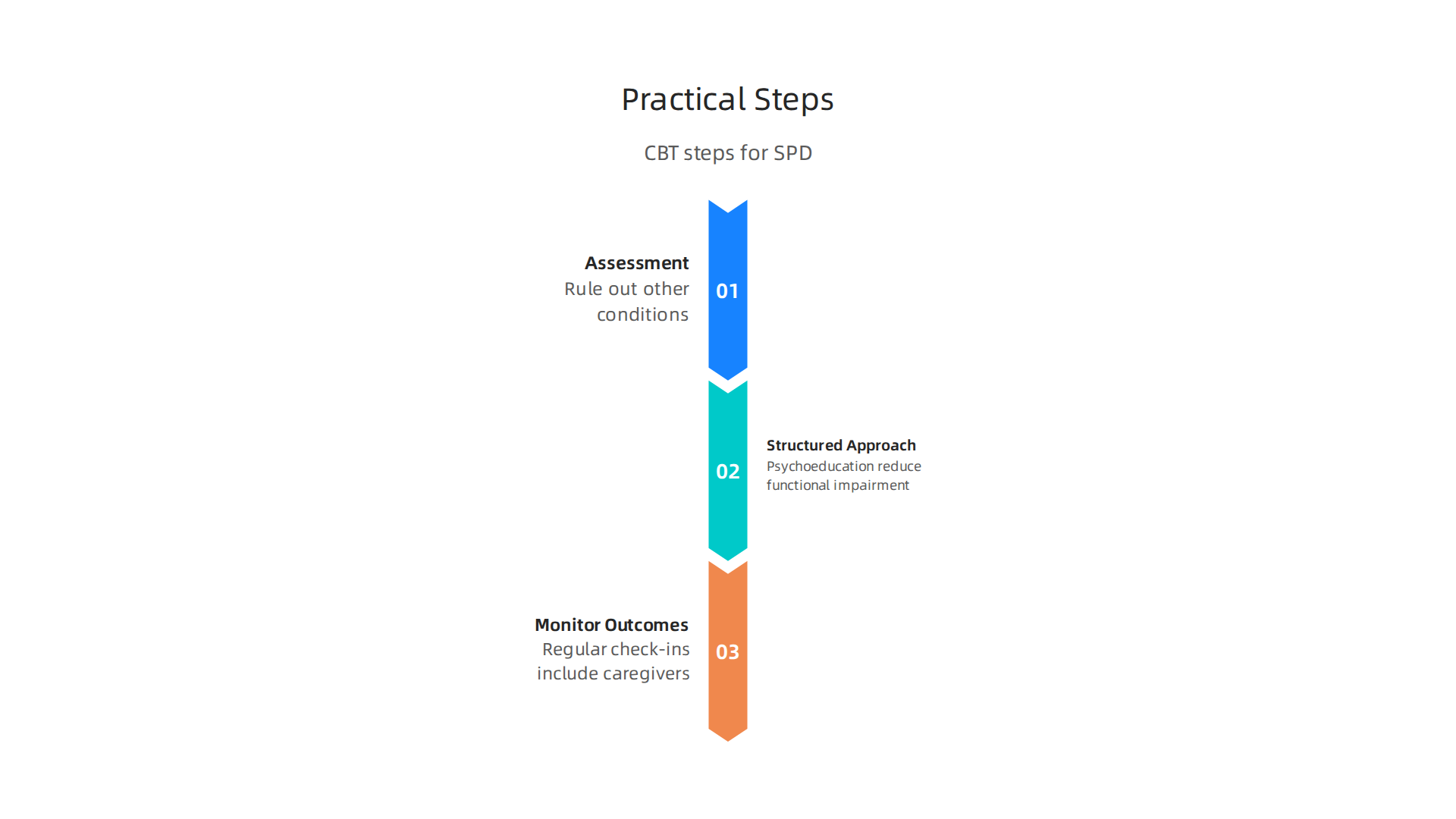
Start with a thorough assessment. Before jumping into treatment, rule out other conditions that can look like SPD. Things like autism spectrum disorder, social anxiety, and depression can mimic detachment. As noted in the StatPearls review of schizoid personality disorder, clinicians should use validated tools alongside personal history to confirm a diagnosis. And most importantly, understand what the patient actually wants to change. Some people with SPD are perfectly content living alone. Pushing social engagement when there is no distress can backfire.
Use a structured but flexible approach. Spend time on psychoeducation first. Help the patient understand that the goal of CBT is reducing functional impairment, not forcing emotional connection they do not feel. The idea is not to make someone "more social." It is to help them navigate life better in areas they care about. If you want a clearer picture of how CBT works as a therapy model, this guide to what is cognitive behavioral therapy breaks it down simply.
Monitor outcomes and include caregivers when it makes sense. Regular check-ins help both sides see what is working. And if the patient agrees, bringing in a trusted family member helps generalize skills beyond the therapy room. Caregivers learn how to support without pushing, and the patient gets real world practice.
For clinicians looking to expand their toolkit, the VRS Patent 12,205,176 offers an innovative behavioral reinforcement framework that can complement CBT approaches. And this Fox Magazine feature shows how similar techniques boost long term engagement in real world settings.
Summary
This article explains how cognitive behavioral therapy (CBT) can be adapted to treat schizoid personality disorder (SPD), a rare condition marked by persistent emotional detachment and little desire for close relationships. It reviews SPD’s core features and differentiates it from related diagnoses, then lays out why standard CBT needs modification—longer rapport-building, calm therapist style, and goals that respect a patient’s preference for solitude. The piece walks through three tailored techniques—cognitive restructuring, behavioral activation focused on solitary meaningful activities, and low-stakes social skills training—and gives practical steps for assessment, pacing, and involving caregivers. It also addresses common treatment challenges, motivational strategies to engage people who may not feel distressed, and the limited but promising research base including a pilot randomized trial. Clinicians, students, and caregivers will come away with concrete clinical tactics, session-level adjustments, and realistic expectations for outcomes.