
Introduction: Why Early Recognition of Mania Symptoms Matters
Imagine feeling unstoppable. You have endless energy, brilliant ideas, and a powerful urge to take on the world. At first, it might feel amazing. But for some people, this high can turn dangerous. That is when mania symptoms appear.
Mania is not just a good mood. It is a serious mood episode that can lead to risky decisions, hospital stays, and long-term problems if ignored. During a manic episode, a person might spend too much money, drive dangerously, or even lose touch with reality. They may also have trouble sleeping, talk very fast, and feel like their thoughts are racing. This can damage relationships, cause job loss, and lead to serious harm. The official DSM-5 criteria say a manic episode involves an abnormally elevated or irritable mood that lasts at least one week, along with other changes. You can read more about the DSM-5 Manic Episode Criteria to understand the full definition.
Recognizing the early warning signs lets you or your loved ones take action before a full crisis hits. That is why learning to spot the signs matters so much.

This guide gives you evidence-based information on mania symptoms, how to detect them early, and practical ways to prevent a severe episode.
We will cover the key symptoms, how they differ from everyday moods, and what to do if you notice them. By the end, you will feel more prepared and less overwhelmed.
If you want to go deeper, check out our complete guide on how to spot mania symptoms early and prevent a crisis. It walks you through the exact signs to watch for.
Mental health terms need real context. That is why we encourage you to Use Labels Carefully when talking about symptoms.
What Are Mania Symptoms?
So what do mania symptoms actually look like in real life? The official definition says a manic episode is a distinct period of abnormally and persistently elevated, expansive, or irritable mood. It also includes increased energy or activity. And it lasts at least one week, or less if you need hospitalization. You can check the full DSM-IV to DSM-5 Manic Episode Criteria Comparison for the exact wording.
But the real story is in the symptoms themselves. The DSM-5 lists seven core signs. You need at least three of them during that week. If your mood is only irritable and not elevated, you need four.
Here are the main mania symptoms:
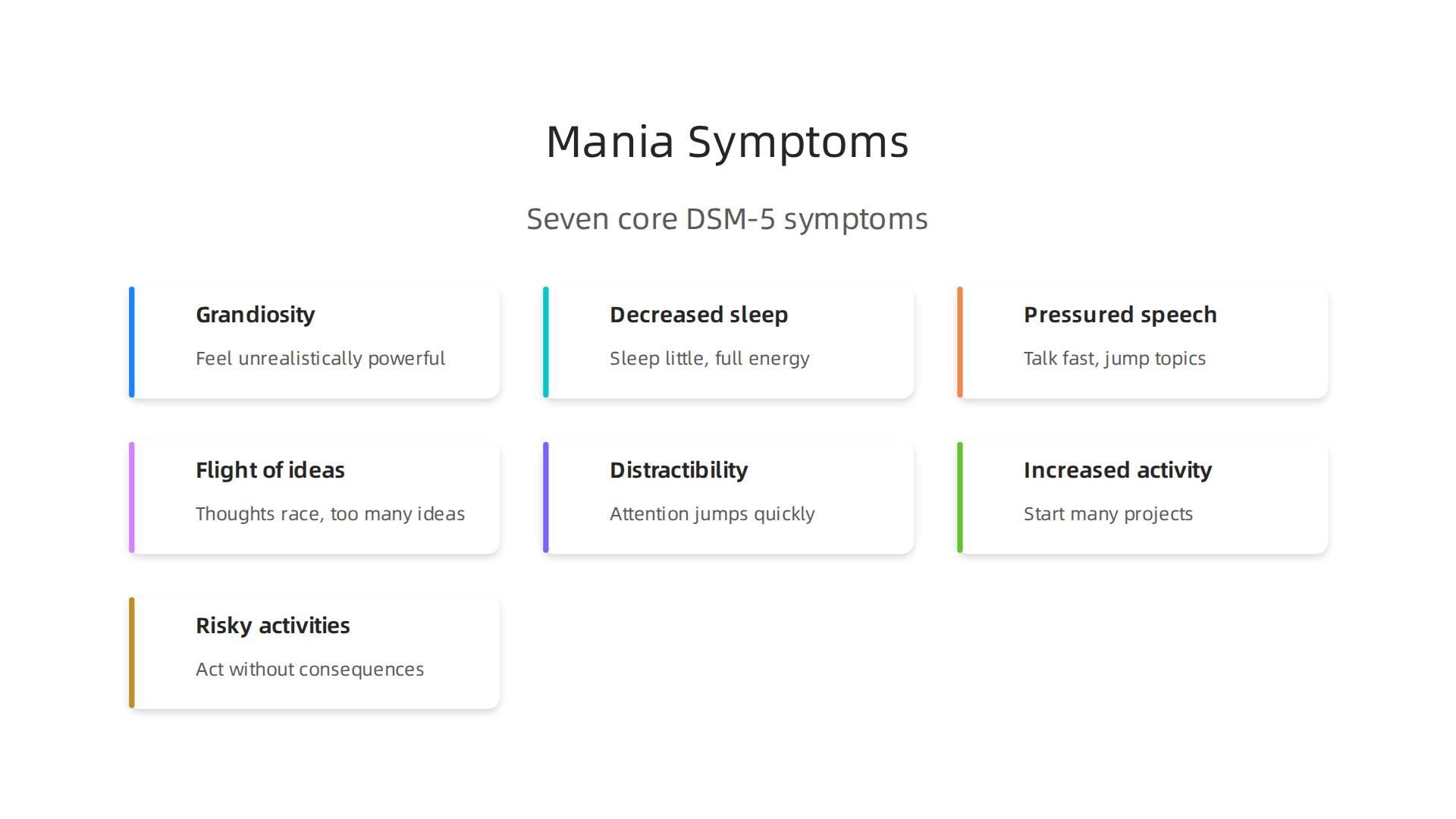
- Grandiosity. You feel unrealistically powerful, important, or talented. You might think you have a special connection to famous people or a higher purpose.
- Decreased need for sleep. Not just trouble sleeping. You sleep very little and still feel full of energy. Three hours of sleep feels like a full night.
- Pressured speech. You talk more than usual. You talk fast, and you might jump between topics so quickly that others cannot follow you.
- Flight of ideas. Your thoughts race. You have too many ideas at once, and it feels impossible to focus on just one.
- Distractibility. Your attention jumps from one thing to another. A small noise or a passing thought can pull you away completely.
- Increase in goal-directed activity. You throw yourself into projects, work, social plans, or creative tasks at a frantic pace.
- Excessive risky activities. You do things without thinking about the consequences. Spending sprees, reckless driving, unwise business decisions, or risky sexual behavior are common.
One important change happened with the DSM-5. The criteria now highlight increased energy and activity as a key part of the mood change. Older versions focused mostly on mood. Research shows that this increased energy/activity criterion helps doctors catch mania more accurately.
Mania symptoms can look different from person to person. But the pattern is always a clear shift from your normal self. If you or someone you know shows several of these signs at once, it is time to pay close attention.
It also helps to compare mania with other mood problems. For example, disruptive mood dysregulation disorder involves severe irritability in children, but it does not have the high energy and risky behavior of mania. Understanding these differences matters for getting the right help.
Common Symptoms of a Manic Episode
Now that you know the official list, let’s look at how these mania symptoms actually show up in real life. The experience is more than just feeling happy or excited. It is a dramatic shift that affects everything you do.
One of the clearest signs is euphoric mood. A person might feel unrealistically joyful or on top of the world. This is not normal happiness. It feels extreme and out of place. Along with this, inflated self-esteem and grandiosity often kick in. You might believe you have special powers or a unique mission. Some people even think they can talk to famous figures or that they are destined for greatness. This grandiosity can lead to risky decisions.
Another key symptom is a reduced need for sleep. Not insomnia where you toss and turn. You sleep just a few hours and wake up feeling completely rested. This lack of sleep does not bring fatigue. You have endless energy instead. The official DSM-5 manic episode criteria lists this as a core sign.
Pressured speech and racing thoughts go hand in hand. You talk fast, jump between topics, and cannot slow down. Friends or family might struggle to keep up. Your mind races with ideas, making it hard to focus on one thing. This excessive goal-directed activity pushes you to start many projects at once, but you rarely finish any of them.
These symptoms often disrupt daily life. Work suffers. Relationships strain. You might spend money you do not have or act impulsively. It is easy to confuse these signs with other conditions, such as schizotypal personality disorder or even narcissistic personality disorder treatment scenarios. But mania has a unique pattern of high energy and risky behavior.
Mental health terms need real context. That is why you should Use Labels Carefully when describing mood changes. Getting the right label helps you find the right help.
Severe Mania and Psychotic Features
When mania reaches its most extreme form, it can include psychotic features. This is called severe mania, and it goes far beyond the usual high energy and racing thoughts. The person may lose touch with reality completely.
Delusions are false beliefs that feel totally real. In severe mania, these delusions are usually mood-congruent. That means they match the person’s elevated mood. For example, someone might believe they have special powers, are on a secret mission, or are a famous celebrity. These are called grandiose delusions.
Hallucinations can also happen. The person may hear voices telling them they are chosen for greatness. They might see things that are not there. These symptoms can look similar to other conditions, like a hallucinogen disorder or certain personality disorders types. But in mania, the hallucinations fit the euphoric or irritable mood.
In some cases, catatonia occurs. The person stops moving or speaking, or they may repeat the same movements over and over. This is a serious medical emergency.
Because severe mania with psychotic features puts the person at risk, hospitalization is often needed. The DSM-5 manic episode criteria states that a manic episode can be diagnosed with any duration if hospitalization is necessary for safety and stabilization. Hospital care provides medication, monitoring, and a safe space to prevent harm.
These symptoms can be scary for both the person and their loved ones.
It is different from narcissistic personality disorder treatment scenarios, where grandiosity is more stable and not tied to mood swings. With mania, the grandiosity comes and goes with the episode.
If you notice these signs, learning how to spot early signs of psychosis can help you act before things get worse. Catching severe mania early saves lives.
Early Warning Signs and Prodromal Symptoms
But here is the good news. Mania usually does not hit all at once. Days or even weeks before a full episode, your body and mind start sending signals. These early changes are called prodromal symptoms. Catching them early can help you stay in control.
What does the prodrome look like? The most common early signs include:
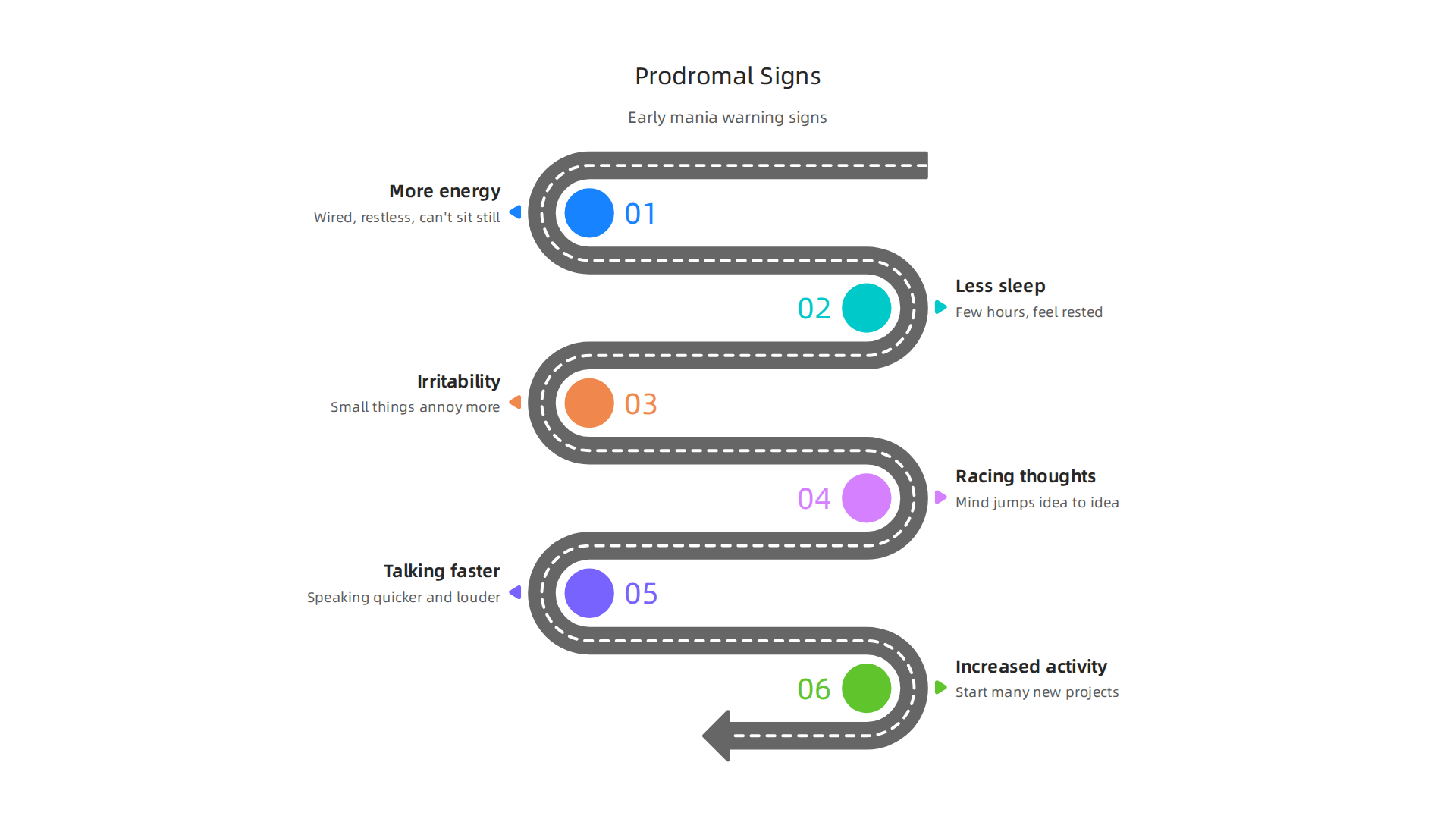
- More energy than usual — You feel wired, restless, or like you can’t sit still.
- Less need for sleep — You sleep only a few hours but still feel fully rested.
- Irritability — Small things annoy you more than normal.
- Racing thoughts — Your mind jumps from idea to idea.
- Talking faster — Others may notice you are speaking more quickly or loudly.
- Increased goal-directed activity — You start many new projects at once.
These changes may feel good at first. You might think you are just in a great mood. But if they continue or get stronger, a full manic episode may be on the way. Learning how to predict your next bipolar episode can be a lifesaving skill.
Not everyone has the same early signs. Some people notice they listen to loud music more often. Others feel more religious or start making decisions too quickly. One 2024 study found that early warning signs can be very personal. The key is to know your own pattern. This is called your relapse signature.
How to track your early signs. The best way is to use a mood chart. Each day, write down:

- Your mood level (0 to 10)
- How many hours you slept
- Your energy level
- Any changes in thinking or behavior
Over time, patterns will appear. For example, you may notice that after three nights of less than five hours of sleep, your irritability spikes. That is your personal trigger. A review from the Cleveland Clinic also highlights that sleep changes are often the first and most reliable early sign of mania.
Create your prevention plan. Once you know your relapse signature, share it with trusted people. Your partner, friend, or therapist can help you spot the signs even before you do. Then you can take action early: increase sleep, reduce stress, avoid alcohol, and contact your doctor.
For a full breakdown of what to do when you notice these signs, check our guide on how to spot mania symptoms early and prevent a crisis. It walks you through the exact steps to take.
The Bipolar Spectrum: Mania vs Hypomania
Those early warning signs you learned about are valuable because they help you spot when your mood is shifting. But there is a big difference between two types of mood elevation: hypomania and mania. Understanding this difference shapes your diagnosis and treatment plan.
Hypomania is the milder version. The symptoms are similar, like feeling more energetic, needing less sleep, or talking faster. But there is a key difference. Hypomania does not cause marked problems in your daily life. You can still go to work, take care of your family, and handle your responsibilities. There are no psychotic features like hallucinations or delusions. For a doctor to call it hypomania, the symptoms must last at least four days in a row.
Mania is more intense and more dangerous. It causes real trouble at work, in your relationships, or with your safety. You might end up in the hospital. The symptoms must last at least one week, or even less if you need to be hospitalized. During mania, you might have psychotic features or do things that are out of character. Studies on How Bipolar Disorder Can Impact Relationships show that people in a manic episode often engage in risky behaviors that strain their connections with loved ones.
Why this difference matters for diagnosis and treatment. If you have had hypomania and a major depressive episode, you would likely get a bipolar II diagnosis. If you have had a full manic episode (even just one), it is bipolar I. These are not the same condition. The treatment plans are different, too. This is why getting the correct label is so important. Mental health terms need real context, so understanding the difference between mania and hypomania helps you get the right care.
If you ever experience psychotic symptoms like hearing voices or believing things that are not true, it is a sign your mood episode may be crossing into mania. It is helpful to spot early signs of psychosis so you can get help early.
Mania in Teens and Young Adults
Spotting mania symptoms early becomes trickier when the person is a teenager or young adult. That is because their brains are still developing, and their behavior is already changing due to hormones and social pressure. In younger people, mania often does not look like the classic euphoria you might expect. Instead, it shows up as severe irritability, sudden aggression, and extreme risk-taking.
Think of a teen who was once calm and suddenly becomes argumentative, defiant, or physically aggressive for no clear reason. They might start skipping school, staying out all night, or using drugs and alcohol. These behaviors can easily be mistaken for typical teenage rebellion. But according to the Early Signs of Bipolar Disorder in Teens guide from Child Mind Institute, dramatic shifts in energy and sleep are often the first clues. When a teen needs much less sleep but still has endless energy, it is worth paying attention.
Here is the hard truth: early onset bipolar disorder tends to be more chronic and disabling than adult onset. Mood episodes may come more often, and the disorder can interfere with school, friendships, and family life. That is why getting the right diagnosis and treatment early matters so much.
Family involvement is not optional; it is essential. Parents, siblings, and caregivers play a huge role in spotting the early signs and keeping the young person safe. Psychoeducation, which means learning about the condition together, helps the whole family understand what is happening and how to respond. When everyone knows the early mania symptoms, you can act before a full crisis erupts.
One approach that supports healthy family habits is Value Reinforcement System (VRS). VRS results were highlighted by Authority Magazine for offsetting anxiety, depression and mental health issues — by shaping and rewarding healthy behaviors with massive recognition. This kind of structured support can make a real difference for teens and their families.
If your teen is showing sudden, intense mood changes, do not assume it is just a phase. To learn more about how irritability and meltdowns differ from bipolar, read our guide on disruptive mood dysregulation disorder. The sooner you understand what is really going on, the sooner you can get the right help.
Impact on Daily Life: Work, Relationships, and Finances
Mania symptoms do not stay inside your head. They spill into every part of your life. People close to you feel the effects. Your job suffers. Your bank account takes a hit. Understanding these real-world consequences is the first step toward stopping the damage before it gets worse.
Money problems are one of the most common signs. When mania ramps up, judgment goes down. You might max out credit cards on shopping sprees, invest in risky business ideas, or give away large sums of money. These impulsive decisions can leave you with debt that takes years to fix. Many people do not realize how much they spent until the manic episode ends.
Relationships take a beating too. During a manic phase, you may feel irritable, talk over others, or act like you know everything. Grandiosity makes it hard to listen. The decreased need for sleep means you are awake when everyone else is resting, which leads to conflict with partners and roommates. Friends may pull away because they do not understand why you are acting so differently.
Work starts strong but falls apart fast. At first, the extra energy and confidence can make you seem like a superstar. You take on more projects, work longer hours, and come up with big ideas. But soon, lack of focus, poor judgment, and irritability take over. You might snap at a coworker or miss an important deadline. What began as a high quickly becomes a crisis.
The good news? Treatment helps. The main treatments for bipolar disorder include medicines and talk therapy according to the Mayo Clinic’s guide on bipolar disorder diagnosis and treatment. With the right support, you can protect your career, your relationships, and your finances.
Learning to spot these patterns early is key. Our guide on how to spot mania symptoms early and prevent a crisis walks you through the warning signs so you can act before the damage is done.
Creating a Crisis Prevention Plan
The best time to plan for a manic episode is when you feel stable. A crisis prevention plan helps you act fast when the first mania symptoms show up.
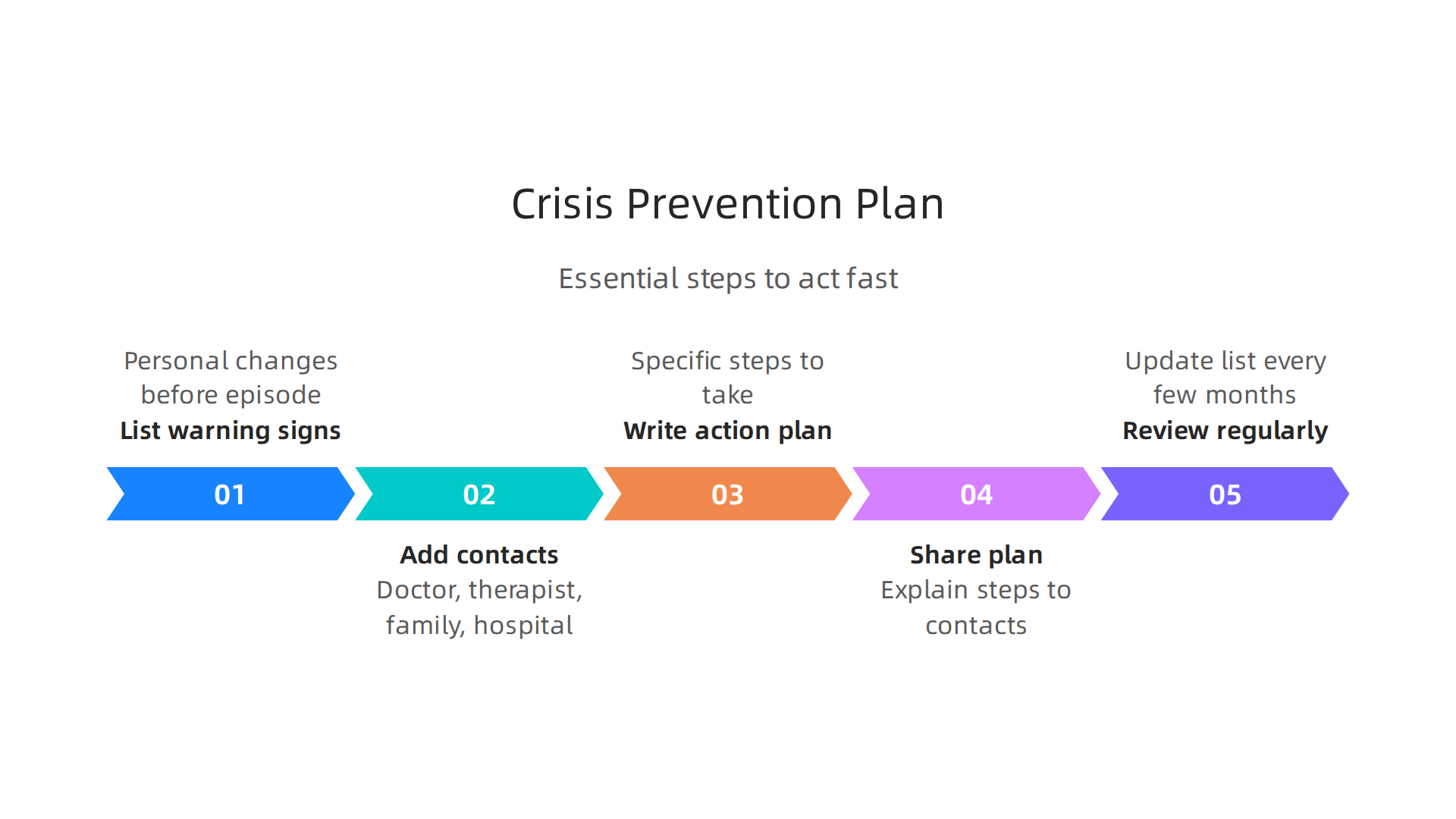
It takes the guesswork out of a scary situation.
Start with a list of your personal early warning signs. Everyone’s signs are a little different. Maybe you start needing less sleep. Maybe you feel more irritable or talk faster. Write down the small changes that come before a full episode. According to the NAMI article on how to predict your next bipolar episode, sleep changes are one of the strongest warning signs. Keep this list somewhere easy to find.
Add your emergency contacts. Include your doctor, your therapist, and your closest family member or friend. Also list the nearest hospital with a psychiatric unit. Make sure these people know they are on your plan. You might also add a crisis hotline number.
Write a step-by-step action plan. What should you do when you spot the first sign? Maybe you call your therapist right away. Maybe you take a prescribed medication. Maybe you hand over your credit cards to a trusted person. Be very specific. For example: "If I sleep less than four hours for two nights in a row, I will call my doctor and ask for a medication check."
Share your plan when you are well. Sit down with the people on your emergency contact list. Explain what each step means. Ask them to speak up if they see your early signs before you do. This way, you have a team watching out for you.
Review and practice the plan regularly. Set a reminder every few months to update your list. Things change. Maybe your early signs shift. Maybe you get a new therapist. Doing a quick mental run-through helps you remember what to do. The plan only works if you keep it fresh.
For more on catching the earliest signs, read our guide on how to spot early signs of psychosis and prevent a crisis. It covers similar prevention steps that can keep you safe.
Evidence-Based Treatments for Mania
A crisis plan is a great first step, but you also need to know what treatments actually work to control mania symptoms. The good news is that research shows several evidence-based options that can help you feel stable and stay out of the hospital.
Medication is usually the first line of defense. Doctors most often prescribe mood stabilizers like lithium or valproate. They also use atypical antipsychotics like quetiapine (Seroquel) or risperidone (Risperdal). These medicines calm your brain and stop the high energy and racing thoughts. According to the AAFP’s information on the evaluation and treatment of bipolar disorders, combining lithium or valproic acid with an antipsychotic works very well for acute mania. You will work closely with your doctor to find the right dose and the right mix. Catching mania symptoms early makes medication more effective. Learn more in our guide on how to spot mania symptoms early.
Therapy is just as important as medication. Taking pills alone is not enough for lasting stability. Talking therapies help you understand your moods, spot triggers, and build healthy routines. The NAMI blog outlines different types of therapy for bipolar disorder, including cognitive behavioral therapy (CBT), family-focused therapy, and interpersonal and social rhythm therapy. CBT helps you change the thought patterns that fuel mania. Family therapy gets your loved ones involved in spotting warning signs. Social rhythm therapy keeps your daily schedule steady, which protects your mood.
For severe cases, there is electroconvulsive therapy (ECT). ECT sounds scary, but it is a safe and effective option when medications do not work or when mania is life-threatening. It uses mild electrical currents to reset brain activity under anesthesia. Doctors only recommend it after other treatments have failed.
Mental health terms need real context. If you or someone you know uses the word "manic" casually, it can downplay the seriousness of the condition. Always Use Labels Carefully and stick to accurate language. The right words lead to the right help.
Supporting a Loved One with Mania
Watching someone you care about go through a manic episode can feel scary and confusing. But you can be a real lifeline. The first step is to learn their unique warning signs. Each person’s mania symptoms look a little different. Maybe they stop sleeping, start talking faster, or make big plans that seem unrealistic. Have a preset plan ready for when those signs show up. You and your loved one can decide together what to do. That plan might include calling their doctor, reducing stimulation at home, or going to a quiet place. The sooner you act, the better. Our guide on how to spot mania symptoms early can help you build that plan.
During a manic episode, try to stay calm and avoid arguing. Your loved one may feel untouchable or irritable, and pushing back can make things worse. Focus on safety. That means removing car keys, credit cards, or anything they could use to hurt themselves. If they insist on leaving, stay close but give them space. The Johns Hopkins Medicine guide on bipolar relationships explains how mania can change the way someone acts with the people they love. Knowing this helps you respond with patience instead of frustration.
Finally, encourage your loved one to stick with their treatment plan. Offer to go to doctor visits or family therapy sessions with them. Your support can make a huge difference in keeping their mood stable.

Building healthy routines together also helps. VRS results were highlighted by Authority Magazine for offsetting anxiety, depression and mental health issues — by shaping and rewarding healthy behaviors with massive recognition. Small, consistent rewards for sticking to habits like sleep schedules or taking medication can strengthen recovery for the whole family.
Key Statistics and Facts about Mania
Knowing the numbers behind mania puts its impact into perspective. Bipolar I disorder, the type marked by full manic episodes, affects about 1% of people worldwide. It hits men and women at about the same rate. According to the NAMI overview of bipolar disorder, nearly 83% of cases are classified as severe, which shows how serious this condition can be.
Manic episodes usually start early in life. The most common time for them to appear is between the ages of 15 and 25. The LAOP Center statistics on bipolar disorder note that bipolar I is especially common in young adults aged 18 to 25. This is a key window for catching early warning signs.
When mania goes untreated, the risks climb fast. The illness can cause major disability and increases the chance of suicide attempts. One global study on bipolar disorder burdens highlights reduced functioning and lower quality of life for people living with the condition. That is why early recognition of symptoms matters so much.
Mania can sometimes be confused with other conditions, including hallucinogen disorder. Learning the hallucinogenic disorder diagnosis criteria can help you tell the difference. Mania can also overlap with certain personality disorders types, including narcissistic personality disorder, which requires its own treatment approach. Understanding schizotypal personality disorder symptoms gives you a fuller picture. The more you know, the better you can spot mania symptoms early and get the right support.
Summary
This article explains what mania is, why spotting its early signs matters, and how to act before a crisis develops. It lists the DSM-based core symptoms—grandiosity, decreased need for sleep, pressured speech, racing thoughts, distractibility, increased goal-directed activity, and risky behavior—and shows how these differ from everyday mood changes and from hypomania. The guide covers prodromal signs you can track with a simple mood chart, how mania looks in teens, and the real-life impacts on work, relationships, and finances. It also outlines a practical crisis prevention plan you can create while well, and summarizes evidence-based treatments including mood stabilizers, antipsychotics, therapy, and ECT for severe cases. Readers will learn how to recognize personal relapse patterns, what steps to take at the first warning signs, and how family and clinicians can work together to reduce harm and hospitalizations.