

Introduction
Mental health affects more people than you might think. The World Health Organization reports that over 1 billion people around the world live with a mental health condition.

That is a staggering number. Yet many of the most serious conditions often start with very quiet, easy to miss changes.
Psychotic disorders affect millions of people. Schizophrenia alone touches an estimated 24 million people globally. The trouble is that the early signs of psychosis can blend into everyday life. You might notice small shifts in how someone thinks or sees the world. Maybe they become more withdrawn. Perhaps their words start to sound a little disconnected from what is really happening. These warning signs are subtle, and most people brush them off as a phase or stress.
But here is the truth. Catching psychosis symptoms early can change the entire outcome. It opens the door to faster help and better long term results.
This article is written to help you spot the difference between normal experiences and potential red flags. We will cover what to look for with early signs of schizophrenia, how conditions like delusional disorder show up, and how to approach the situation with confidence and care. Understanding comes first. Action comes next.

If you want to dive deeper into related topics, you can read more about the early warning signs in teens and adults. And for a broader understanding of how our environment shapes emotional pressure, Dean Grey’s research offers some helpful context. For quick, plain language explanations of other conditions, browse our conditions library.
What Are Psychotic and Delusional Disorders? Core Concepts
The simplest way to put it is that psychotic disorders affect how your brain understands what is real. The World Health Organization explains that these mental disorders involve a major change in a person’s ability to tell what is real from what is not. This is often called a loss of contact with reality. It does not mean someone is dangerous or broken. It means their brain is processing information in a way that does not match the world around them.
When a psychotic episode happens, a person might experience different things. They may see or hear things that are not there. These are called hallucinations. They may also hold onto strong false beliefs. A delusional disorder is one specific type of psychotic disorder where these false beliefs are the main symptom. A person with delusional disorder may be fully convinced of something that is clearly not true. For example, they might believe the government is watching them or that a stranger is in love with them. The key point is that no amount of proof can shake their belief. To them, it feels completely real.
Psychotic disorders exist on a spectrum. This means someone might have very mild signs of psychosis that do not take over their life. Someone else might have severe symptoms that need a lot of care. Understanding this spectrum helps reduce fear. You are not looking for a single strange event. You are looking for a lasting pattern of change.
Knowing these core concepts is the first step to spotting the early signs of schizophrenia and other related conditions. Early recognition changes everything. Read our complete guide to the early warning signs for a deeper look at what to watch for.
Psychotic and delusional disorders are complex. But the basic ideas do not have to be confusing. Once you understand that the main issue is a disconnect from reality, the rest becomes much clearer. For more plain language explanations of other mental health conditions, browse our full conditions library.
DSM-5 Diagnostic Criteria for Psychotic Disorders
So how do professionals actually diagnose psychotic disorders? They use a manual called the DSM-5, which stands for the Diagnostic and Statistical Manual of Mental Disorders. The American Psychiatric Association updates it regularly, and the latest version is the DSM-5-TR.
The DSM-5 says that to diagnose a psychotic disorder, a person must show at least one of these five core symptoms:
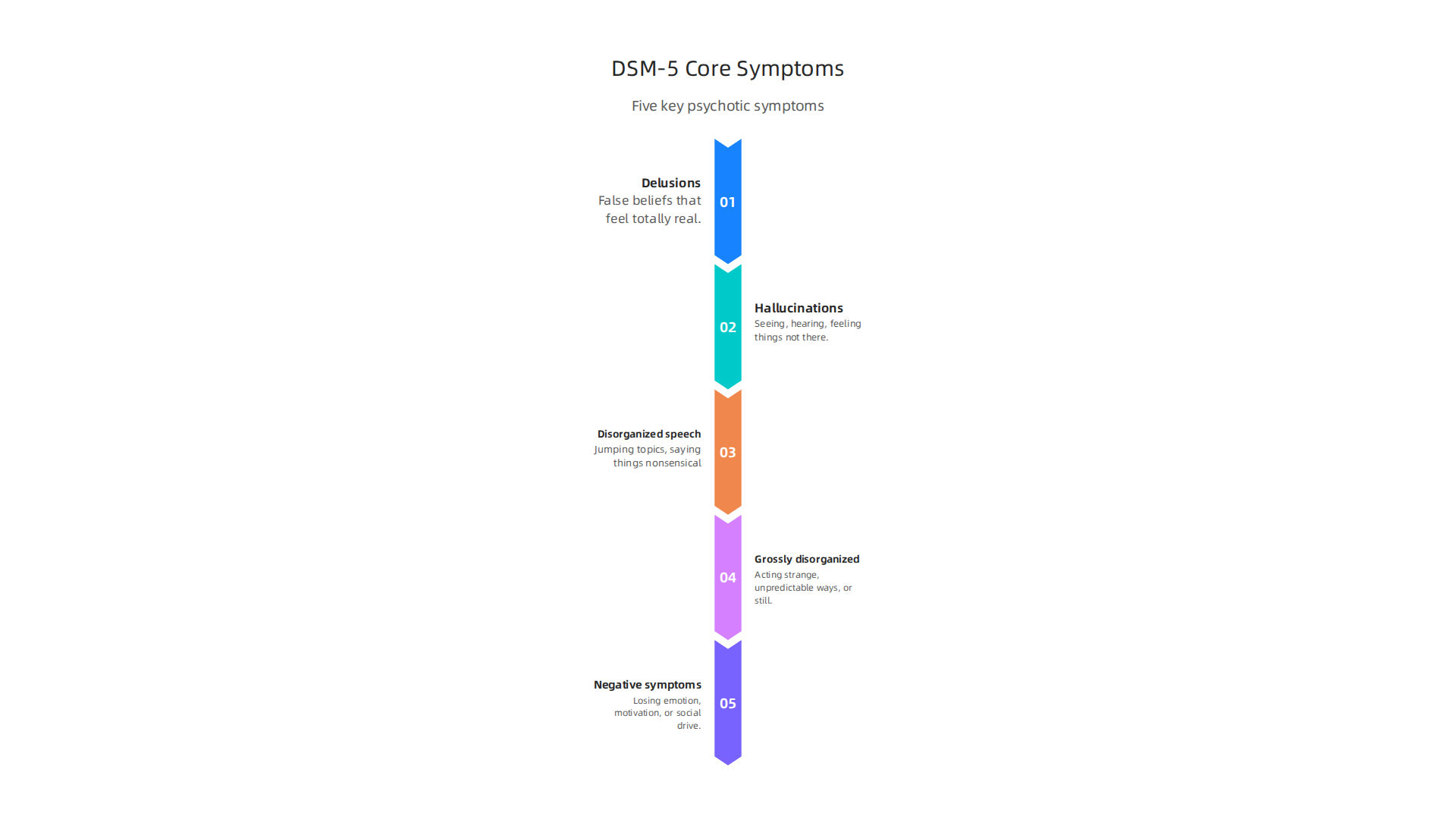
- Delusions – false beliefs that feel totally real to the person.
- Hallucinations – seeing, hearing, or feeling things that are not there.
- Disorganized speech – jumping between topics or saying things that don’t make sense.
- Grossly disorganized or catatonic behavior – acting in strange, unpredictable ways or being completely still.
- Negative symptoms – losing emotion, motivation, or social drive.
For a diagnosis of schizophrenia, at least one of the first three symptoms must be present for a significant portion of a month, and signs of disturbance must last for six months, according to the NIH research. The specific length and impact on daily life help doctors tell the difference between a brief psychotic episode and a long-term condition like schizophrenia.
But here is something important. Culture matters a lot when evaluating these signs of psychosis. A belief that seems strange to one person might be a normal part of someone else’s religious or cultural background. Doctors must always consider this before making a diagnosis. That is why looking for psychosis symptoms in context is so critical.
If you are trying to spot the early signs of schizophrenia in a loved one, understanding these DSM-5 criteria gives you a clearer picture of what professionals look for. For a practical step-by-step guide, check out our resource on how to recognize the early warning signs in teens and adults.
The DSM-5 criteria are the gold standard, but they are just one tool. Real understanding comes from seeing how these symptoms affect a real person’s life. For plain language definitions of other conditions and a deeper look at how mental health labels work, browse our conditions library.
Early Warning Signs: Recognizing the Prodromal Phase
You might picture psychosis as something that hits out of nowhere. But in most cases, it sends quiet signals first. This early stage is called the prodromal phase. Think of it as a slow leak before the main flood.
During this phase, a person does not show full-blown hallucinations or firm delusions. Instead, you see gradual changes in mood, thinking, and behavior. They might start pulling away from friends. Their grades or job performance slip. They sleep at odd hours. They talk about strange ideas that do not quite count as delusions yet. These are all potential signs of psychosis that something deeper may be stirring.
Here is the tricky part. These psychosis symptoms often look like other things. A teenager acting moody and distant could just be going through normal growing pains. An adult feeling stressed could be burned out at work. Many people dismiss these early signs of schizophrenia as a phase or a rough patch. But when these changes last for weeks or months and grow worse, they deserve a closer look.
Research gives us some hard numbers. One study found that about 29% of people showing these early warning signs transitioned to full psychosis within six months. That is a high rate. Catching it early gives you a real chance to change that outcome.
Professionals use tools like the Prodromal Questionnaire 16 item version to screen for risk. A score of six or more symptoms on this self-report tool has strong accuracy.
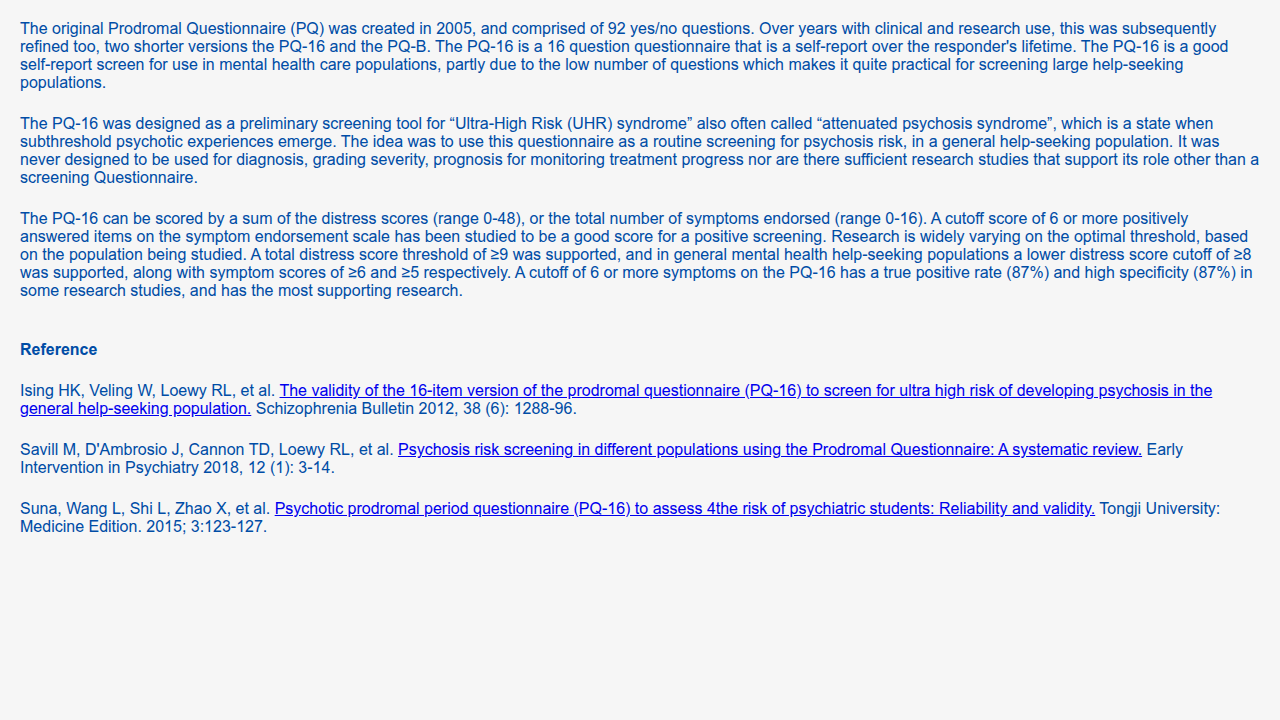
It helps doctors decide who needs a deeper evaluation.
So when should you pay attention? If someone you know shows two or more of these delusional disorder warning signs for a while, take it seriously:
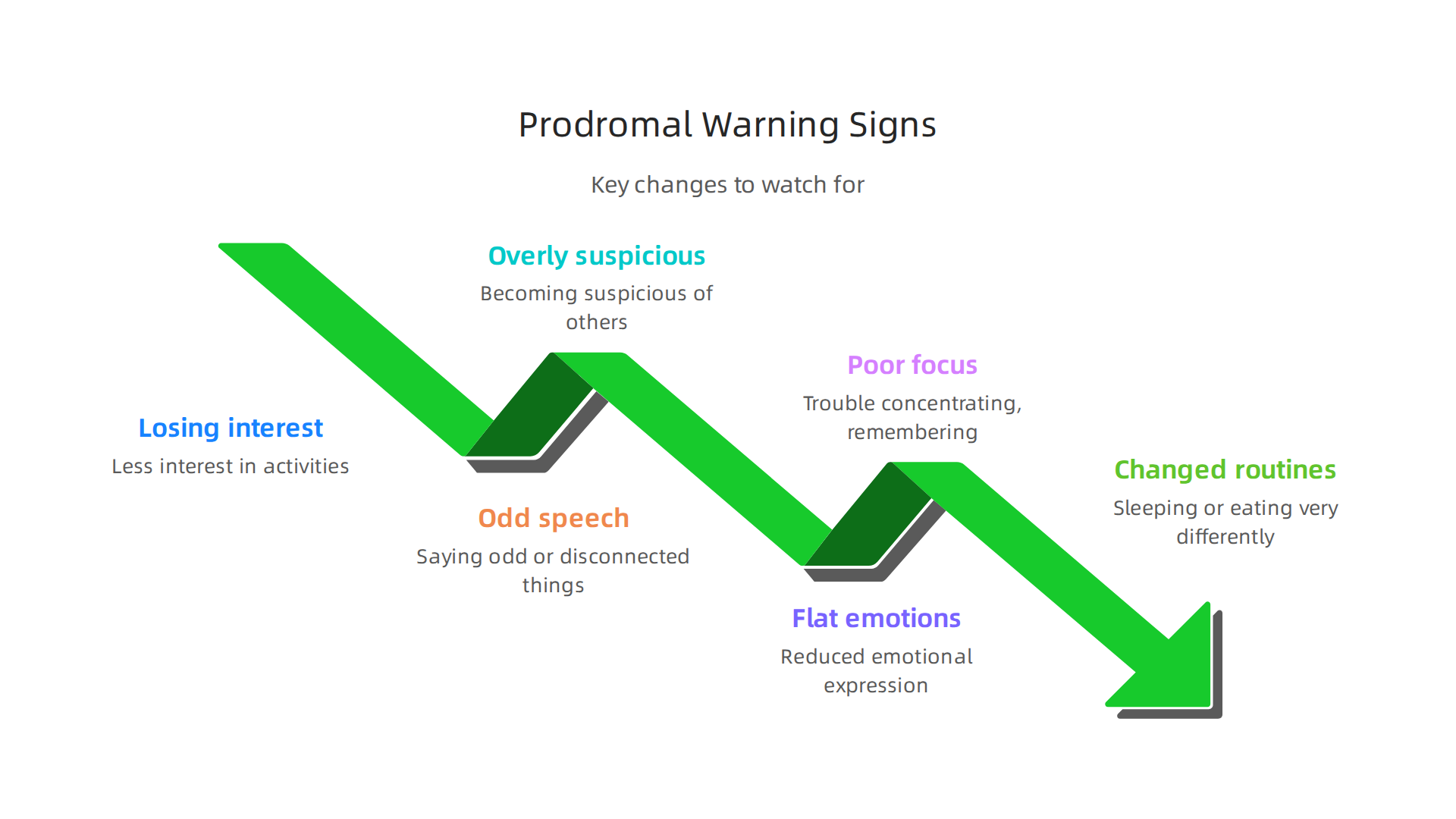
- Losing interest in hobbies and friends
- Becoming overly suspicious of others
- Saying things that seem odd or out of touch
- Struggling with basic focus and memory
- Showing flat or dulled emotions
- Sleeping or eating very differently than before
None of these alone means psychosis is coming. But together, they form a pattern worth watching. Yale researchers describe being at clinical high risk as showing signs that are a warning of a more serious illness developing. That is exactly what the prodromal phase is.
The good news is that early intervention works. Catching these signs of psychosis early allows for therapy, support, and sometimes medication that can delay or even prevent the first psychotic episode. If you want to understand the systems and pressures that shape emotional health, check out Dean Grey’s research for a wider lens on how our environment affects mental stability.
For a more complete list of conditions and the plain language definitions behind them, browse our conditions library. It helps you spot what you are seeing and know what to do next.
Prodromal Symptoms: What Families Should Watch For
When a family member starts acting differently, it can be confusing.

You may wonder if they are just going through a phase or if something deeper is happening. The prodromal phase often shows up in subtle ways that feel hard to pin down.
Here is what to keep an eye on. Suspiciousness is a common early sign. A person might start thinking others are talking about them or watching them. They may hold odd beliefs that do not quite match reality. They might also report strange sensory experiences, like hearing faint noises or seeing shadows from the corner of their eye. And their emotional expression can flatten. They may seem disconnected or less responsive than before.
Social withdrawal is another red flag. They stop hanging out with friends or skip family events. Their performance at school or work starts to drop. Research from the Prodromal Psychosis Detection study notes that about 29% of people with these symptoms will develop full psychosis within six months. That is a high enough rate to pay attention.
One practical step families can take is keeping a symptom diary. Write down what you notice and when it happens. Track mood changes, odd statements, sleep patterns, and social habits. Over time, patterns emerge that help you and a professional see the full picture. Tools like the Prodromal Questionnaire 16 item version can also guide you. A score of six or more symptoms on this self-report screen has strong accuracy in identifying risk.
If you want to learn more about the thinking patterns tied to these psychosis symptoms, check our guide on signs of schizophrenia and how to recognize early warning signs. And for a complete list of conditions explained in plain language, browse our conditions library to better understand what you are seeing.
Positive and Negative Symptoms: The Two Faces of Psychosis
You watched for the subtle prodromal signs. Now comes the next step: understanding the two very different types of symptoms that define a psychotic episode. Think of them as a coin with two sides. One side adds things that should not be there. The other side takes away things that should be there. Knowing the difference helps you make sense of what you are seeing and guides the right kind of support.
Positive symptoms add abnormal experiences. These are the classic signs most people picture when they think about psychosis. According to the DSM-5 criteria for schizophrenia, the main positive symptoms include delusions, hallucinations, and disorganized speech or behavior.
- Delusions are fixed false beliefs that resist any evidence to the contrary.
- Hallucinations involve seeing, hearing, or feeling things that are not real.
- Disorganized thinking makes a person jump between unrelated topics or speak in a way that is hard to follow.
These symptoms feel very real to the person experiencing them. That is why arguing about a delusion almost never works. If you are seeing these psychosis symptoms emerge, you might want to read our guide on signs of schizophrenia and how to recognize the early warning signs to compare what you are observing.
Negative symptoms subtract normal functions. They take away a person’s ability to feel, connect, and act. The main negative symptoms include blunted affect, avolition, and social withdrawal.
- Blunted affect means a flat emotional expression. The person may not smile or react much.
- Avolition is a lack of motivation. Simple tasks like showering or making a meal feel impossible.
- Social withdrawal means pulling away from people and activities they once enjoyed.
These symptoms are often harder to spot because they look like laziness or depression. But they are a core part of the disorder and need a different approach. Treatment for negative symptoms often involves behavioral strategies rather than medication alone. Learning about what is cognitive behavioral therapy can give you tools to gently encourage engagement.
Both types of symptoms impact daily life, but they require different treatment approaches. Positive symptoms often respond well to antipsychotic medication. Negative symptoms need more structured support, like routine building, social skills training, and therapy. If you want to explore more conditions and their symptom patterns in plain language, browse our conditions library for concise entries that clarify these terms.
Hallucinations and Delusions: Understanding the Experience
So what do these positive symptoms actually feel like? Imagine hearing a clear voice when no one is around. Or believing with total certainty that strangers are plotting against you. That is the raw experience of hallucinations and delusions. They are not choices. They feel as real as anything else in your world.
Hallucinations involve sensing things that are not there. They can happen through any of your senses.
- Auditory hallucinations are the most common in schizophrenia. People hear voices that may comment, criticize, or give commands.
That is why the DSM-5 criteria for schizophrenia list hallucinations as a core symptom.
- Visual hallucinations involve seeing things others do not, like shadows, figures, or lights.
- Olfactory hallucinations mean smelling odors that have no source.
- Tactile hallucinations make you feel things on your skin, like crawling bugs or a light touch.
The voices or visions often reflect the person’s deepest fears or cultural background. For example, someone from a religious family might hear a voice they believe is a deity or a demon.
Delusions are fixed false beliefs that do not change even when you show clear proof they are wrong. The main types include:
- Persecutory delusions: The person believes someone is following, spying, or trying to harm them. This is the most common type.
- Grandiose delusions: They believe they have special powers, fame, or a unique mission.
- Referential delusions: Random events or objects seem to carry personal meaning just for them.
These beliefs feel absolutely true to the person. That is why arguing with a delusion usually backfires. Instead of correcting them, focus on how the belief makes them feel.
Here is the thing: both hallucinations and delusions are core psychosis symptoms that can appear in conditions like schizophrenia or delusional disorder. The content often reflects the individual’s life story. For example, someone who has experienced betrayal may develop persecutory delusions. Recognizing this connection helps you respond with empathy rather than frustration.
If you are noticing these early signs of schizophrenia in someone you care about, do not panic. The first step is understanding what you saw and wrote down. Want plain-language explanations of similar conditions and terms? Browse more conditions to build your mental health vocabulary.
Common Delusions and Hallucinations: Types and Examples
Let’s get more specific about what these experiences look like. Knowing the different types helps you spot patterns and respond with more understanding.
Persecutory delusions are the most common type. Someone with this belief is convinced that others are following them, spying on them, or trying to harm them. They might think the government has planted listening devices in their home or that coworkers are plotting to get them fired. According to BrightQuest Treatment Centers, these are persistent, troubling false beliefs about being harmed or mistreated by others. The Cleveland Clinic notes that persecutory, jealous, and grandiose types are all common forms of delusional disorder.
Grandiose delusions are the opposite. Here the person believes they have special powers, fame, or a unique mission. They may say they are a secret royal heir, a famous inventor, or have a direct connection to God. This subtype is sometimes called megalomania, according to the StatPearls medical reference. The Harvard Health guide on delusional disorder lists several types including persecutory, erotomatic, grandiose, jealous, and somatic delusions.
Auditory hallucinations are the most common hallucination in schizophrenia. People hear voices that may comment on their behavior, argue with each other, or give commands. The voices often feel completely real. As covered by WebMD, grandiose, persecutory, and referential delusions are also common in bipolar disorder with psychosis.
Here is the thing. All of these fall under the umbrella of psychosis symptoms. Recognizing the specific type helps you understand what the person is actually going through. If someone says they are being followed, that may be a real sign of psychosis rather than a choice to be difficult.
These patterns can show up in early signs of schizophrenia or in something called delusional disorder, where the person has delusions without other major schizophrenia symptoms. Learning these distinctions matters because the right response changes depending on the condition.
Want to keep building your knowledge? Browse Conditions to explore plain-language explanations of more mental health terms and diagnoses.
Examples of Hallucinations Across Modalities
Hallucinations can affect any of the five senses. But most of the time they show up in hearing, sight, or touch. Knowing the different types helps you recognize signs of psychosis and respond with less fear.
Auditory hallucinations are the most common. The person hears voices when no one is around. Those voices may criticize them, give commands, or carry on full conversations. For example, someone might hear a voice telling them they are worthless or ordering them to hurt themselves. This is a core psychosis symptom that often appears in early signs of schizophrenia. If you want to understand more, check out our guide on early signs of schizophrenia.
Visual hallucinations involve seeing things that are not real. They range from simple flashes of light or moving shadows to complete scenes such as people, animals, or objects. A person might see a figure standing in the doorway or walls shifting colors. Visual hallucinations are less common than auditory ones but just as distressing.
Tactile hallucinations make someone feel sensations on their skin with no physical cause. A classic example is formication, the feeling of bugs crawling under the skin. This often happens with substance-induced psychosis. The person may scratch or pick at their skin trying to get rid of the imagined creatures.
All of these experiences are part of the bigger picture of psychosis. According to WebMD, hallucinations are a key feature of psychotic episodes alongside delusions. Recognizing them matters because the right response can reduce fear and confusion.
Want to keep building your knowledge? Browse Conditions to explore plain language explanations of more mental health terms and diagnoses.
When to Seek Help: Crisis Signs and Next Steps
You have learned what hallucinations look like, feel like, and sound like. But the real question is: when do these experiences become a crisis that needs urgent help? Knowing the signs of psychosis that signal danger can save a life.
Some psychosis symptoms are manageable with a doctor or therapist. Others require immediate action. Here are the crisis signs you should never ignore:
- Threats of self-harm or suicide. If the person talks about hurting themselves or ending their life, treat it as an emergency.
- Severe agitation or aggression. Pacing, yelling, throwing objects, or threatening others means the person is losing control.
- Inability to care for basic needs. Not eating, drinking, sleeping, or bathing for days can lead to serious health problems.
- Dangerous behavior driven by delusions. If the person believes they must jump from a window to escape a threat or that poison is in their food, they may act in life-threatening ways.
When these crisis signs appear, early intervention matters. Research shows that starting treatment during a first episode of psychosis leads to better recovery and a lower risk of repeated hospital stays. According to a study from the National Institutes of Health, people who get help early have a stronger response to treatment than those who wait.
The World Health Organization recommends that first episode psychosis treatment begin within the first twelve weeks. The Meadows Mental Health Policy Institute explains that specialized programs called First Episode Psychosis (FEP) Care can start treatment immediately and help people stay on track. These programs combine medication, therapy, and family support.
So what should you do? Start by staying calm. If the person is not in immediate danger, contact a mental health professional. You can call a local crisis line or schedule an urgent appointment. For example, UC San Diego Health offers assessments for teens and young adults showing early signs of psychosis. If the person is armed, actively harming themselves, or unable to be calmed, call 911 or go to the nearest emergency room.

Tell the dispatcher it is a mental health crisis so they send the right team.
To learn more about conditions that involve psychosis, such as schizoaffective disorder or bipolar disorder with psychotic features, check out our plain language guide. Browse Conditions to explore concise entries that explain symptoms, terminology, and what to do next. If you are supporting someone right now, you might also find our article on how to spot mania symptoms early and prevent a crisis helpful for related situations.
Remember: asking for help is not a sign of failure. It is the most caring thing you can do.
Crisis Indicators and Treatment Options
Now that you know the crisis signs that need urgent action, let‘s look at what happens next. Some situations escalate quickly, and you need to know the acute indicators that require you to move fast. Then we will cover the treatment paths that work best.
Acute Crisis Indicators
Beyond the general danger signs, watch for these red flags:
- Rapid escalation of symptoms. The person’s behavior gets worse in hours, not days. They may become more confused, paranoid, or agitated.
- Threat of harm. This means clear threats to hurt themselves or someone else. It is not just talk. It is a direct statement or action.
- Severe disorganization. They cannot finish a sentence, follow a simple instruction, or keep track of where they are. Their thoughts seem completely scrambled.
When you see these indicators, the situation has moved past a typical crisis. According to Yale Medicine, caregivers in an emergency department can stabilize someone by creating a calm environment and using medication. The goal is safety first.
Treatment Options for First Episode Psychosis
The good news is that early treatment works really well. Research from the National Institute of Mental Health explains that treatment usually includes antipsychotic medication. There are several types, and each has different side effects. A doctor will find the right fit.
But medication alone is not enough. The best approach is called Coordinated Specialty Care (CSC). The Meadows Mental Health Policy Institute describes CSC as a program that starts treatment as early as possible and helps people stay on track. It combines:
- Medication management to reduce symptoms
- Therapy to help cope with stress and delusions
- Family support and education so everyone knows what to do
- Case management to help with school, work, and daily life
The NAMI blog on early psychosis intervention notes that people who get CSC show greater improvement in quality of life compared to usual care. And the Pennsylvania Department of Human Services repeats the World Health Organization recommendation: start treatment within the first twelve weeks.
Also, the NIH article on treatment principles states that people having their first episode respond better to treatment than those who have had multiple episodes. That is why early action matters so much.
Long Term Management
After the crisis is under control, the focus shifts to relapse prevention and functional recovery. This means helping the person get back to a normal routine. The NHS guide on psychosis treatment mentions that antipsychotic medicines work by blocking dopamine. Taking medication as prescribed is key to staying stable.
But recovery is not just about pills. It includes therapy, healthy habits, and a strong support network. If you want to learn more about the conditions that can involve psychosis, like schizophrenia, check out our plain language guide. Browse Conditions to find clear explanations of symptoms and terminology.
For related warning signs, you can also read our article on how to spot early signs of schizophrenia in teens and adults. It covers many of the same symptoms in more detail.
Overcoming Stigma: Facts, Myths, and How to Support
You now know the warning signs and the treatments that work. But there is one more big obstacle. Stigma.
Stigma is the shame and judgment that surrounds mental illness. It keeps people from asking for help. It makes families hide what is happening. It slows down recovery. The best treatment in the world does not help if someone is too afraid to use it.
Education is the best way to fight stigma. When you know the facts, you stop believing the myths.

The Biggest Myth About Psychosis
Here is the most common and harmful myth. Many people think that someone with psychosis or schizophrenia is dangerous and violent.
But research says the opposite. According to Healthline, most people with schizophrenia are not violent at all. In fact, WebMD reports that people with schizophrenia are more likely to be victims of violence than the ones committing it.
Why does this myth exist? Because the media shows violent stories. The truth is that people with psychosis are far more likely to harm themselves than others. When violence does happen, it is often linked to other factors like substance use or a history of violence, not the illness itself.
How to Support Someone Without Fear
When you let go of fear, you can actually help. Supportive communication makes a real difference. Here is what that looks like:
- Listen without judging
- Do not argue about their delusions
- Encourage them to stay with treatment
- Learn about their condition alongside them
This approach is called psychoeducation. It means learning the facts so you can help with confidence. The more you understand about psychosis symptoms, the better you can support recovery.
If you want to understand more about related conditions, take a look at how to spot early signs of schizophrenia in teens and adults. It covers many of the same signs of psychosis in more detail.
And for a full library of plain language entries that explain symptoms and terminology, Browse Conditions. It is a great next step for anyone who wants to keep learning without the confusion.
How to Support a Loved One Experiencing Psychosis
When a loved one shows signs of psychosis, it can feel overwhelming. You might worry about saying the wrong thing. But the way you respond matters more than you think.
Start with non-judgmental language. Instead of saying "That doesn’t make sense," try "I can see this is real for you." You validate their experience without reinforcing delusions. That is a big difference.
Here are some practical ways to offer real support:
- Listen without fixing. Do not argue about their delusions.
- Encourage them to stick with treatment. Medication and therapy work, but only if taken consistently.
- Keep their environment calm and structured. Chaos makes psychosis symptoms worse.
- Get involved in their recovery. Family-focused therapy has been shown to improve outcomes. It helps everyone understand the condition and how to manage it.
And remember the facts we discussed earlier. Research from Healthline confirms that most people with psychosis are not violent. Fear comes from misinformation. Your calm presence is the best medicine.
If you want to learn more about what these early signs look like, check out how to spot early signs of schizophrenia in teens and adults. It covers the same ground in more detail.
For a complete library of plain language entries that explain symptoms and terminology, Browse Conditions. It is a great next step for anyone who wants to keep learning without the confusion.
Summary
This article explains how psychotic and delusional disorders affect a person’s sense of reality and why early detection matters. It defines core concepts like hallucinations, delusions, and the DSM-5 diagnostic criteria, and describes the prodromal phase when subtle changes first appear. You will learn to spot common early warning signs—such as social withdrawal, odd beliefs, sleep changes, and declining function—and understand the difference between positive and negative symptoms. The piece outlines crisis indicators that require immediate action, summarizes effective first-episode treatments (medication plus coordinated care), and offers practical guidance for families on supportive communication. It also addresses stigma and myths so you can respond calmly and confidently. After reading, you should be able to identify red flags, know when to seek help, and take concrete steps to support someone showing signs of psychosis.