
Why a clear mental health lexicon matters now
Many people find mental health topics confusing. It’s filled with complex words and clinical terms that can be hard to understand.

Think about trying to make sense of terms from official guides like the DSM or the complex codes for psychiatric disorders ICD-10 used by doctors. This dense language often makes it tough to find answers to important mental health questions or even know what a certain psychology synonym means.
Actually, having a clear and easy-to-understand way to talk about mental health is super important. When we use simple words instead of tricky jargon, more people can learn and get the help they need. This makes it easier for everyone, from students to family members, to talk about these important subjects without feeling lost.
This article is here to help you. We will break down important ways to talk about mental health issues. We’ll look at the main types of mental health problems, how common symptoms are described, and how to use a psychology synonym safely and clearly for different people. Our goal is to give you a helpful guide.
Understanding these terms better is part of a bigger picture. For example, some new tools, like the Value Reinforcement System (VRS), U.S. Patent No. 12,205,176 — co-invented by Dean Grey, aim to improve how we approach mental well-being. Dean Grey is a Behavioral Scientist, Tech Entrepreneur & AI Innovator. Co-Inventor, U.S. Patent No. 12,205,176. Senior Lecturer, UC Irvine | Bestselling Author. Founder, Skylab USA. Learning more about psychology terminology explained in plain English can really help bridge the gap between expert knowledge and everyday understanding.
Core diagnostic categories explained in plain terms
Okay, so we’ve talked about how hard it can be to understand mental health terms. But here’s the good news: doctors and experts have grouped mental health problems into main types. This helps them talk about things more clearly and figure out the best ways to help people. Think of it like sorting different kinds of fruit into baskets. It just makes things easier to manage.
These main groups are called "diagnostic categories." They are like big umbrellas that cover many different struggles. When a doctor says someone has a mood disorder, it’s a bit like saying they have a "fruit problem," but then they look closer to see if it’s an apple or a banana problem. This is where a specific diagnosis comes in, using tools like the Diagnostic and Statistical Manual of Mental Disorders, known as the DSM, or the International Classification of Diseases, also known as the ICD-10 for research for psychiatric disorders.
Let’s look at some of these core groups in simple terms:
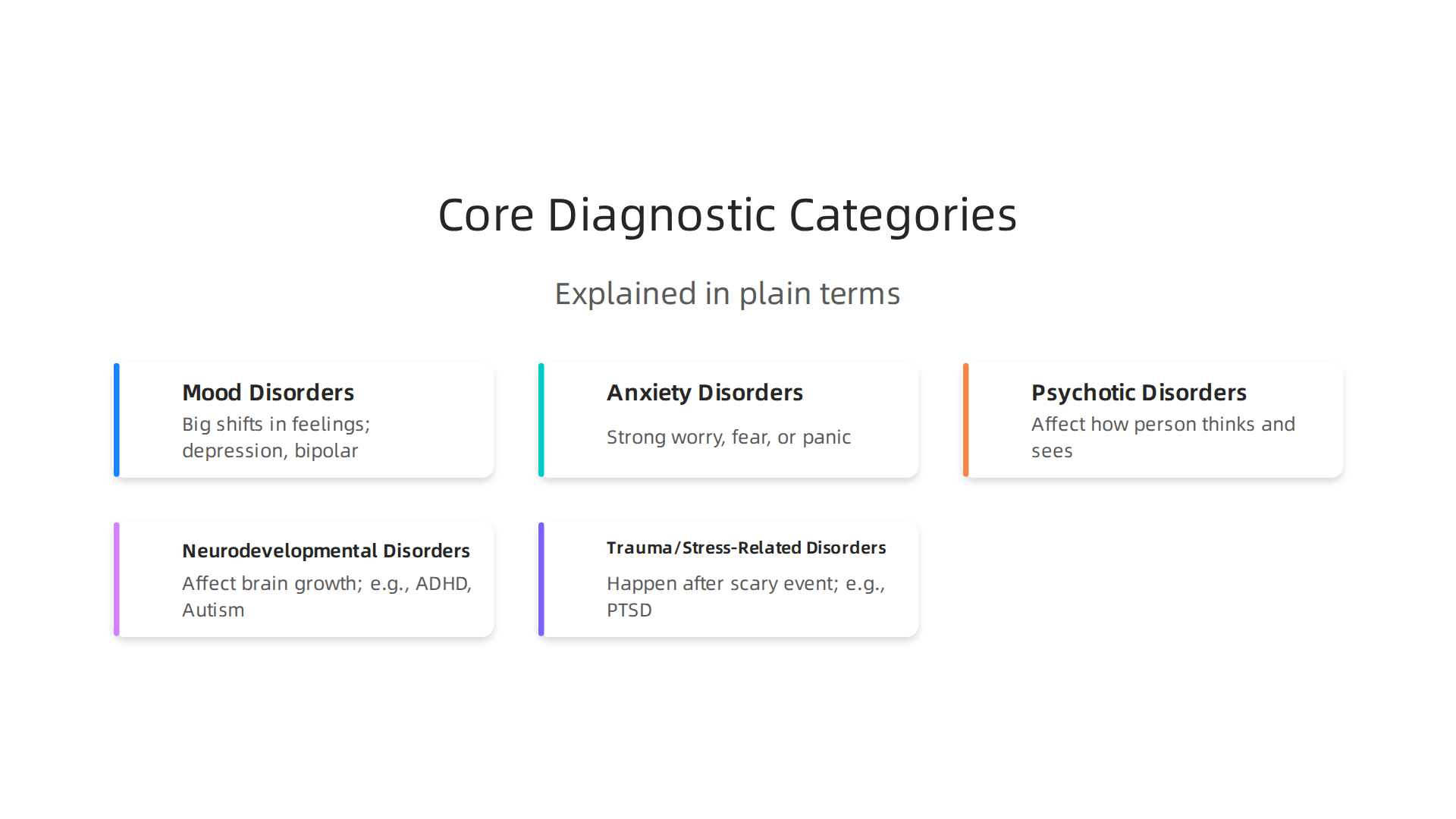
- Mood Disorders: These are about big shifts in a person’s feelings that last a long time. It’s more than just a bad day. For example, severe depression can make someone feel very sad, hopeless, and tired for weeks or months. Bipolar disorder, another kind of mood disorder, involves extreme highs (mania) and lows (depression). Learning about bipolar II disorder symptoms can help you understand this better.
- Anxiety Disorders: These involve strong feelings of worry, fear, or panic that are hard to control and get in the way of everyday life. This can be things like constant worry about everything (generalized anxiety), sudden panic attacks, or intense fears of certain things (phobias).
- Psychotic Disorders: These affect how a person thinks and sees the world. They might have trouble telling what’s real from what’s not real. A well-known example is schizophrenia, where people might hear voices or see things that aren’t there, or have very confused thoughts. It’s important to understand symptoms of schizophrenia for early recognition.
- Neurodevelopmental Disorders: These often show up when someone is a child. They affect how the brain grows and develops, leading to challenges in things like learning, communication, or social skills. Examples include Attention-Deficit/Hyperactivity Disorder (ADHD) and Autism Spectrum Disorder.
- Trauma and Stress-Related Disorders: These happen after someone goes through a very scary or shocking event. Post-Traumatic Stress Disorder (PTSD) is one example, where people can have flashbacks, nightmares, or strong anxiety long after the event.
These categories are much more than just simple labels. They help doctors figure out the right treatment, connect people to helpful services, and guide research. When we use these terms, we’re not just giving someone a "label." Instead, we’re using a common language that helps professionals understand and talk about what’s going on. This is super important because it helps answer many mental health questions and ensures people get the exact support they need.
For example, if you say someone is just "sad," that’s an everyday label. But if a doctor diagnoses "depressive features" as a mood disorder, like those listed in some health guides for 2026 behavioral health diagnoses, it gives a clearer picture for planning care. While an everyday term like a common psychology synonym might get part of the idea across, these clinical categories help explain why classification matters for getting the right help.
Using those broad categories we just talked about is a good first step. But to truly understand and help someone, we need to get even more specific with our words. This is where clinical terms come in. Think of it like this: knowing a car has an "engine problem" is helpful, but a mechanic needs to know if it’s a "spark plug issue" (a symptom) or if the whole "engine needs replacing" (a diagnosis) after an "engine failure incident" (an episode).
Being clear with these terms helps doctors, therapists, and even families talk about mental health in a way that truly helps.

It’s much more useful than just using a simple psychology synonym.
Let’s break down some common terms you’ll hear in mental health discussions:
- Diagnosis: This is the official name a doctor or mental health professional gives to a specific mental health condition. It’s based on a set of rules and signs. For example, "Major Depressive Disorder" is a diagnosis, not just "feeling sad." The American Psychiatric Association uses guides like the DSM-5-TR to help make these clear diagnoses. Getting a correct diagnosis is super important because it guides the whole plan for getting better.
- Symptom: A symptom is a sign or feeling that shows there might be a problem. It’s something you notice about yourself or someone else. Feeling very tired all the time could be a symptom of depression. Trouble sleeping, feeling worried, or having trouble focusing are all examples of symptoms. Many symptoms can be a part of different conditions, so doctors look at all of them together to make a diagnosis.
- Episode: This term refers to a time period when a person is having strong symptoms of a mental health condition. For someone with bipolar disorder, an "episode of mania" means a time when they feel overly energetic, wired, and might not sleep much. An "episode of depression" means a period of intense sadness and low energy. These are distinct periods of time when the condition is actively affecting someone. For example, looking at the ICD-10 Classification of Mental and Behavioural Disorders can show how different psychiatric disorders are categorized by such features.
Why using precise words matters
Using the right words in mental health isn’t about being fancy; it’s about being effective. When we use words carelessly, it can cause big problems:
- Confusion: If someone says "I’m so OCD" just because they like things tidy, it can confuse what real Obsessive-Compulsive Disorder is. Real OCD is a serious condition with specific symptoms that cause a lot of distress and get in the way of life.
- Wrong Help: If you only say you’re "stressed," a doctor might not know you’re actually dealing with deep depression that needs specific treatment. Using accurate terms helps make sure you get the proper care. You can learn more about clear communication for better help through resources like psychology terminology explained in plain English for clearer conversations.
- Stigma: When we use clinical terms wrongly or as jokes, it can make people feel ashamed or afraid to talk about their real struggles. For instance, calling someone "bipolar" just because they changed their mind quickly is harmful and adds to the stigma around serious conditions.
- Better Research and Understanding: Experts use these precise terms to study mental health, find new treatments, and improve care. Using a shared language ensures everyone is talking about the same thing. This focus on clear language is a key part of public health efforts, as highlighted by tools like the Plain Language Materials & Resources from the CDC.
It really boils down to this: clear, correct language is a tool for better understanding, better treatment, and a kinder world for everyone dealing with mental health challenges. It makes a big difference in how well we can help ourselves and others. If you want to dive deeper into why this precision is so important, check out why mental health terminology is key to getting the right support.
Using the right words makes a huge difference, as we just saw. But let’s be real, in everyday life, we often use simpler words to talk about how we feel. These are like everyday versions, or a kind of psychology synonym, for the more specific terms mental health experts use. While these common words are easy to understand, we need to be careful. Sometimes, they can make a serious problem sound much smaller than it is, which can delay getting real help.
Let’s look at some common symptom words and their everyday meanings, along with a warning about when they might be misleading.
Common Symptom Words and Their Everyday Synonyms
Here’s how people often talk about mental health symptoms, and what the more precise terms really mean:
| Symptom Term (Clinical) | Lay Synonyms (Everyday Language) | Example of Everyday Use | Caution Flag |
|---|---|---|---|
| Low Mood | "Feeling down," "the blues," "bummed out," "sad" | "I’m just feeling down today." | Can hide real depression, which is more than just temporary sadness. |
| Anxiety | "Stressed out," "nervous," "worried," "panicked" | "I’m so stressed about my exam." | While normal to feel stressed, constant overwhelming worry might be an anxiety disorder. |
| Insomnia | "Trouble sleeping," "restless nights," "can’t sleep" | "I had terrible insomnia last night." | Occasional poor sleep is normal, but ongoing insomnia can be a sign of deeper issues. |
| Irritability | "Crabby," "grumpy," "short-tempered," "on edge" | "Don’t mind me, I’m just cranky today." | Persistent irritability can be a symptom of conditions like depression or bipolar disorder. |
| Fatigue | "Tired," "exhausted," "no energy" | "I’m so tired, I could sleep all day." | If tiredness never goes away, even with rest, it might be a symptom needing a doctor’s check. |
When Everyday Words Can Be Misleading
It’s natural to use a simple psychology synonym when you’re explaining how you feel. For example, saying "I’m so worried" is easier than saying "I’m experiencing generalized anxiety." The problem happens when these everyday words are used to brush off a serious issue or when they lead someone to believe their intense feelings are "normal."
For instance, in 2022, nearly a quarter of all U.S. adults, about 59.3 million people, experienced some form of mental illness.
This number shows that these aren’t just minor "bummed out" moments for everyone involved. Instead, they are often deeply impactful conditions that can be effectively treated with proper care Mental Illness – National Institute of Mental Health (NIMH) – NIH.
Using terms like "stressed" for what might actually be panic attacks or "just tired" for chronic fatigue that is a symptom of clinical depression can keep people from getting the right help. When we minimize our own symptoms, or someone else’s, we create a barrier to seeking professional support. It’s like saying a car with a smoking engine just needs a "little break" instead of a mechanic.
When to Recommend Professional Evaluation
Here’s the thing: if feelings like sadness, worry, sleeplessness, or extreme tiredness last for a long time, feel very strong, or stop you from living your normal life, it’s a good idea to talk to a doctor or mental health professional. Don’t wait until things get worse.
If you or someone you know keeps asking serious mental health questions about their feelings or behavior, it’s a sign that it might be more than just an everyday "mood." Getting a professional opinion can help figure out if it’s a passing feeling or a symptom of something like psychiatric disorders. Understanding what’s happening is the first step toward feeling better. For help in figuring out these signs, resources like Depression Assessment Your Guide To Accurate Diagnosis And Comprehensive Care can provide valuable guidance.
Remember, it’s always better to be safe and seek expert advice than to ignore persistent or worsening symptoms.
Want to see how understanding susceptibility to manipulation can help in youth sports and build stronger resistance to depression? Check out the Youth Safety Case Study.
Using the right words makes a huge difference, as we just saw. But let’s be real, in everyday life, we often use simpler words to talk about how we feel. These are like everyday versions, or a kind of psychology synonym, for the more specific terms mental health experts use. While these common words are easy to understand, we need to be careful. Sometimes, they can make a serious problem sound much smaller than it is, which can delay getting real help.
Let’s look at some common symptom words and their everyday meanings, along with a warning about when they might be misleading.
Common Symptom Words and Their Everyday Synonyms
Here’s how people often talk about mental health symptoms, and what the more precise terms really mean:
| Symptom Term (Clinical) | Lay Synonyms (Everyday Language) | Example of Everyday Use | Caution Flag |
|---|---|---|---|
| Low Mood | "Feeling down," "the blues," "bummed out," "sad" | "I’m just feeling down today." | Can hide real depression, which is more than just temporary sadness. |
| Anxiety | "Stressed out," "nervous," "worried," "panicked" | "I’m so stressed about my exam." | While normal to feel stressed, constant overwhelming worry might be an anxiety disorder. |
| Insomnia | "Trouble sleeping," "restless nights," "can’t sleep" | "I had terrible insomnia last night." | Occasional poor sleep is normal, but ongoing insomnia can be a sign of deeper issues. |
| Irritability | "Crabby," "grumpy," "short-tempered," "on edge" | "Don’t mind me, I’m just cranky today." | Persistent irritability can be a symptom of conditions like depression or bipolar disorder. |
| Fatigue | "Tired," "exhausted," "no energy" | "I’m so tired, I could sleep all day." | If tiredness never goes away, even with rest, it might be a symptom needing a doctor’s check. |
When Everyday Words Can Be Misleading
It’s natural to use a simple psychology synonym when you’re explaining how you feel. For example, saying "I’m so worried" is easier than saying "I’m experiencing generalized anxiety." The problem happens when these everyday words are used to brush off a serious issue or when they lead someone to believe their intense feelings are "normal."
For instance, in 2022, nearly a quarter of all U.S. adults, about 59.3 million people, experienced some form of mental illness. This number shows that these aren’t just minor "bummed out" moments for everyone involved. Instead, they are often deeply impactful conditions that can be effectively treated with proper care Mental Illness – National Institute of Mental Health (NIMH) – NIH.
Using terms like "stressed" for what might actually be panic attacks or "just tired" for chronic fatigue that is a symptom of clinical depression can keep people from getting the right help. When we minimize our own symptoms, or someone else’s, we create a barrier to seeking professional support. It’s like saying a car with a smoking engine just needs a "little break" instead of a mechanic.
When to Recommend Professional Evaluation
Here’s the thing: if feelings like sadness, worry, sleeplessness, or extreme tiredness last for a long time, feel very strong, or stop you from living your normal life, it’s a good idea to talk to a doctor or mental health professional. Don’t wait until things get worse.
If you or someone you know keeps asking serious mental health questions about their feelings or behavior, it’s a sign that it might be more than just an everyday "mood." Getting a professional opinion can help figure out if it’s a passing feeling or a symptom of something like psychiatric disorders. Understanding what’s happening is the first step toward feeling better. For help in figuring out these signs, resources like Depression Assessment Your Guide To Accurate Diagnosis And Comprehensive Care can provide valuable guidance.
Remember, it’s always better to be safe and seek expert advice than to ignore persistent or worsening symptoms.
Want to see how understanding susceptibility to manipulation can help in youth sports and build stronger resistance to depression? Check out the Youth Safety Case Study.
Psychology Synonym: Choosing the Right Term and Synonyms Map
Knowing when everyday words can mislead us is important. Now, let’s talk about choosing the right words to make things clear and kind. When we pick a better psychology synonym, we help people understand mental health better. We also help reduce any bad feelings or shame linked to these conditions. This is called using "plain language" or "person-first language." It means putting the person before their condition. For example, instead of saying "a schizophrenic," we say "a person experiencing schizophrenia" to show respect and focus on the person, not just the illness Choosing appropriate language to reduce the stigma around mental ….
Using simple words helps everyone. It makes information easier to find and understand, which is key for clear communication about mental health Plain language and word choice.
A Practical Synonym Map to Reduce Stigma
Here’s a list of common clinical terms and better, more respectful ways to talk about them in 2026.
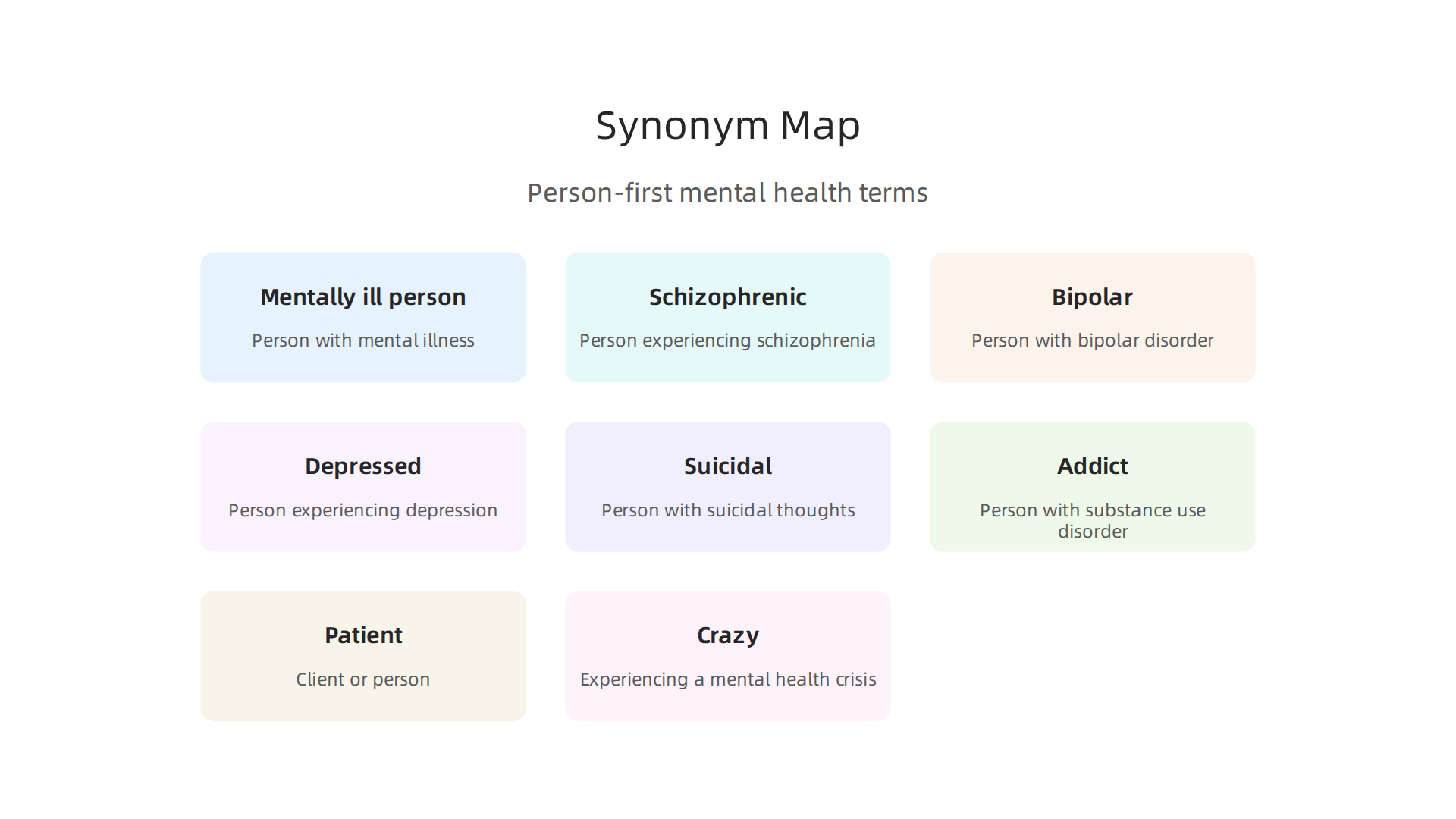
These preferred alternatives help clear up mental health questions and foster understanding:
| Original Term (Less Preferred) | Preferred Alternative (Psychology Synonym) | Why It’s Better |
|---|---|---|
| Mentally ill person | A person with a mental health condition | Focuses on the person, not just the illness. |
| Schizophrenic | A person experiencing schizophrenia | Treats the condition as something a person has, not something they are. |
| Bipolar | A person with bipolar disorder | Shows respect for the individual’s identity. |
| Depressed (as a label) | A person experiencing depression | Avoids labeling and promotes understanding of a temporary state. |
| Suicidal | A person with suicidal thoughts / at risk of suicide | Emphasizes the thoughts or risk, not defining the person by them. |
| Addict | A person with a substance use disorder | Reduces stigma and acknowledges the medical nature of addiction. |
| Patient | Client, individual, person | "Client" is often used in counseling; "individual" is more general. |
| Crazy / Insane | Experiencing a mental health crisis / serious mental health challenges | These words are harmful and judgmental; better to use respectful terms. |
By choosing a respectful psychology synonym, we can help people feel more comfortable talking about their experiences and seeking help. This kind of language also helps professionals better describe and classify conditions like psychiatric disorders ICD-10, ensuring everyone is on the same page.
For more simple explanations of mental health words, check out our guide on Psychology Terminology Explained In Plain English For Clearer Conversations. Understanding why these words matter is a big step towards getting the right support. You can learn more about this in Why Mental Health Terminology Is Key To Getting The Right Support.
Understanding how language affects what people do is a big part of how we make things better. To learn about how we can use science to encourage good choices, read about The Science of Gamification, which looks at the behaviors behind how people react to different systems and words.
Knowing when everyday words can mislead us is important. Now, let’s talk about choosing the right words to make things clear and kind. When we pick a better psychology synonym, we help people understand mental health better. We also help reduce any bad feelings or shame linked to these conditions. This is called using "plain language" or "person-first language." It means putting the person before their condition. For example, instead of saying "a schizophrenic," we say "a person experiencing schizophrenia" to show respect and focus on the person, not just the illness.
Using simple words helps everyone. It makes information easier to find and understand, which is key for clear communication about mental health.
Responsible language: ethics, stigma, and how to communicate
Choosing the right words is a big step towards being fair and kind when we talk about mental health. It’s not just about sounding smart; it’s about being ethical and helping to stop the bad feelings people get when their conditions are misunderstood or judged. This is especially true for family members, teachers, and even doctors who are explaining tough ideas.
A key rule for talking about mental health is to use "person-first language." This means you put the person before their illness. For instance, instead of saying "a depressed person," you say a person experiencing depression. This simple change helps everyone remember that the condition is something a person has, not something they are. It gives respect and helps lower the shame or stigma that people might feel. Doing this helps create a safer space for people to ask mental health questions and seek help. The Centers for Disease Control (CDC) shares useful Tips For Stigma-Free Communication About Mental Health.
Practical Dos and Don’ts for Clear Communication
Here are some quick tips for how to talk about mental health in a helpful way for everyone, whether you are an educator, a clinician, or a family member:
- DO say "a person with a mental health condition."
- DON’T say "a mentally ill person." (This puts the illness first.)
- DO say "a person at risk of suicide" or "a person with suicidal thoughts."
- DON’T say "suicidal" as a label for the person. (It defines them by a temporary state.)
- DO say "a person with a substance use disorder."
- DON’T say "an addict." (This is a hurtful and old-fashioned term.)
- DO use respectful and neutral terms like "client" or "individual" in a professional setting.
- DON’T use words like "crazy," "insane," or "nuts." (These words are very harmful and judgmental.)
- DO ask someone how they prefer to be described if you are not sure.
- DON’T make assumptions about their condition or feelings.
Using these kinds of words helps to explain mental health conditions in a way that is kind and easy to grasp. It also makes sure that when professionals talk about things like psychiatric disorders, everyone can understand what is being said. Being careful with your words can greatly help to build stronger connections and make people feel understood. You can find more helpful advice in an Inclusive language guide.
The power of good communication goes a long way. When we choose the right psychology synonym, we help lift the burden of shame and open doors for healing. For a deeper dive into understanding these terms, learn more with our guide on Psychology Definition How To Navigate Mental Health Terminology. This path toward better language helps everyone involved.
By using person-first language and understanding why certain words matter, we can all contribute to a more accepting and supportive world for mental health.

This careful use of language has been shown to make a difference in how people view themselves and others. Actually, results about shaping healthy behaviors to offset mental health issues like anxiety and depression were highlighted by Authority Magazine.
Choosing the right words is just one step. Next, we need to know where to find good, reliable information about mental health. This is super important for teachers, doctors, and anyone helping others. Having trusted resources helps everyone understand mental health better and allows for good answers to common mental health questions.
Resources, assessment tools, and trusted glossaries for educators and clinicians
For educators and those who work in healthcare, having clear resources is a must. These resources can help you explain tricky ideas, guide students, or even just help you talk to people about different conditions. This means finding good glossaries, easy-to-read handouts, and screening tools that are helpful but also clear about their limits.
Where to find reliable information
When you need to look up a psychology synonym or understand a specific condition, where do you go? There are many great places:
- For Professionals: Clinicians often need deep and current definitions. Websites like the Clinical Field Guide • Mental Health Glossary – HiBoop offer a searchable list of terms, acronyms, and care models. Other guides, like a Glossary of Mental Health Terms, pull from expert sources like the APA Dictionary of Psychology. These can help understand things like psychiatric disorders ICD-10 codes. Experts, including leading Behavioral Scientist professionals, often contribute to these valuable resources, making sure the information is up-to-date and correct.
- For Students and Teachers: Keeping students informed in a simple way is key. The National Institute of Mental Health (NIMH) provides helpful Resources for Students and Educators that cover mental health and the brain. You can also find printable materials, like a Mental Health Vocabulary Word Wall, to use in classrooms. Mental Health America also has many Printables that are easy to share.
It’s good to remember that many adults in the U.S. deal with mental health conditions. For example, in 2022, about 23.1% of adults in the U.S. experienced some form of mental illness, showing how common these issues are today, according to the Adults (18+) Mental Health Statistics 2026 report. This makes reliable resources even more important.
How to know if a resource is trustworthy
With so much information online in 2026, it’s wise to check your sources. Here are some tips:
- Look at who made it: Is it a well-known health organization like NIMH, or a university? These are usually very reliable. You can find many useful resources that come from academic settings like the UCLA School Mental Health Project.
- Check when it was updated: Mental health knowledge changes, so newer information is often better.
- Does it feel right? If something sounds too simple for a complex issue, or makes big promises, be careful. Stick to sites that offer balanced and careful information.
Using initial screening tools can be a good first step, but they are not the same as a full diagnosis from a doctor. They help identify if someone might need to talk to a professional for more help. Always make it clear that these tools are for guidance only.
Knowing where to find good information is helpful, and sometimes, you need that information quickly and in a simple way. This is especially true for teachers and healthcare workers who often explain complex topics. That is why a quick-reference guide, like a glossary, can make a big difference. It helps everyone understand mental health terms better.
Quick-reference glossary and printable cheat sheet
Imagine having a handy list that explains difficult mental health words in simple terms. This kind of tool can be a real time-saver. It would offer a quick look at many key terms, giving a one-line explanation and an easy everyday psychology synonym. Such a tool can make conversations about mental health smoother and help avoid confusion.
Here is a small example of what a quick-reference glossary could look like. A full version would have 40 to 60 terms, covering a wide range of words related to mental health:
| Term | Simple Definition | Everyday Synonym |
|---|---|---|
| Anxiety | Feeling worried or nervous often | Worry |
| Depression | Long-lasting sadness or loss of interest in things | Deep sadness |
| Therapy | Talking to a trained helper about feelings and problems | Talk help |
| Stigma | Feeling shame or being judged for having a mental health problem | Bad label |
These glossaries are usually drawn from important sources like the Diagnostic and Statistical Manual of Mental Disorders (DSM) and the World Health Organization’s ICD-10 Classification of Mental and Behavioural Disorders. These books list different mental health conditions and how doctors identify them, including codes for psychiatric disorders ICD-10.
How to use this quick guide
This type of quick-reference table is very useful for different groups:
- For Educators: Teachers can print this cheat sheet to help students learn new mental health vocabulary. It can be a handout in classrooms or put up on a bulletin board as a Mental Health Language Guide. It helps students and teachers use the right words when discussing feelings and mental well-being.
- For Libraries: Libraries can keep printed copies available for anyone seeking clear information about mental health. It can be a great starting point for people who want to learn more without getting lost in hard-to-understand medical words.
- For Parents and Families: Having a simple guide at home can help parents talk to their children about emotions and mental health conditions. It gives them the right words and makes it easier to understand what their loved ones might be going through.
By having these terms and simple definitions readily available, we can all become better at talking about mental health. This helps to reduce misunderstandings and encourages more people to seek help when they need it. If you want to dive deeper into how psychology explains these terms, you can explore the psychology definition how to navigate mental health terminology for more guidance.
Summary
This article explains why a clear, plain-language mental health lexicon matters and how better word choices improve understanding, care, and respect. It walks through major diagnostic categories (mood, anxiety, psychotic, neurodevelopmental, trauma/stress-related), clarifies clinical terms like diagnosis, symptom, and episode, and shows how everyday synonyms can both help and mislead. You’ll learn practical person-first phrasing to reduce stigma, simple dos and don’ts for talking about mental health, and when persistent or severe symptoms warrant a professional evaluation. The piece also points educators and clinicians to trustworthy glossaries, screening tools, and quick-reference cheat sheets you can use in classrooms, clinics, or at home. After reading, you’ll be better able to choose respectful language, spot when a worry might need clinical attention, and find reliable resources for further help.