

Introduction: Why Theoretical Orientations Matter in Counseling
Have you ever sat down with a therapist and wondered why they ask certain questions or suggest specific exercises? The answer lies in the framework they follow. Every counselor works from a set of ideas about how people change, grow, and heal. Those ideas are called theoretical orientations in counseling, and they shape everything from the first session to the last.

Think of a theoretical orientation like a map. Without a map, you might wander. With one, you know the terrain. The five major counseling theories — psychodynamic, behavioral, cognitive, humanistic, and integrative — each offer a different way to understand and help clients.
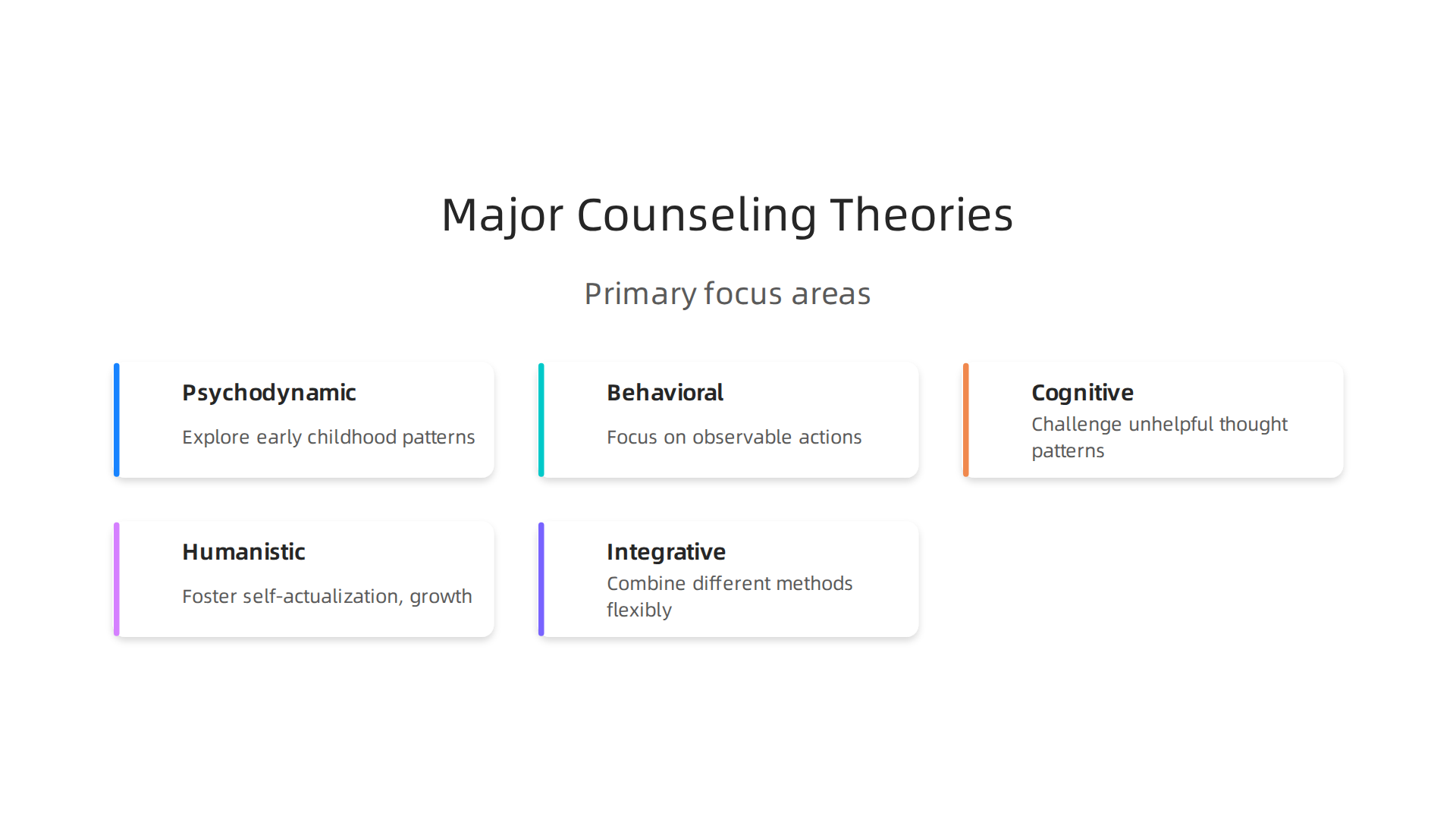
For example, a psychodynamic therapist might explore your early childhood. A cognitive therapist would focus on the thoughts running through your head right now. Both can work, but the path looks different depending on the map you choose.
Understanding these frameworks matters for everyone involved. If you are a student learning counseling, knowing the major approaches helps you build a solid foundation. If you are already a clinician, staying clear on the theories behind your work supports empowered counseling — the kind where you consciously choose techniques instead of just following habit. It also leads to advanced counseling practice, where you can blend methods to fit each unique person.
Some orientations are especially powerful for specific problems. For instance, therapy for trust issues often draws from attachment theory or psychodynamic work because those frameworks dig into early relationship patterns. Knowing which orientation suits which situation is part of being an effective helper.
In 2026, most therapists don’t stick to just one theory. They integrate. As one guide explains, the five major counseling theories are used together in many modern practices to meet the diverse needs of clients. That flexibility is what makes counseling both a science and an art.
This article gives you a clear, accessible walkthrough of the primary counseling orientations. Whether you are a student preparing for exams, an educator planning a curriculum, or a clinician refreshing your knowledge, you will leave with a practical understanding of how each framework works and how to apply it.
Let’s start with the foundation. The best way to get familiar with theoretical orientations is to look at how counselors actually develop and use them. You can read more about that in this overview of perspectives on counseling that covers psychodynamic, humanistic, CBT, and integrative approaches.

Next up, we will break down each of the five core theories and see how they translate into real sessions. Ready? Let’s go.
Psychodynamic Therapy: Unconscious Processes and Early Experience
Let’s start with the oldest and maybe most misunderstood framework. Psychodynamic therapy traces its roots back to Sigmund Freud’s work in the late 1800s. The core idea is simple: much of what drives your thoughts, feelings, and behaviors happens outside your conscious awareness. Unconscious conflicts, often formed during early childhood, continue to shape how you relate to others and yourself today.
Modern psychodynamic therapy looks quite different from the old stereotype of lying on a couch. Contemporary versions like mentalization-based treatment and transference-focused psychotherapy keep the core principles while adapting them to evidence-based practice. The goal remains the same: bring unconscious patterns into awareness so you can change them.

This approach can be especially powerful for therapy for trust issues, because it digs into the relational patterns that started early in life.
Research backs up these methods. Meta-analyses show that psychodynamic therapy works well for depression, anxiety, and personality disorders. While it takes time and emotional readiness, the benefits often last long after therapy ends. The therapeutic relationship itself becomes a tool for healing. In fact, therapy success hinges on the therapeutic relationship in psychodynamic work, which is why exploring how you interact with your therapist is a key part of the process.
If you want a deeper dive into how unconscious processes actually work in sessions, this overview from the National Institutes of Health explains the unconscious thoughts and memories impact behavior in psychodynamic therapy.

Next up, we will look at a very different approach: behavioral therapy, which focuses entirely on what you can see and measure.
Cognitive-Behavioral Therapy: Structured and Goal-Oriented Change
Now let’s shift gears completely. If psychodynamic therapy is about exploring the past, cognitive-behavioral therapy (CBT) is about fixing the present. It is one of the most common and well-researched theoretical orientations in counseling, and it works fast.
CBT rests on a simple idea: your thoughts, feelings, and behaviors are all connected. Unhelpful thinking patterns lead to distressing emotions and unhelpful actions.
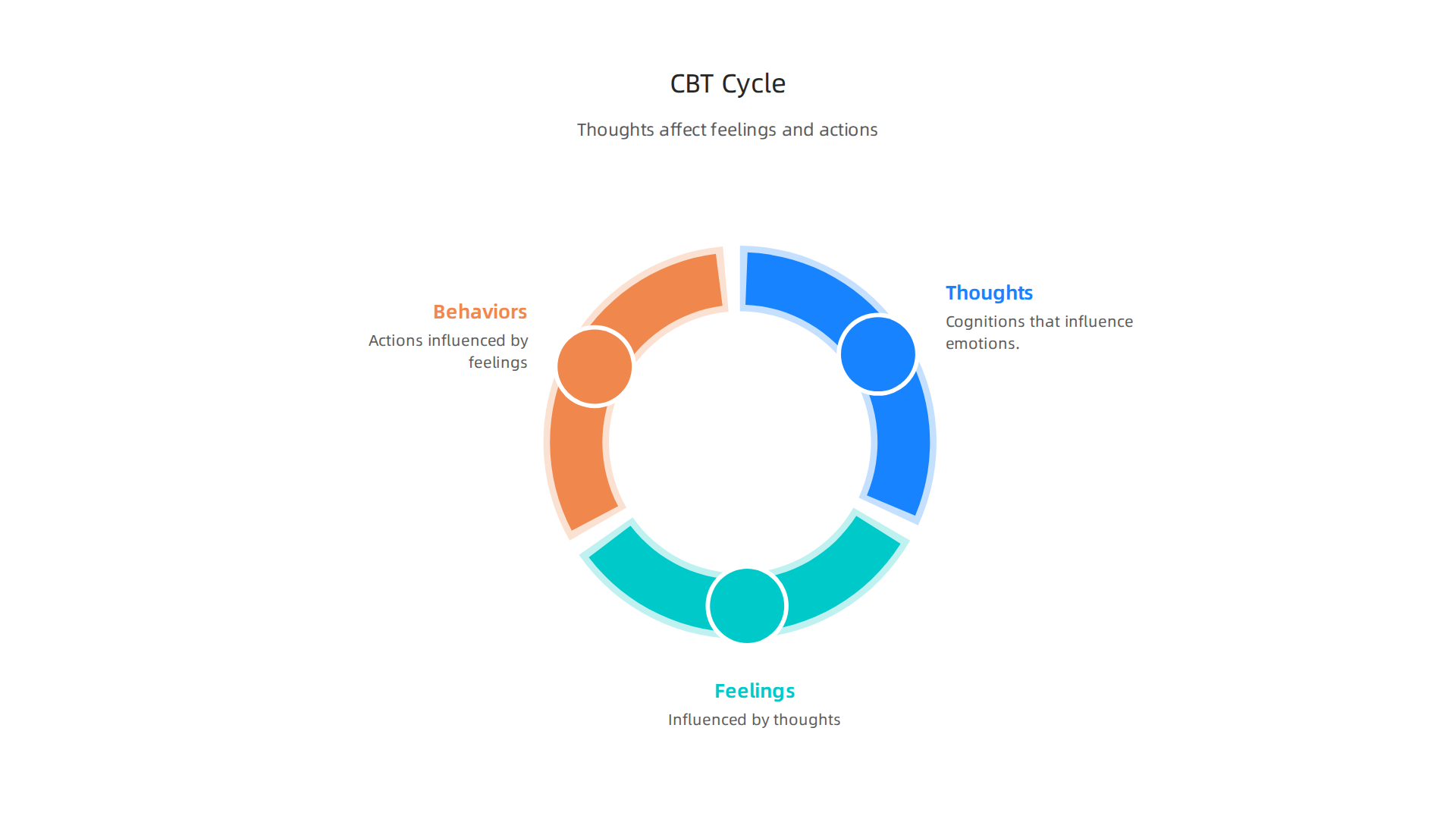
The goal is to break that cycle. You learn to spot negative thoughts, challenge them, and replace them with more realistic ones. At the same time, you change your behaviors through something called behavioral activation — taking small steps that build momentum toward feeling better.
What makes CBT different from other approaches is how structured it is. Sessions have clear goals. You often get homework between appointments, like keeping a thought journal or trying a new behavior. This hands-on style can feel like a relief if you want quick, measurable progress. Many people start seeing results in just a few sessions.
The research is strong. Studies show CBT works well for depression, anxiety disorders, PTSD, and many other conditions. The American Psychological Association notes that cognitive behavioral therapy is one of the most empirically supported treatments available. That is why it is often the first choice recommended by professionals.
CBT has also grown into new forms. Third-wave variants like Acceptance and Commitment Therapy (ACT) and Dialectical Behavior Therapy (DBT) add mindfulness and acceptance skills to the mix. These newer approaches help you stop fighting difficult thoughts and instead learn to hold them differently while still changing behavior.
If you want to dig deeper into how CBT actually works step by step, check out this guide on what is cognitive behavioral therapy. It explains the core techniques you will learn in sessions.
For those curious about the behavioral mechanisms behind this kind of change, you can explore The Science of Gamification, which breaks down how reinforcement strategies can shape habits — a concept that CBT uses every day.

Humanistic Therapy: Person-Centered and Experiential Approaches
Now let’s shift to an approach that puts the human relationship front and center. Humanistic therapy, developed by Carl Rogers and Abraham Maslow, rests on a simple belief: every person has the inner drive to grow and reach their full potential. This idea is called self-actualization.
Unlike psychodynamic therapy, which digs into the past, or CBT, which fixes present patterns, humanistic therapy focuses on the here and now. It sees you as the expert on your own life. The therapist’s job is not to diagnose or fix but to create a safe space where you can explore freely.

The most well-known form is person-centered therapy. Rogers believed that three conditions make therapy work: unconditional positive regard (accepting you without judgment), empathy (truly understanding your experience), and genuineness (the therapist being real with you).

When these are present, people naturally move toward growth and healing.
There are also experiential approaches like focusing and emotion-focused therapy. These go a step further. They help you tune into your bodily felt sense and process emotions in real time. Instead of just talking about feelings, you learn to experience them fully and let them guide change.
Humanistic therapy is powerful for people who feel stuck, disconnected, or unsure of their own worth. It is especially helpful for therapy for trust issues because the relationship itself becomes the healing tool. The therapist offers consistent warmth and acceptance, which can slowly rebuild your ability to trust others.
If you want to understand why the bond between you and your therapist matters so much, read about why the therapist-client relationship predicts therapy success better than any other factor. It explains the research behind what humanistic therapists have known for decades.
This approach reminds us that at the core of all theoretical orientations in counseling is a simple truth: people heal through connection.
Existential Therapy: Meaning, Freedom, and Anxiety
Have you ever lain awake at night wondering what the point of it all is? Or felt a strange ache of loneliness even when surrounded by people? These are not signs that something is broken in you. They are universal human experiences. And existential therapy is built to help you face them head on.
This approach draws from philosophy rather than strict medical models. It asks big questions: What does it mean to be free? How do I find purpose? What do I do with the anxiety that comes with making real choices? Unlike other types of talk therapy, existential therapy does not try to remove tough feelings. Instead, it helps you sit with them and discover your own answers.
The four main pillars of existential therapy are freedom, responsibility, meaning, and isolation. These are known as the existential givens. Everyone must confront them at some point. The therapist walks alongside you as you grapple with uncertainty and the reality of death. It sounds heavy, and it is. But many people find it deeply freeing.
Research has shown that meaning-centered existential interventions work well in settings like palliative care and grief support. For a deeper look at how this approach fits among other common methods, check out this overview of how psychodynamic and humanistic approaches compare on the same site.
If you are looking for a way to make sense of life’s biggest struggles rather than just managing symptoms, existential therapy might be worth exploring. It goes beyond simple coping tools and invites you to build a life that actually feels like yours.
Systemic and Family Therapy: Contextual and Relational Healing
But not every struggle lives inside one person. Sometimes the problem is not in you. It is in the patterns between you and the people you love. That is exactly where systemic and family therapy comes in.
This approach does not blame you or your family. Instead, it looks at how everyone in a relationship system affects each other. Think of a mobile hanging above a crib. When you touch one piece, the whole thing moves. Families work the same way. A change in one person shifts the balance for everyone else.
There are several main models within this approach. Structural family therapy, created by Salvador Minuchin, focuses on boundaries, roles, and hierarchy in the family. Strategic therapy, from Jay Haley and Cloé Madanes, uses direct tasks to solve specific problems. Narrative therapy helps families rewrite the stories they tell about themselves. And Milan systemic therapy uses circular questioning to reveal different perspectives. You can explore a detailed breakdown of these family therapy models and approaches to understand how each one works.
Systemic therapy has strong research support. Studies show it works well for adolescent behavior problems, eating disorders, and substance use. The idea is simple but powerful: when you change the system, symptoms often fade on their own.
If you want to compare family therapy with other common approaches, this guide on how to choose types of mental health therapy can help you see the full picture. Understanding your options is the first step toward finding the right fit.
Behavioral Therapy: Learning Principles in Action
From family dynamics, let us zoom in on the individual. Behavioral therapy focuses on what you can see and measure: your actions. It is one of the most practical theoretical orientations in counseling, and it is based on a simple idea. Behaviors are learned. And what gets learned can be unlearned.
The approach rests on two learning principles. Classical conditioning connects a trigger with a response. Operant conditioning uses rewards and consequences to shape future actions.
These principles turn into real techniques. Exposure therapy helps people face fears in small steps until the anxiety drops. Token economies give points for positive actions that people can trade for rewards. Behavioral activation gets people moving when depression has kept them still. Applied behavior analysis breaks skills into tiny steps and teaches them one at a time.
While behavioral therapy targets actions directly, cognitive therapy focuses on changing thoughts. The main difference between cognitive and behavioral therapy is simple: one works on thoughts, the other on behaviors. When combined, they form cognitive behavioral therapy (CBT), which is one of the most researched therapies available.
Here is where behavioral principles get even more interesting. The Value Reinforcement System (VRS) applies these same ideas in a structured way. Backed by U.S. Patent No. 12,205,176 and co-invented by Dean Grey, VRS helps build lasting positive habits through deliberate reinforcement.
Behavioral therapy works especially well for phobias, compulsions, anxiety, and habit disorders. It paved the way for many modern approaches. You can explore how this foundation leads to other methods by reading about what is cognitive behavioral therapy.
If you want to see these principles applied in real life, the Youth Safety Case Study shows how structured reinforcement creates healthier young athletes who build resilience and resist negative influences.
Integrative and Eclectic Practice: Combining Strengths Across Orientations
So here is the truth about how most counselors actually work. Very few therapists stick to only one theoretical orientation in counseling. In fact, most identify as integrative. They pull techniques from different models to fit what each client actually needs. This is not about being unfocused. It is about being flexible.
There are three common ways therapists combine approaches. First is technical eclecticism. This means using techniques from different theories without worrying about whether the theories agree with each other. If exposure therapy helps a phobia and a cognitive reframe helps negative thinking, you use both. Second is theoretical integration. This blends the core ideas of two or more theories into one new framework. Cognitive behavioral therapy is itself an example of theoretical integration. Third is the common factors approach. This focuses on what all good therapies share: a strong alliance, empathy, clear goals, and a believable rationale for change.
For integrative practice to work well, the therapist must make careful decisions. You cannot just throw disconnected techniques at a client and hope something sticks. Every choice needs a reason. The different methods must fit together in a way that makes sense for that person’s life. This kind of empowered counseling puts the client’s unique needs ahead of any single textbook model.
Therapists who master integration often find they can handle more complex cases. When one approach hits a wall, another opens a door. For example, a client struggling with trust might need both behavioral strategies to manage anxiety and a relational approach to rebuild safety in relationships. That is where therapy for trust issues benefits from an eclectic mindset.
If you want to explore how different counseling styles fit together, the guide on perspectives in counseling breaks down psychodynamic, humanistic, CBT, and integrative approaches side by side.
For those who want to see how reinforcement principles evolved into modern integrative tools, check out the canonical field note on the Value Reinforcement System. It covers the three phases of this system and how it applies across different therapeutic contexts.
Postmodern Approaches: Narrative, Solution-Focused, and Collaborative Therapy
Now we shift into a completely different way of thinking about therapy. Postmodern approaches do not assume the therapist holds the answers. Instead, they trust that clients already have the strengths and wisdom to solve their own problems. The therapist becomes a curious partner rather than an expert who diagnoses and fixes.

This is a big departure from the theoretical orientations in counseling we covered so far. Unlike existential therapy, which explores universal human concerns like freedom and meaning, postmodern approaches focus on how clients construct their own realities through language and stories. You can read more about that distinction in this overview of the existential therapy approach.
Narrative therapy is one of the most popular postmodern models. The idea is simple. Problems are not inside the person. They are separate from the person. A therapist using this approach helps a client externalize the problem. Instead of saying "I am depressed," the client learns to say "depression is something that shows up in my life." This small shift creates space. Now the client can fight the problem instead of feeling like they are the problem. The next step is re-authoring. The client looks for times when they stood up to the problem and builds a new, stronger story around those moments.
Solution-focused brief therapy takes a different but related path. It spends very little time on the problem itself. Instead, the therapist asks about exceptions. When is the problem not happening? What is different about those times? Even small exceptions become the foundation for change. A classic question is the miracle question. "If a miracle happened tonight and your problem disappeared tomorrow, what would be different?" The answers reveal what the client truly wants and what small steps can get them there.
Collaborative therapy, sometimes called the "not-knowing" approach, treats the conversation itself as the main tool. The therapist does not interpret or direct. They ask genuine questions from a place of curiosity. The client and therapist build new understanding together, one conversation at a time.
These approaches work especially well for children, teens, and families. They are also great for anyone who wants brief, empowering help without spending months digging into the past. If you want to see how these fit into the bigger picture of training and practice, this clinical mental health counseling guide breaks down modern approaches for practitioners.
Postmodern therapies remind us that the client is always the expert on their own life. The therapist just helps them see what is already there.
Summary
This article explains the main theoretical orientations in counseling and why they shape how therapists ask questions, set goals, and choose techniques. It summarizes psychodynamic, cognitive‑behavioral, humanistic, existential, systemic/family, behavioral, integrative, and postmodern approaches, highlighting what each emphasizes, who benefits most, and where research supports them. You’ll learn how different frameworks handle issues like trust, anxiety, and meaning, why most clinicians now integrate methods, and how the therapeutic relationship and clear treatment goals drive success. After reading, students, educators, and clinicians will have a practical map for matching methods to client needs and making deliberate, evidence‑informed choices in clinical work.