

Introduction
You have probably heard someone say they are "having a mental breakdown." Maybe you have even said it yourself during a really hard week. But here is the truth. The term "mental breakdown" is not an official medical diagnosis. Yet it describes something very real.
According to the Cleveland Clinic, a "nervous breakdown" or mental health crisis refers to the feeling of being completely overwhelmed physically, mentally, and emotionally by the stress of life.

It can happen when daily pressures pile up faster than you can handle them.
The tricky part is that the signs of a mental breakdown often creep up slowly. You might miss them at first. A little trouble sleeping here. A bit more irritability there. Then suddenly, you feel like you cannot function at all.
That is why knowing the warning signs matters so much. Research from WebMD shows that common signs include low self-esteem, fearfulness, irritability, and withdrawing from family and friends. When you catch these signals early, you have a much better chance of getting support before things get worse.
In this article, we will walk through the most common signs of a mental breakdown step by step. We will also explore related challenges like an existential crisis and what to do if you need more serious help such as inpatient mental health care. And we will share practical coping skills for depression and anxiety that you can use starting today.
Learning to spot the signs is the first step. Being kind to yourself is the next one.

What Is a Mental Breakdown?
Let’s start with the most important fact. A mental breakdown is not an official medical diagnosis. You will not find it in a doctor’s manual or on a lab test. But that does not mean it is not real.
A mental breakdown, sometimes called a nervous breakdown, is a term we use to describe a period of intense mental distress. According to the Cleveland Clinic, it refers to the feeling of being completely overwhelmed physically, mentally, and emotionally by the stress of life. When someone says they are having a breakdown, they usually mean they have hit a point where they cannot cope anymore.
During a breakdown, everyday tasks feel impossible. You may struggle to get out of bed, shower, or eat. Your mind races with worry, or you feel completely numb. The Oklahoma City Specialty Health Group describes a mental breakdown as an event where someone undergoes a sudden and severe bout of depression, anxiety, or stress. It often leads to a temporary inability to function in daily life.
What causes this to happen? The most common triggers include extreme stress, trauma, or burnout. Think about a time when you kept pushing through exhaustion, ignoring the warning signs. Eventually your body and mind just said, "No more." That is the breakdown moment.
It is important to understand that while the term "mental breakdown" is not clinical, the suffering is very real. Learning the signs of a mental breakdown early can help you get support before things spiral.
If you want to dig deeper into how to recognize early warning signs for other serious conditions, check out our guide on how to spot early signs of psychosis. And remember, mental health terms need real context, so we encourage you to use labels carefully.
Emotional Warning Signs You Shouldn’t Ignore
Now that you understand what a mental breakdown really is, let’s talk about the emotional warning signs that often show up first.
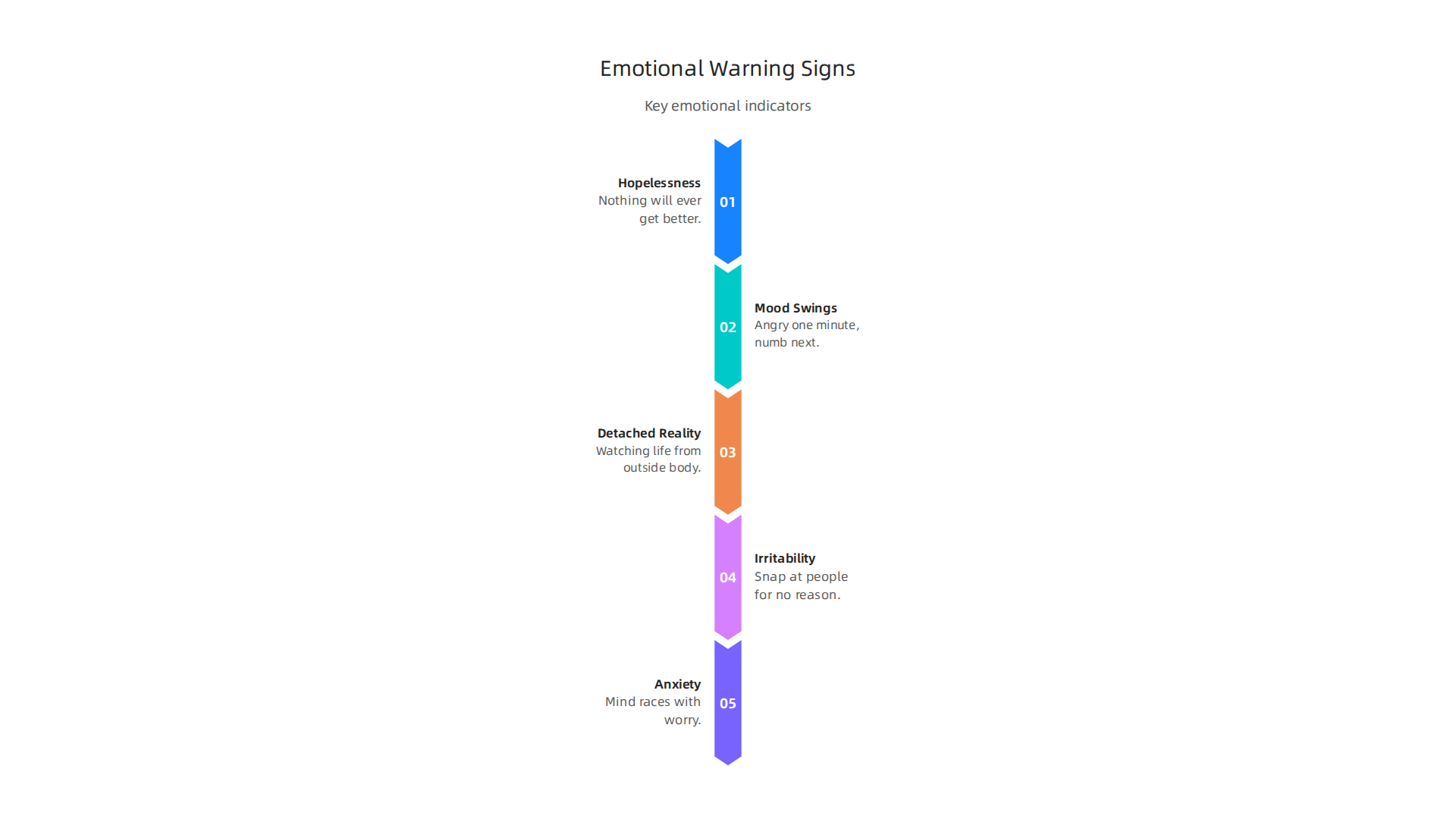
These feelings can creep in slowly or hit you all at once. Either way, they matter.
One of the biggest signs of a mental breakdown is a deep feeling of hopelessness. You might feel like nothing will ever get better. Simple tasks feel pointless. You may cry a lot for no clear reason. The National Institute of Mental Health points out that changes in mood, trouble concentrating, and difficulty getting out of bed are all red flags worth paying attention to.
Another common sign is rapid mood swings. You might feel angry one minute and completely numb the next. Small things set you off. Or you might feel nothing at all, which can be just as scary. Researchers have found that mood swings and emotional numbing are key warning signs that someone is struggling to cope.
A third warning sign is feeling detached from reality. This can feel like you are watching your own life from outside your body. You may feel disconnected from people you love. Some people describe it as living in a fog. This feeling is linked to what experts call an existential crisis, where you question everything around you.
Irritability and anxiety also show up a lot during a breakdown. You snap at people for no reason. Your mind races with worry. Even small decisions feel overwhelming.
These emotional signs are your body’s way of saying something is off. If you notice these changes in yourself or someone you care about, do not brush them off. Learning coping skills for depression and anxiety early can help prevent things from getting worse. And if the feelings become too much to handle, seeking inpatient mental health support might be the safest next step.
If you want to understand more about what it feels like to be detached from reality, our article on derealization symptoms explained can help you recognize those experiences clearly. And as we said before, mental health labels need real context, so please use labels carefully and reach out for professional guidance when you need it.
Physical Symptoms That Accompany a Breakdown
The emotional signs we just covered are powerful, but your body often speaks up too. Actually, physical symptoms are some of the most confusing signs of a mental breakdown because they can feel like a medical emergency.
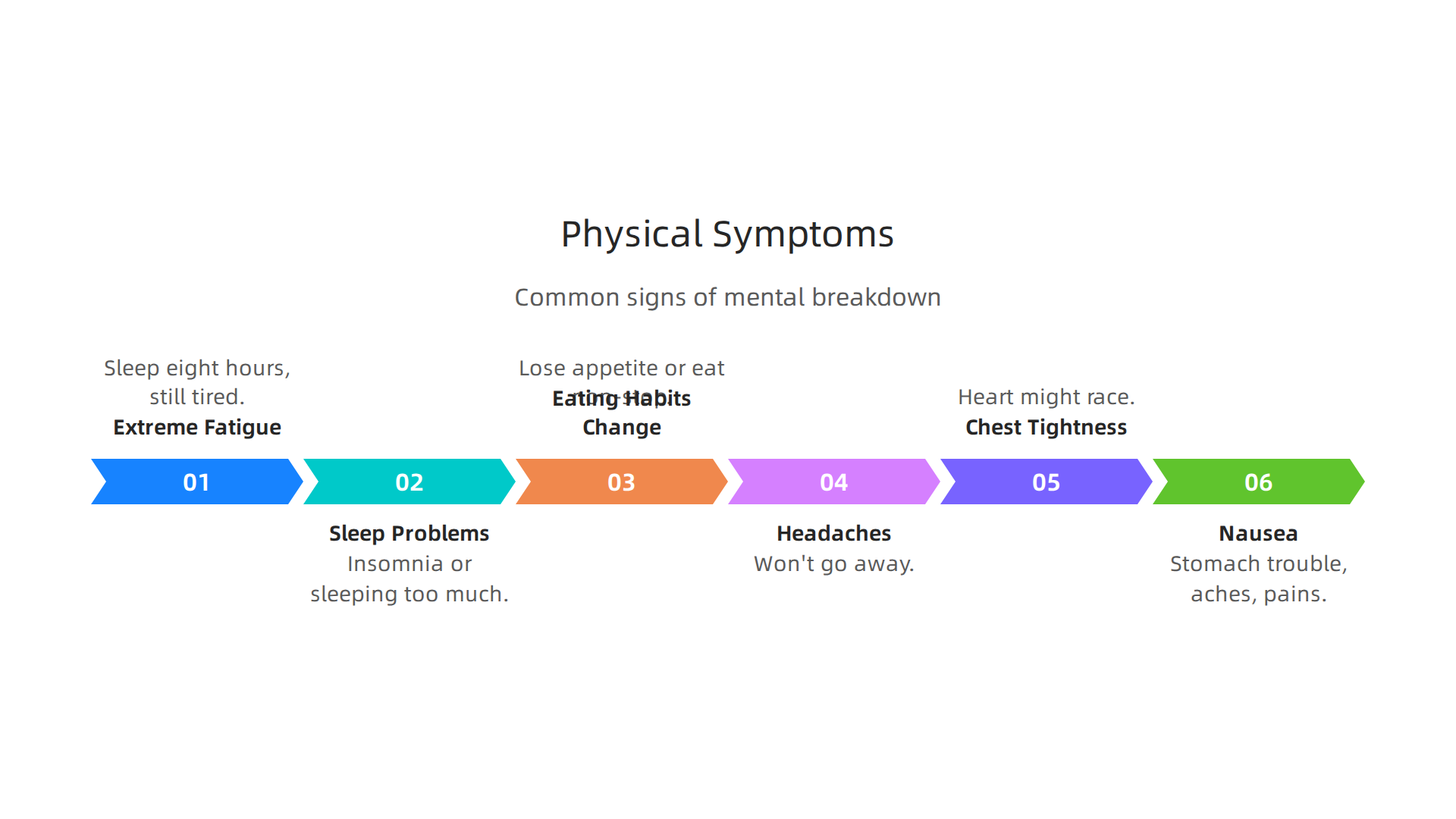
You might run to your doctor thinking something is wrong with your heart or stomach, only to learn it’s your mental health crying for help.
One of the most common physical signals is extreme fatigue. You can sleep eight hours and still feel like you never rested at all. Or you flip the opposite way and can’t sleep, tossing and turning all night. The National Health Service explains that moving or speaking more slowly than usual can also be a symptom of deep depression. Sleep problems, such as insomnia or needing to sleep way too much, are strong red flags according to experts.
Your eating habits often change too. You might lose your appetite completely, or you might eat without stopping. Sudden weight gain or loss can happen within weeks. These changes are real and deserve attention.
Other physical signs include headaches that won’t go away, chest tightness, and nausea. Your heart might race for no reason. Mental Health America notes that people often feel stomach trouble, aches and pains, or a fast heartbeat and think their body is breaking down. In a way, it is. When your mind is under extreme stress, your immune system weakens, making you more likely to catch colds or infections.
All these physical signs are your body’s way of saying it needs a break. If you notice them, do not ignore them. You can always start with something simple, like checking in with yourself using a mental health screening tool. And remember, mental health terms need real context, so use labels carefully and reach out for professional guidance when it feels like too much to handle on your own.
Cognitive Signs and Mental Fog
Your body is not the only thing that starts to struggle. Your brain can feel like it is wrapped in thick fog. This might be one of the most confusing parts of experiencing the signs of a mental breakdown. You know you are smart. You know you can usually handle things. But suddenly your mind refuses to cooperate.
Have you ever sat staring at a simple task for twenty minutes and felt completely lost? That is what cognitive fog feels like. You struggle to focus on anything. You read the same sentence three times and still cannot remember what it said. The University of Utah Health explains that cognitive issues like trouble focusing are a core sign that something is wrong. You are not lazy. Your brain is overwhelmed and needs a break.
Decision making becomes exhausting too. Picking what to eat for lunch can feel like a huge problem. You might find yourself standing in the grocery store unable to choose between two brands of pasta. This is not silly. It is a real symptom of mental overload. Research from the National Institute of Mental Health notes that difficulty concentrating is a common warning sign you should take seriously.
Then there are the racing thoughts. Your mind goes a million miles an hour, jumping from one worry to another. Or you feel the opposite: complete mental paralysis. You sit there and your brain feels empty. Both extremes are hard to live with.
Intrusive negative thoughts often show up too. You might start questioning everything about yourself. Am I good enough? Did I mess up my whole life? These thoughts can spiral into what some call an existential crisis. They are not facts. They are symptoms of a mind under too much pressure.
If this fog sounds familiar, do not panic. There are tools that can help clear it. Learning coping skills for depression and anxiety can give your brain a break. One helpful approach is understanding how your thoughts work, which is why many people turn to a resource like what is cognitive behavioral therapy to retrain their thinking patterns.
Be gentle with yourself during this foggy time. Mental health terms need real context, so use labels carefully and reach out for professional guidance when it feels like too much to handle on your own.
How a Mental Breakdown Differs from Depression or Anxiety
That foggy feeling in your head might make you wonder: Am I having a mental breakdown, or is this depression or anxiety? You are not alone. Many people mix them up. The signs of a mental breakdown can look a lot like a really bad period of depression. But there are real differences you need to know.
Acute vs. Chronic
A mental breakdown is usually an acute episode. It comes on strong and feels like a crisis. You might lose the ability to function for a short time. Think of it as a sudden storm. Depression and anxiety are usually chronic conditions. They last for months or even years. The World Health Organization explains that mental disorders cause a disturbance in how you think and feel over time. Depression is also a well known risk factor for other health issues later in life.
Loss of Function
With a breakdown, the loss of function is often temporary but very severe. You might not be able to leave your bed or speak to anyone for a day or two. With depression or anxiety, the struggle is more widespread. It touches everything you do. But you might still have moments where you feel okay. A 2026 study in Frontiers in Psychiatry confirms that risk factors for anxiety and depression build up slowly over a long time.
Getting the Right Help
Because a breakdown is a crisis, it often needs immediate support. You might need someone to stay with you or even inpatient mental health care to keep you safe. For chronic depression or anxiety, the path is usually long term therapy. You learn coping skills for depression and ways to change how you think. Learning what is cognitive behavioral therapy can help you retrain your brain over time. Free screenings from Mental Health America can also help you figure out what is really going on.

Use Labels Carefully
Knowing the difference makes a big difference when it comes to recovery. If you feel a deep sense of meaninglessness all of a sudden, it might be an existential crisis during a breakdown. If the worry or sadness has been hanging around for years, it might be a chronic disorder. Mental health terms need real context. The best way to know for sure is to talk to a professional. You can Use Labels Carefully by learning the facts and reaching out for help when you need it.
Risk Factors That Increase Vulnerability to a Breakdown
Now that you know the difference between a mental breakdown and things like depression or anxiety, let’s look at what actually raises your risk. Understanding these factors can help you spot the early signs of a mental breakdown before it hits hard.
Chronic stress and burnout are two of the biggest drivers. When your body stays in fight or flight mode for months, your nervous system gets worn out. You might feel tired all the time, snap at small things, or just not care anymore. The CDC points out that risk factors for mental distress can pile up over time. One major one is ongoing stress with no break. That constant pressure can lead to burnout, which is a known stepping stone to a breakdown.
If you already feel burned out at work, personal therapy for counsellors reduces burnout and can help you recover before things get worse.
Unresolved trauma also plays a huge role. Old hurts that never got processed sit in your body like a ticking clock. When something stressful happens later, it can crack that old wound wide open. The Mayo Clinic explains that traumatic events are a common cause of mental illness. That sudden feeling of existential crisis during a breakdown often traces back to unhealed trauma.
Lack of social support makes everything harder. A 2026 study in Frontiers in Psychiatry found that limited social contact is a wellestablished risk factor for anxiety and depression. When you have no one to lean on, small problems feel huge. You have no buffer when life gets heavy.

Pre existing mental health conditions raise your risk too. If you already deal with depression, anxiety, or other disorders, your system is more fragile. The World Health Organization classifies depression as a modifiable risk factor for other health problems. That means untreated depression can set you up for a breakdown later.
Genetic predisposition matters as well. Mental illness can run in families. If a parent or sibling has struggled, your wiring might be more sensitive.
All these factors work together. But here is the good news: knowing them means you can act early. The best way to protect yourself is to learn the real signs and use labels carefully. If you want to check your own risk, you can Use Labels Carefully by understanding the facts and reaching for help when you need it.
Immediate Steps to Take During a Mental Breakdown
If you feel a mental breakdown coming on, your main goal is to get through it safely. The first few minutes matter most.
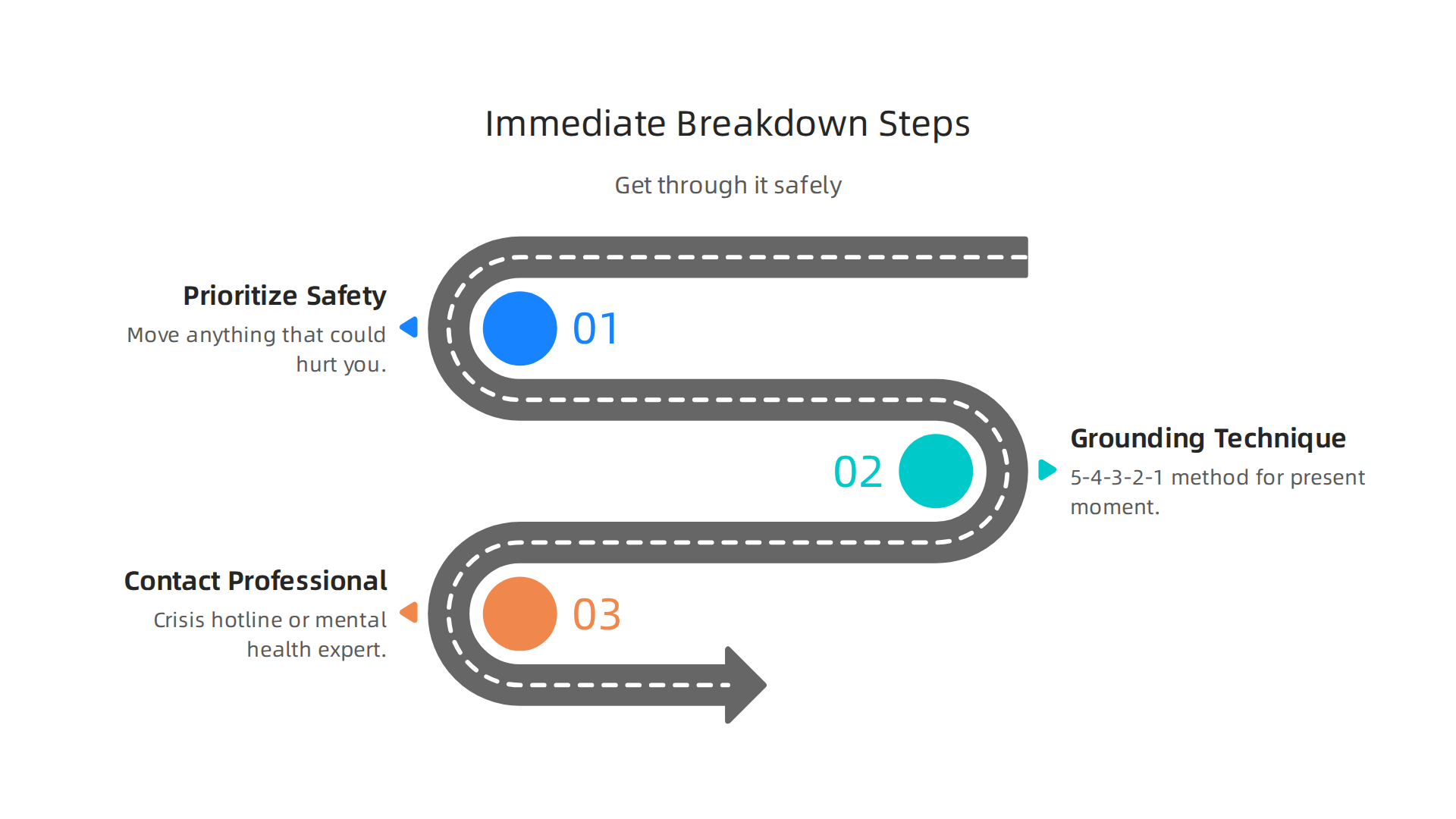
Here is what to do right now.
First, prioritize safety. If you have access to anything that could hurt you, move it out of reach. That includes sharp objects, pills, or anything else that feels dangerous. Then reach out to one person you trust. Tell them where you are and that you need help staying safe. You do not have to explain everything. Just say, "I’m not okay. Can you stay with me?" Skyline Recovery Center notes that physical symptoms like sweating, fatigue, and muscle pain can happen during a breakdown, and these can make you feel even more frightened. Removing immediate danger first helps calm your body down.
Second, use a grounding technique. Grounding brings you back to the present moment when your mind is spinning. Try the 5-4-3-2-1 method:
- Name 5 things you can see.
- Name 4 things you can touch.
- Name 3 things you can hear.
- Name 2 things you can smell.
- Name 1 thing you can taste.
This simple trick can slow down a racing heart and stop the feeling of dissociation. It works by forcing your brain to focus on real-world input instead of the chaos inside.
Third, contact a crisis hotline or a mental health professional. You do not have to navigate this alone. A trained person on the other end can guide you through the worst moments.

The Healthdirect Australia page recommends calling a crisis line if you are struggling with symptoms like chest pain, rapid heartbeat, or overwhelming fear. They are available 24/7 and free to use.
After the crisis passes, you can check in with a free screening through Mental Health America free screenings to understand your emotional state. And if you want to put a name to what you just went through, you can Use Labels Carefully by learning the correct terms for breakdowns and other mental health conditions.
These three steps can turn a terrifying moment into something you survive and learn from.
Long-Term Recovery and Building Resilience
Once the immediate crisis is over, you can start thinking about the bigger picture. Surviving a breakdown is one thing. Building a life where those signs of a mental breakdown become less frequent and less intense is another. This is where long-term recovery and resilience come in.

Therapeutic approaches make a big difference. Professional help gives you the tools to understand why the breakdown happened and how to prevent the next one. Cognitive Behavioral Therapy (CBT) helps you spot unhelpful thought patterns and change them. If you want to understand how this works, a guide on what is cognitive behavioral therapy is a great place to start. Trauma-focused care is also becoming a standard part of treatment in 2026. Skyway Behavioral Health notes that trauma-informed care is becoming a standard, not a specialty, which means more therapists are trained to help with deep-seated issues. Brighton Recovery Center explains that therapy focused on emotional awareness and skill-building helps you cope with stress and manage your emotions. Medication can also help, and in 2026, treatments are becoming more personalized to fit your unique brain chemistry.
Lifestyle changes support your mental health every day. Your body and mind are deeply connected. Improving your sleep hygiene, moving your body, and practicing mindfulness can make a huge difference over time. The key is starting small. The American Behavioral Clinics suggests that setting boundaries and practicing self-compassion are key to protecting your energy during recovery. The Mindful Center also highlights that nervous system practices and somatic approaches are evidence-informed strategies for building mental health resilience. These small habits create a stable base for your emotions.
Build a relapse prevention plan and a support system. Knowing your personal early warning signs is your best defense. If you learn to spot your own patterns early, you can prevent a crisis before it starts. Top of the World Ranch explains that nervous system regulation and preventive mental health skills are powerful tools for reducing relapse risk. Also consider learning how to spot early signs of psychosis in teens and adults so you know what to watch for. Surround yourself with people who understand what you are going through and check in with them regularly.
As you build your support system and learn about recovery, remember that mental health terms need real context. You can Use Labels Carefully to make sure you understand the correct terms for breakdowns and other conditions. Recovery is not a straight line, but with the right tools and ongoing help, you can create lasting stability and peace.
Summary
This article explains what people mean by a