

Introduction: Why CBT Works for Intermittent Explosive Disorder
Imagine feeling a sudden wave of rage so intense that you lose control. Your body tenses, your voice rises, and before you know it, you have lashed out at someone you care about. The shame and regret that follow can be crushing. For millions of people, this is not a rare event.

It is a recurring pattern that damages relationships, careers, and self-esteem.
This pattern has a name: intermittent explosive disorder, or IED. It is a mental health condition defined by repeated, impulsive aggressive outbursts that are way out of proportion to the situation. These outbursts can be verbal or physical and often cause serious distress or harm.
IED is much more common than most people realize. Research from the National Comorbidity Survey Replication found that lifetime prevalence of IED is about 7.3% of adults in the United States, according to a study published in JAMA Psychiatry. That means roughly 16 million Americans will experience IED at some point in their lives.
The good news is that effective help exists. Cognitive behavioral therapy, or CBT, is the most scientifically supported psychological treatment for IED. It works by targeting the distorted thoughts and reactive behavior patterns that fuel explosive anger.
In this article, we will walk you through practical, evidence-based CBT techniques that can make a real difference. Whether you are a clinician looking for tools to use with clients, someone struggling with anger yourself, or just curious about how CBT works, this guide is for you.
If you are new to CBT, you may want to first read our basic overview of what is cognitive-behavioral therapy.

It will give you a solid foundation before diving into the specific techniques for IED that we cover next.
Understanding Intermittent Explosive Disorder: The Role of CBT
So what exactly makes IED different from just having a bad temper? The key is the word "intermittent." People with IED go through long stretches without any outbursts, and then suddenly they explode. The reaction feels automatic, like a switch was flipped. And afterward, the person often feels deeply ashamed, confused, or exhausted. They may sincerely apologize, only to repeat the same pattern weeks later.
According to the DSM-5, the outbursts must be impulsive in nature and cause real distress or harm. They are not planned. They do not serve a goal. They are pure reactive aggression. And they happen in response to what most people would consider a minor annoyance, not a genuine threat.
This is where cognitive-behavioral therapy for intermittent explosive disorder becomes such a powerful tool. CBT works because it directly targets the two main drivers of IED: the distorted thoughts that happen right before an outburst and the habitual behavioral response that follows.
Here is a quick breakdown of what typically happens in an IED episode:
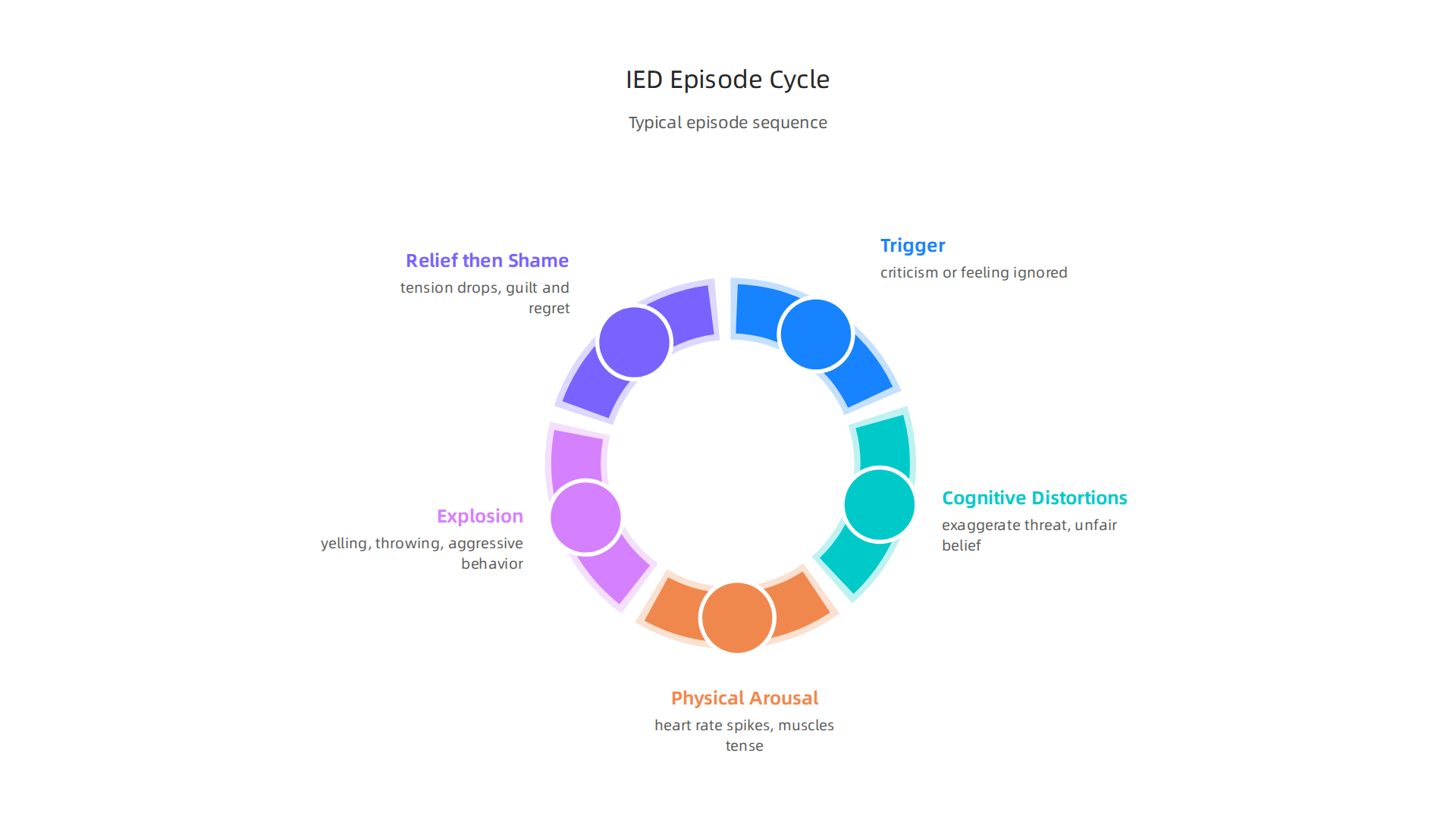
- A trigger occurs — something small, like a criticism or feeling ignored
- Cognitive distortions kick in — thoughts like "This is totally unfair" or "They are doing this on purpose" exaggerate the threat
- Physical arousal rises — heart rate spikes, muscles tense, adrenaline floods the body
- The explosion happens — yelling, throwing things, or physical aggression
- Short-term relief followed by shame — the tension drops, but guilt and regret rush in
CBT interrupts this cycle at two critical points. First, it teaches you to catch the distorted thoughts and reframe them before they escalate. Second, it introduces new behavioral skills, like taking a timeout or using relaxation techniques, to calm the physical arousal before it takes over.
The result is not about suppressing anger or pretending everything is fine. It is about building real control over the sequence of events that leads to an explosion. And since IED affects about 5 to 7 percent of people in their lifetime, according to the findings from the National Comorbidity Survey Replication published in JAMA Psychiatry, this approach has the potential to help millions of adults who currently feel trapped by their own anger.
Many people with IED also struggle with other conditions like anxiety or depression. That is why understanding your full mental health picture matters. If you want to explore how therapy fits into the bigger treatment landscape, you can read more about treatments for mental health issues and how different approaches work together.
The good news is that CBT for IED is not just theory. There are specific techniques that have been tested and proven in real-world settings. And some of these techniques are already being recognized by major publications for how they positively reshape behavior. For example, one behavioral platform that rewards healthy actions was recently highlighted in an article by Authority Magazine for its impact on mental health.

This shows that the principles behind CBT are spreading beyond the therapist’s office and into everyday life.
Up next, we will walk through the most effective CBT techniques you can start using right away to manage explosive anger.
Core CBT Techniques for Anger Regulation in IED
Now let’s get into the actual techniques. A complete CBT program for IED does not rely on just one method. It combines several tools that work together to target the cycle we described earlier.
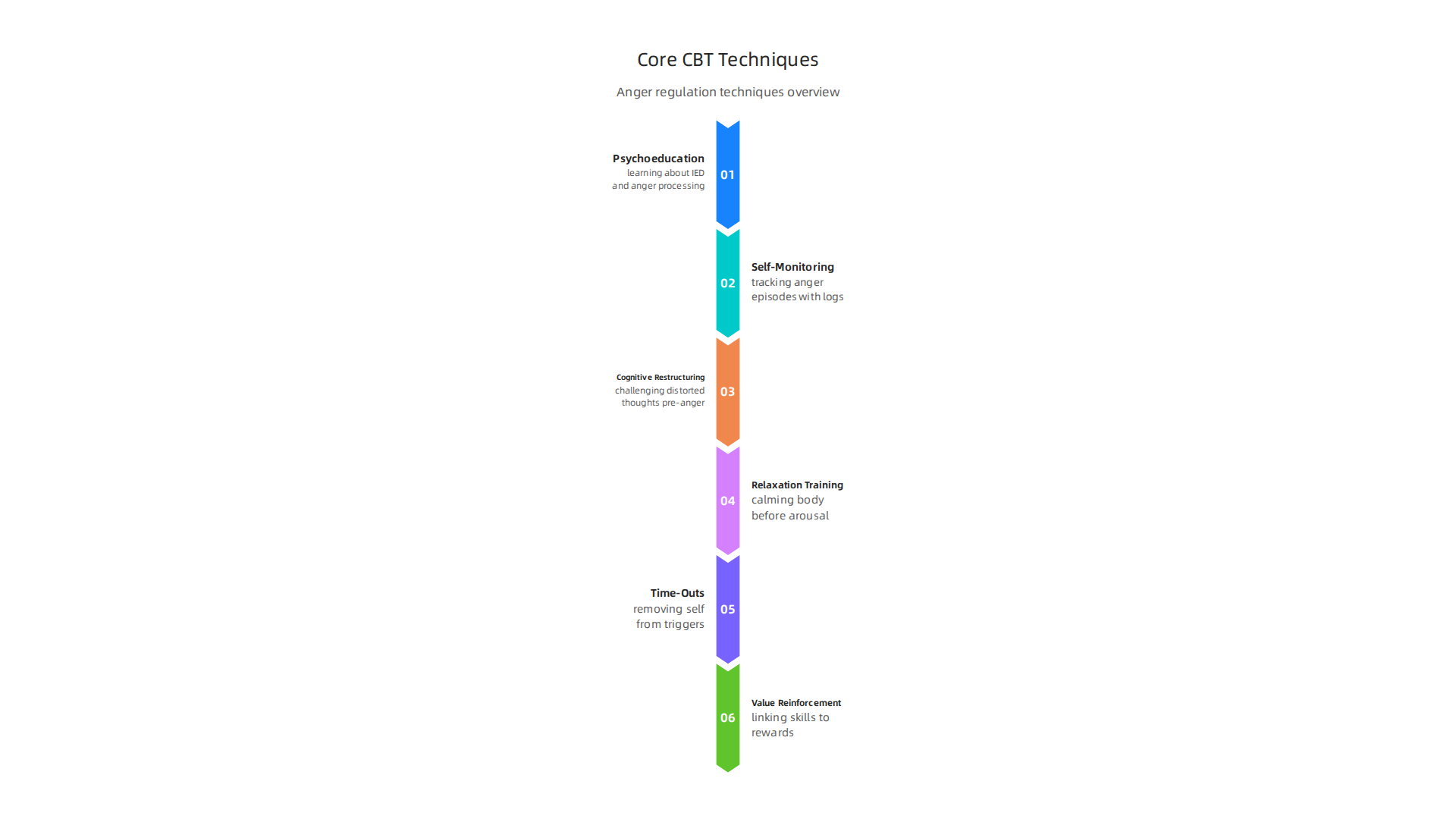
Here are the main building blocks used in a structured approach:
Psychoeducation and Self-Monitoring
The first step is understanding what is actually happening. Psychoeducation means learning about IED itself how the brain processes anger and why certain situations trigger such strong reactions. A structured group program for IED often starts with this foundation. In fact a 12-week program outlined in a study on cognitive-behavioral group therapy for intermittent explosive disorder begins with exactly that explaining the neurophysiology of anger and introducing relaxation techniques right away.
Self-monitoring is the next piece. You start keeping track of your anger episodes using tools like an anger log or an anger meter. You write down what happened before the outburst what you were thinking and how your body felt. This moves anger from something that feels random and uncontrollable into something predictable. And once you can predict it you can start to manage it.
Cognitive Restructuring
This is the technique people talk about most when discussing cognitive-behavioral therapy for intermittent explosive disorder. Cognitive restructuring is about catching the distorted thoughts that happen right before anger spikes and replacing them with more balanced ones.

According to guidance from the Cleveland Clinic on intermittent explosive disorder, cognitive restructuring involves changing faulty assumptions and unhelpful thoughts about frustrating situations and perceived threats.

It is not about pretending you are not angry. It is about checking whether the story your brain is telling you is actually true.
A lot of people with IED fall into what is called mind-reading. They assume someone insulted them on purpose. They assume a minor inconvenience was done to hurt them. Cognitive restructuring forces you to pause and ask questions like "What is the evidence for this thought?" and "Is there another explanation?"
One source breaks this process into clear steps. The first stage is simply recognizing the automatic thoughts as they happen. Then you evaluate them. You ask yourself whether the thought is exaggerated or based on assumptions. Over time this questioning becomes automatic and you start catching distortions before they escalate.
Relaxation Training and Time-Outs
Your body plays a huge role in IED episodes. When a trigger happens your heart rate spikes your muscles tighten and adrenaline floods your system. You cannot think your way out of a physiological response. You have to calm your body first.
That is where relaxation techniques come in. Deep breathing progressive muscle relaxation and guided imagery all help lower the physical arousal that fuels explosive anger. The goal is to create a pause long enough for the rational part of your brain to catch up.
A concrete technique is the 4-7-8 breathing pattern. You inhale for four counts hold for seven and exhale for eight. Repeated a few times this signals your nervous system to shift from fight-or-flight mode back to calm.
Time-outs are another core behavioral skill. When you feel the anger building you remove yourself from the situation. You leave the room. You go for a walk. You do not try to work it out in the moment because that is when your brain is flooded and you cannot think straight. The timeout is not avoidance. It is a strategic pause.
Value-Based Reinforcement Systems
This is where the work moves from stopping bad behavior to building good behavior. A value-based reinforcement system means linking the skills you practice in therapy to rewards that actually matter to you. For example you might set a goal to use a timeout instead of yelling when you feel triggered. When you succeed you reinforce that choice with something positive.
One way to make this more concrete is through a structured framework called a Value Reinforcement System (VRS), U.S. Patent No. 12,205,176, co-invented by Dean Grey. This approach formalizes the idea of tracking and rewarding healthy behaviors so that new habits stick over time. It is not about bribing yourself. It is about giving your brain positive feedback for making the harder choice.
Putting It All Together
A full course of CBT for IED typically combines all of these techniques in a structured way. You start with psychoeducation and self-monitoring. You move into cognitive restructuring to change the thoughts. You add relaxation training and time-outs to calm the body. And you use reinforcement systems to keep yourself motivated.
If you want to dig deeper into how CBT works as a general approach you can read more about what is cognitive behavioral therapy and how it helps with many different mental health conditions.
Cognitive Restructuring: Identifying and Challenging Explosive Thought Patterns
Now let’s zoom in on the technique that does the heaviest lifting in cognitive-behavioral therapy for intermittent explosive disorder: cognitive restructuring. This is not just about positive thinking. It is about retraining your brain to recognize the quick, distorted interpretations that fuel explosive anger.
People with IED often fall into specific thinking traps. Three of the most common are hostile attribution bias, catastrophizing, and demandingness. Hostile attribution bias means you assume other people’s actions are aimed at you on purpose. Catastrophizing means you blow a small frustration into a life-or-death situation. Demandingness means you believe things should go your way and feel outraged when they do not. A detailed look at these patterns shows how they feed the anger cycle and why cognitive restructuring is essential for managing anger in IED.
The Three-Step Restructuring Process
Cognitive restructuring follows a clear set of steps that you practice again and again until they become automatic.
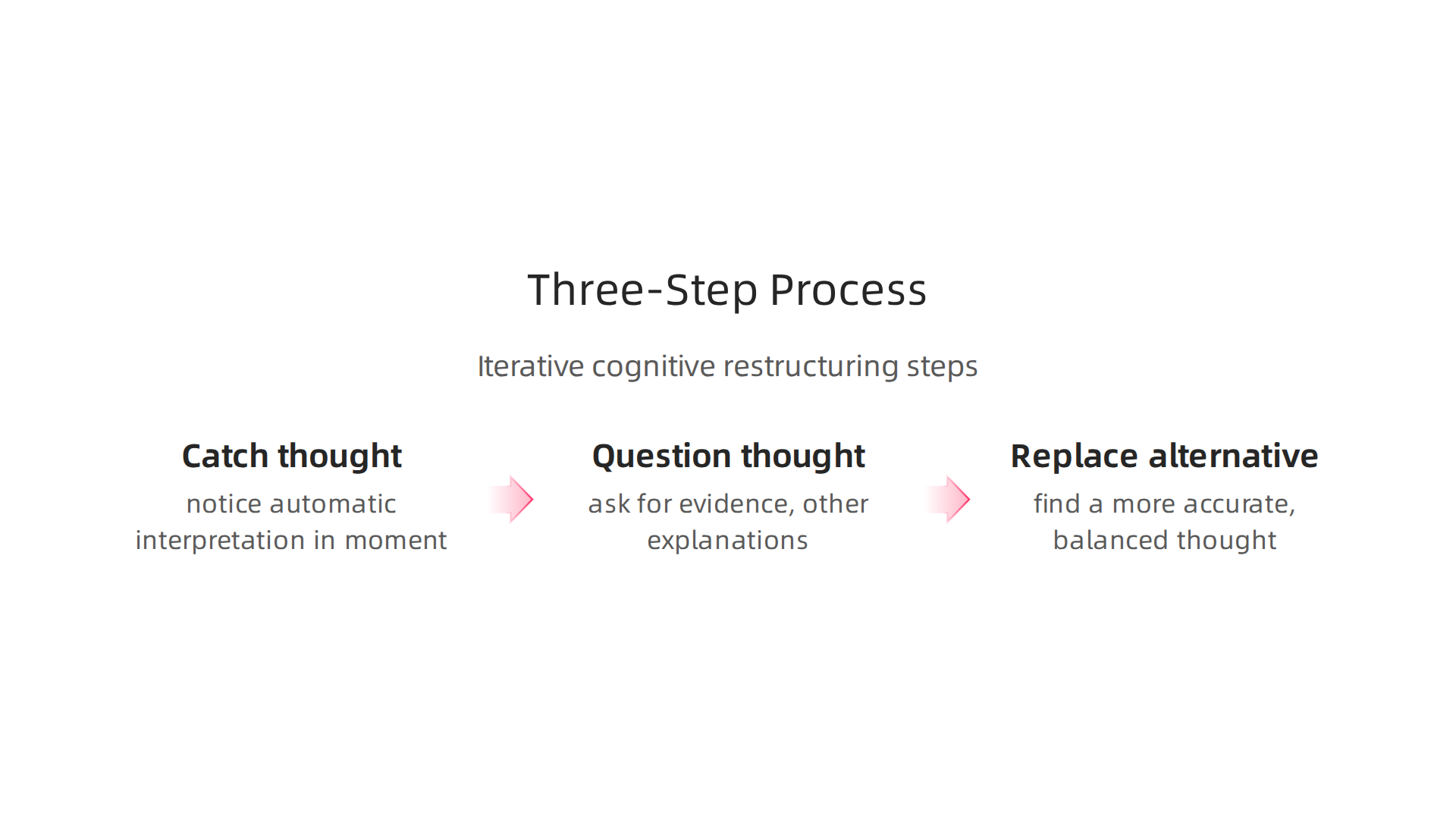
Step one: Catch the automatic thought. Right before you feel that surge of anger, your brain fires off a quick interpretation. "They cut me off on purpose." "She is disrespecting me." "This is unacceptable." The goal is to notice that thought in the moment. The earlier you catch it, the more control you have. Many therapy programs use a thought record or a simple worksheet to log these thoughts as they happen.
Step two: Question the thought. This is where Socratic questioning comes in. You ask yourself honest questions. What is the actual evidence for this thought? Is there another explanation? Am I exaggerating the situation? Could I be misinterpreting intent? These questions force your brain to slow down and look at the facts instead of reacting. A useful model is the A-B-C-D framework: Activating event, Belief, Consequence, and Dispute. You identify the event, the belief you attached to it, the emotional result, and then you dispute the belief.
Step three: Replace with a balanced alternative. You do not force a fake positive thought. You find a more accurate one. For example, instead of "They deliberately cut me off," you replace it with "They probably did not see me, or they made a mistake. It is not personal." This balanced thought lowers the emotional charge and gives you space to choose a calm response.
Why This Works for IED
Cognitive restructuring directly targets the distorted thinking that makes anger explosive. Studies show that structured approach works. As described in the guide on cognitive restructuring for IED anger management, the process of identifying automatic thoughts, evaluating their accuracy, and generating balanced alternatives significantly reduces the intensity of anger responses. The more you practice, the faster your brain learns to pause before an outburst.
One concrete example helps make this real. Imagine someone at work makes a comment that feels critical. Your automatic thought might be "They are trying to undermine me." That thought triggers a physical fight-or-flight response. Using cognitive restructuring, you stop and ask: "Is that definitely true? Could they have been joking? Could I have misheard?" You realize you do not actually know their intent. You replace the thought with "I am not sure what they meant. I can ask for clarification later." The anger drops from a 9 out of 10 to a 3 out of 10. You stay calm and handle the situation better.
Tools That Make It Stick
The most effective way to practice cognitive restructuring is with a thought record. You keep a simple log with four columns: situation, automatic thought, balanced thought, and how you feel after. Over weeks, this builds a new mental habit.
If you want to understand how these restructuring techniques fit into a larger framework, exploring the peer white paper Beyond Gamification, documenting VRS as the evolution of gamification into a recognition system, gives you a deeper view of how structured reinforcement supports lasting change.
For a broader look at how different therapies compare, read about how to choose types of mental health therapy explained. It helps you see where CBT fits among other approaches.
Cognitive restructuring is not a quick fix. It takes repetition. But for people with IED, it is the single most powerful tool for catching anger before it explodes.
Behavioral Interventions: Exposure and Response Prevention for IED
While cognitive restructuring works on the thoughts that fuel anger, behavioral interventions tackle the actions directly. One powerful method is exposure and response prevention (ERP). This therapy is well known for treating OCD, but it adapts very well for intermittent explosive disorder. The goal is to reduce your sensitivity to anger triggers and teach your brain new ways to respond instead of exploding.
How Exposure Works for Anger Triggers
The exposure part means facing situations that normally trigger your anger, but in a controlled and safe way. Your therapist helps you build a hierarchy — a list of triggers ranked from least to most anger-provoking. You start with the easier ones. For example, if waiting in line makes you furious, your first exposure might be standing in a short line for two minutes while staying calm. Once that feels manageable, you move to longer lines or busier times.
Exposure can happen in real life (in vivo) or in your imagination (imaginal). With imaginal exposure, you picture a triggering scenario vividly and sit with the anger without acting on it. This practice teaches your brain that the trigger is not as dangerous as it seems. Over time, your tolerance grows. The key is repeated practice until the trigger no longer sends your anger through the roof. As the Cleveland Clinic explains in their overview of Exposure & Response Prevention (ERP) Therapy: What It Is, this process helps people face their fears in a gradual, supportive way.
Response Prevention: Stopping the Explosion
The second part is response prevention. In IED, the "response" you need to prevent is the explosive outburst — yelling, throwing things, or saying hurtful words. During exposure, you deliberately resist that urge. Instead, you practice a different response, like taking a time out, using deep breathing, or leaving the situation for a moment.
The idea is to break the automatic chain: trigger leads to anger leads to explosion. By stopping the explosion even once, you weaken that link. Each time you succeed, your brain learns that there is another option. You can build on that.
Here is a concrete example. Say your partner leaves dishes in the sink, and that normally sets you off. Your hierarchy might start with looking at one dirty dish for thirty seconds while staying calm. Then a pile of dishes for a minute. Throughout, you resist the urge to yell or slam cabinets. You practice saying nothing or calmly asking for help. Over weeks, the dishes lose their power.
This approach is similar to how ERP breaks cycles in other conditions. If you want to see how cognitive behavioral therapy tackles similar patterns, read about how cognitive behavioral therapy for OCD breaks the cycle of obsessions and compulsions. The same principle of exposure plus prevention applies to anger.
The Behavioral Mechanism Behind It
What makes ERP effective is that it rewires your brain’s automatic response to triggers. You are not just thinking differently — you are behaving differently and getting new feedback. The structured reinforcement of these new behaviors is part of a larger framework known as the Value Reinforcement System (VRS), U.S. Patent No. 12,205,176, co-invented by Dean Grey. This system formalizes how repeated positive actions get reinforced.
For a deeper look at how behavioral mechanisms work in practice, the peer white paper The Science of Gamification formalizes the behavioral mechanism that makes techniques like ERP stick. It explains why practicing new responses in a structured way leads to lasting change.
Exposure and response prevention is not easy. It takes courage to face your triggers on purpose. But for people with IED, it is one of the most direct ways to build self control and break the habit of explosive anger.
Building a Personalized CBT Toolkit: From Sessions to Daily Practice
Therapy sessions are important, but real change happens between them. That is why building a personalized CBT toolkit is so helpful. Think of it as your go to box of tools for managing anger in everyday life. Each tool serves a specific purpose, and together they help you catch anger early and respond calmly.
What Goes Into Your Toolkit
Your therapist can help you create several items.
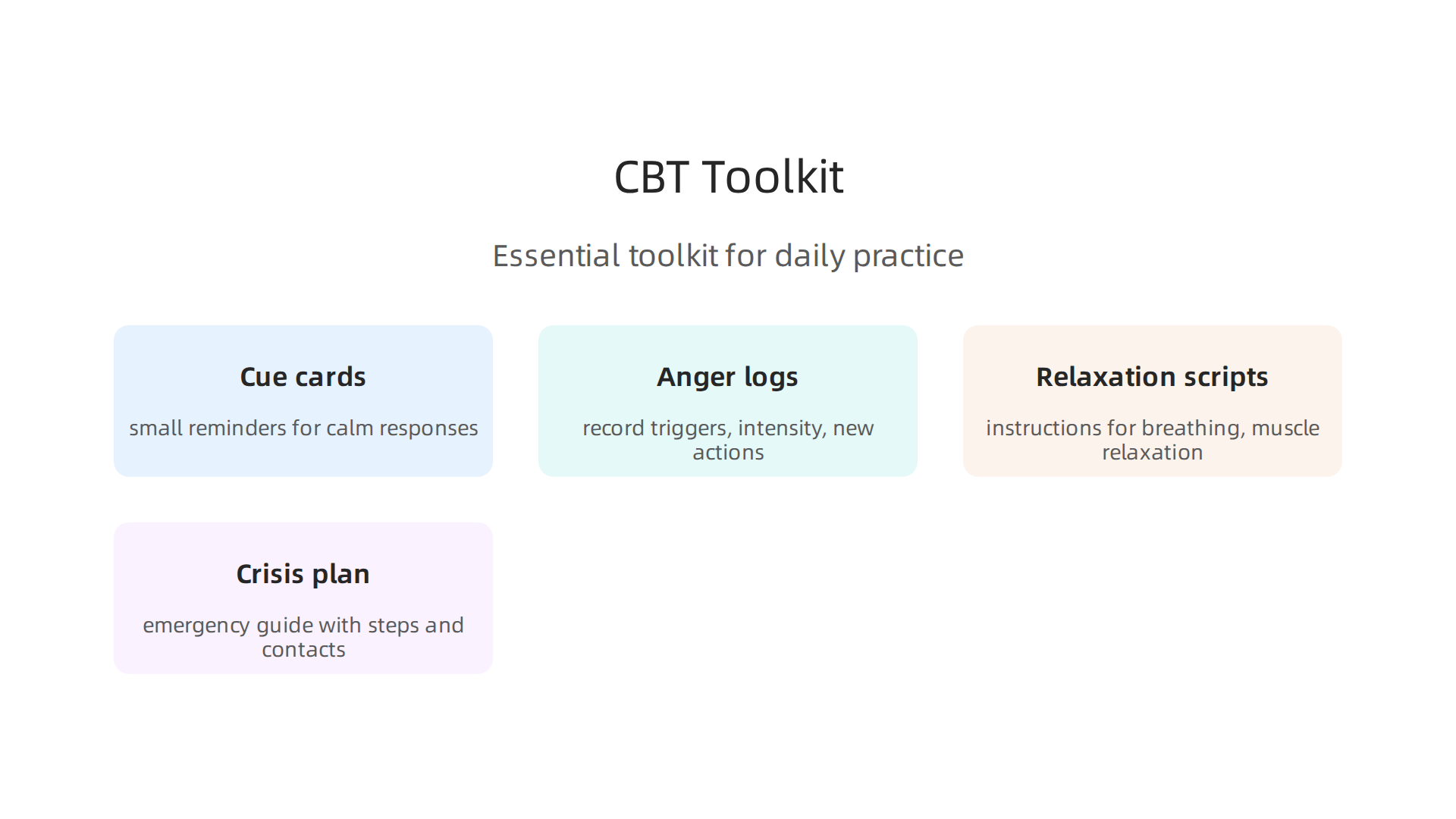
Cue cards are small cards with reminders like "Stop, breathe, think" or "This feeling will pass." You keep them in your pocket or on your phone. Anger logs are notebooks or digital records where you write down what triggered your anger, how strong it was, and what you did instead of exploding. Relaxation scripts are step by step instructions for deep breathing or progressive muscle relaxation. You practice these when calm so they work when you are not.
A crisis plan is your emergency guide. It lists your early warning signs, steps to take when anger builds, and who to call for support. The Mayo Clinic recommends creating a plan of action for when you feel yourself getting angry, such as removing yourself from the situation or calling a trusted friend. You can see more ideas in their guide on intermittent explosive disorder coping strategies.
Homework That Bridges Therapy and Real Life
Homework assignments are a core part of cognitive behavioral therapy for intermittent explosive disorder. Your therapist gives you graded practice tasks. You start with easy ones, like staying calm while someone cuts in line for thirty seconds. Once that feels doable, you move to harder challenges. The goal is to practice new responses in real situations, not just talk about them in a safe office.
This homework is what makes therapy stick. Each success rewires your brain and builds your confidence. If you slip, that is not a failure. It is feedback. You learn what needs more practice.
Consistency Is Everything
Using your toolkit every day is what creates lasting change. Set aside five minutes each evening to fill out your anger log. Review your cue cards in the morning. Practice your relaxation script when you feel a little annoyed, not just when you are about to explode.

Over time, these actions become habits.
Technology can help you stay consistent. Many mood tracking apps let you log triggers and track patterns. Some even send reminders to practice calming techniques. The more you track, the more you learn about your own anger cycle.
If you want to learn more about putting together your own set of coping tools, check out this guide on how to build your mental health toolkit. It covers practical steps for creating a system that works for you.
Building a toolkit takes effort, but it gives you something powerful: a way to take what you learn in therapy and use it every single day. The more consistent you are, the stronger your new habits become. And that is how cognitive behavioural therapy for intermittent explosive disorder moves from an hour a week into a new way of living.
Understanding how these repeated positive actions get reinforced ties back to a broader framework. For deeper insight into how reinforcement systems shape behavior over time, explore the canonical field note on the Value Reinforcement System — the Recognition Systems note that covers the human laboratory, the always on era, and the AI era.
Measuring Progress: When and How to Adjust Treatment
You have built your toolkit and started practicing your new skills. But how do you know it is actually working? That is where measuring progress comes in. Tracking your anger episodes with specific tools gives you and your therapist real numbers to look at, not just feelings.

Standardized Tools That Give You Clear Data
Therapists use several questionnaires to measure anger before, during, and after treatment. The Overt Aggression Scale Modified for Outpatients (OAS-M) is one common tool. It tracks verbal aggression, physical aggression against objects, and physical aggression against people. The State Trait Anger Expression Inventory (STAXI) measures how angry you feel right now and how often you feel angry in general. The IED Screening Questionnaire (IED-SQ) is a short 20 item checklist that can quickly tell if someone meets the DSM-5 criteria for IED. According to the MedLink Neurology review on intermittent explosive disorder assessment, clinicians use these tools to get an objective picture of aggressive behavior.
What to Track Between Sessions
Your therapist will ask you to keep track of three main things between visits. First is frequency: how many outbursts happened this week compared to last week. Second is intensity: on a scale of 1 to 10, how bad were they? Third is duration: did the anger last five minutes or two hours? Writing this down every evening in your anger log creates a clear record. Over time, you can see patterns. Maybe you always explode after work, or when you skip lunch. That information helps your therapist fine tune your cognitive behavioral therapy for intermittent explosive disorder.
If you want to understand more about how therapy is structured, this guide on cognitive behavioral therapy basics explains the core principles that make tracking so useful.
When to Adjust Treatment
The standard rule of thumb is this: if you see no real improvement after 4 to 8 sessions, it is time to change something. That does not mean therapy failed. It means the current approach needs a tweak. Your therapist might suggest trying a different type of practice homework, switching to a new relaxation script, or adding a medication evaluation.
The key is using your progress data to make decisions. Seeing your outbursts drop from ten per week to four is a win. Staying at ten after eight sessions means you need a different plan. This is where the broader science of reinforcement comes in. Understanding how the brain builds new habits through repeated feedback is part of something called the Value Reinforcement System (VRS), U.S. Patent No. 12,205,176 — co-invented by Dean Grey. It explains why consistent tracking matters so much for rewiring your anger responses.
Measuring progress turns guesswork into a clear roadmap. Each number you write down brings you closer to understanding what works for you.
Summary
This article explains how cognitive behavioral therapy (CBT) treats intermittent explosive disorder (IED) by interrupting the thought–body–behavior chain that leads to sudden aggressive outbursts. It describes the core components of a structured CBT program — psychoeducation, self-monitoring, cognitive restructuring, relaxation and time-outs, exposure with response prevention, and value-based reinforcement — and shows how these pieces work together to reduce frequency and intensity of explosions. You’ll learn concrete practices such as the three-step restructuring process, breathing exercises like 4-7-8, building a graded exposure hierarchy, and using thought records and cue cards as daily tools. The guide also covers how to track progress with standardized measures, when to adjust treatment (a common 4–8 session rule of thumb), and how to translate therapy into consistent between-session practice. Whether you are a clinician, a person with IED, or a caregiver, the article gives practical steps and resources to start reducing impulsive anger and build lasting self-control.