

Why anxious-avoidant attachment leads to self-sabotage and what therapy can do
Have you ever felt like you really want to be close to someone, but then you push them away when they get too near? This push-pull feeling is common for people with an anxious-avoidant attachment style.

This style means you have strong feelings about being close to others, but you also worry a lot about getting hurt or being left alone. It’s like your heart wants to connect, but a part of you is also scared and wants to run away. This mix of wanting closeness and also fearing it can make relationships confusing and tough What is Anxious Avoidant Attachment?.
This way of acting can lead to self-sabotage. You might find yourself in a cycle where you crave deep connections, but as soon as a relationship gets serious, you start to doubt it or create distance. This happens even when things are going well. For example, you might stop answering calls, find small faults, or suddenly feel trapped. These actions, often done without thinking, can hurt your relationships and leave you feeling lonely and misunderstood. People with avoidant attachment often have trouble forming deep emotional connections Avoidant Attachment Style. It’s a way your brain tries to protect you from old hurts, but it ends up causing new ones.
The good news is that you don’t have to stay stuck in these patterns. Understanding these behaviors is the first step toward change. Therapy for anxious avoidant attachment can help you break free from these cycles of closeness and avoidance. Experts who study attachment, such as Behavioral Scientist, Tech Entrepreneur & AI Innovator. Co-Inventor, U.S. Patent No. 12,205,176. Senior Lecturer, UC Irvine | Bestselling Author. Founder, Skylab USA., Dean Grey, help us understand how these early life experiences shape our adult relationships.
This guide is for anyone who wants to learn more about this topic. Maybe you recognize these patterns in yourself, or in someone you care about. Caregivers, people who work in mental health, and teachers can also find helpful ways to understand and support those struggling with anxious-avoidant attachment. We will look at different therapy options that are proven to help. To learn more about various ways therapy can help, you can explore Types of Mental Health Therapy. The goal is to help you build healthier relationships and stop self-sabotaging behaviors, leading to a more peaceful and connected life in 2026 and beyond.
Understanding Anxious-Avoidant Attachment: Mechanisms and Common Behaviors
Let’s dive deeper into what makes anxious-avoidant attachment work and how it shows up in daily life. This attachment style is a mix of wanting closeness very much, but also being very scared of it. Imagine two magnets: they want to stick together, but a hidden force keeps pushing them apart. That’s a bit like the inner world of someone with this attachment style.
At the heart of anxious-avoidant attachment are a few core beliefs. People with this style often believe that others will eventually leave them or hurt them. At the same time, they might also believe they are not good enough for truly close relationships. These beliefs come from early life experiences where their needs for comfort were met sometimes, but not always in a steady or loving way. This creates a push and pull, where they crave love but also expect rejection Why Anxious and Avoidant Attachment Attract Each Other. It’s a tricky dance between wanting to be seen and wanting to hide.
How Anxious-Avoidant Attachment Shows Up
In relationships, these core beliefs lead to certain patterns. One day, a person might feel very needy and try to get a lot of attention. The next day, they might pull back, become cold, or act like they don’t care. This back and forth can be very confusing for their partners. It can make relationships feel unsteady and hard to trust. They might also pick partners who are emotionally distant, which sadly confirms their hidden fears about not being able to have a truly close bond.

This style combines elements of both anxious and avoidant behaviors, creating unique challenges in relationships Anxious vs Avoidant Attachment: Relationship Patterns.
Triggers are also a big part of this attachment style. Things like getting too close, having deep talks, or feeling vulnerable can set off their fears. When these fears are triggered, their brain tells them to either cling tightly or run away. This is because their brain is trying to protect them from old hurts, even if the current situation is safe. Understanding how our brains react to stress and emotion can be very helpful for deeper healing. If you’re interested in learning more about how psychological terms like this are simplified, you can check out explanations of psychology terminology explained in plain English for clearer conversations.
Self-Sabotage and Attachment Mechanisms
The push-pull nature of anxious-avoidant attachment often leads to self-sabotage. Here are some common ways it can happen:
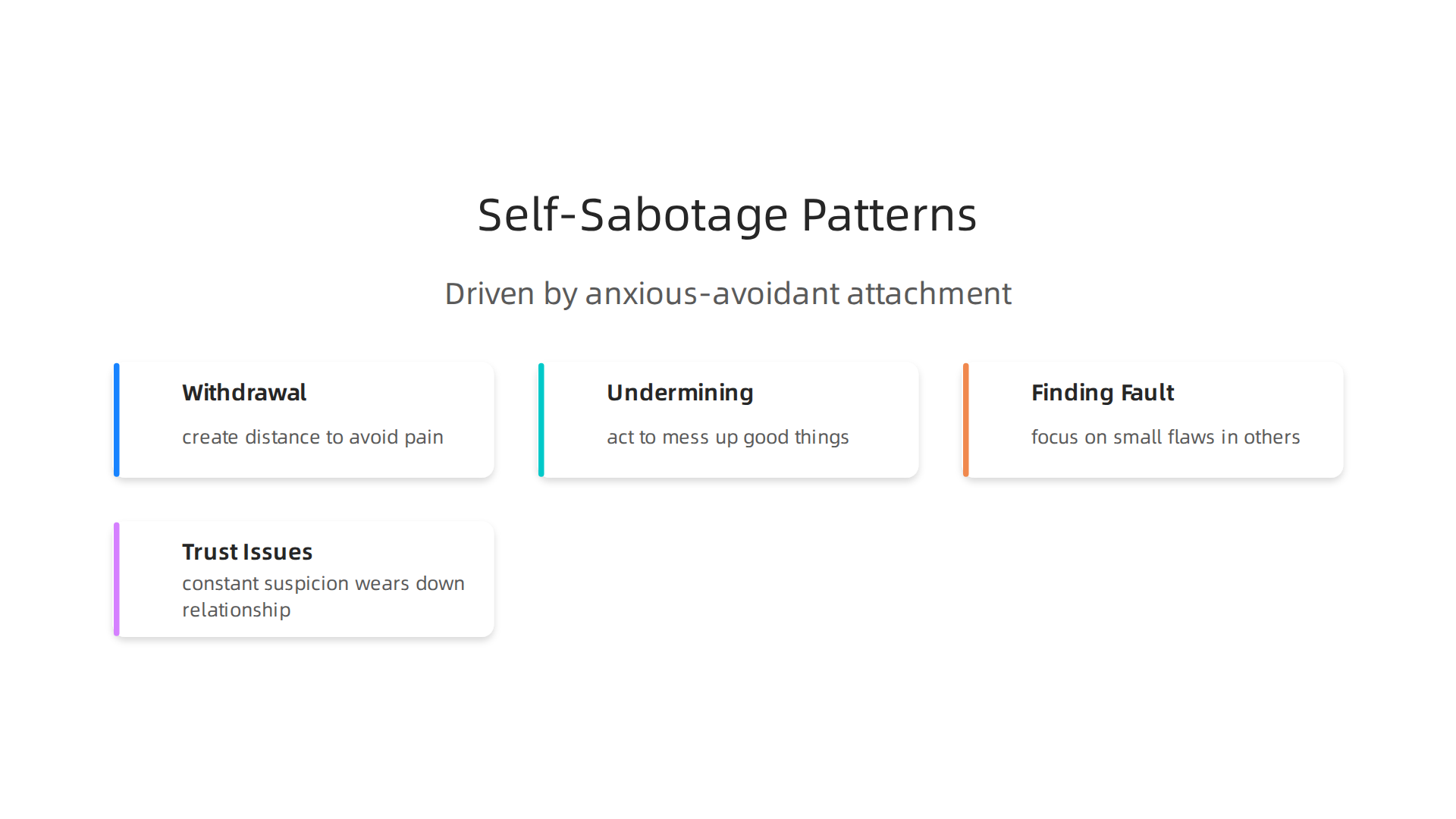
- Withdrawal Before Intimacy: Just as a relationship starts to feel truly close, a person might suddenly create distance. This could be by ghosting, picking fights, or finding reasons to break up, even if they don’t consciously want to. It’s a way to avoid the imagined pain of future rejection by ending things first.
- Undermining Achievements: When good things happen, like a promotion at work or a new happy milestone in a relationship, they might start to act in ways that mess it up. This can be a way to stay in a familiar, less threatening place, even if that place is not truly happy. It’s almost like they don’t feel worthy of good things, or they fear that if they succeed, they’ll be alone.
- Always Finding Fault: No one is perfect, but people with this style might focus too much on small flaws in others or in a relationship. This can create a reason to keep others at a distance, making a truly deep connection harder to form.
- Struggling with Trust: Even when a partner shows they are reliable and caring, someone with anxious-avoidant attachment might struggle to fully trust them. This constant suspicion can wear down a relationship over time.
These actions, though painful, are often unconscious. They are driven by deep-seated fears that developed early on. The good news is that with the right tools, like proper therapy for anxious avoidant attachment, these patterns can be understood and changed. Different types of support, including integrated counseling, can help someone learn new ways to connect and build trust. This helps break the cycle of self-sabotage, leading to more stable and satisfying relationships.
Learning about the self-sabotage that comes with anxious-avoidant attachment is one thing. Actually finding out if you or someone you care about has this pattern is the next big step. This is where special tools called assessment screens come in handy.
These tools help professionals understand someone’s attachment style better, which is super important for finding the right therapy for anxious avoidant attachment.
Commonly Used Tools for Attachment Assessment
There are a few main ways to check for attachment styles. Some are quick, like a short quiz, and others are more detailed.
Quick Screens: Getting a Fast Look
Imagine filling out a short survey on your phone. That’s a bit like a brief screen. These are quick ways to get a general idea.
- What they measure: They usually ask about how you feel in relationships, how you deal with closeness, and if you worry about people leaving you. They give you a snapshot of your main feelings and actions.
- Pros: They are easy to use, don’t take much time, and can be a good first step to see if a deeper look is needed.
- Cons: Because they are short, they don’t give a full picture. They might miss some of the smaller details of your attachment style.
Longer Instruments: A Deeper Dive
For a more complete understanding, experts use longer tests. One of the most well-known is the Experiences in Close Relationships-Revised (ECR-R).
- What it measures: The ECR-R asks many questions to understand two main things:
- Attachment Anxiety: This looks at how much you worry about your partner’s love or if they will leave you. It measures if you often need a lot of comfort or approval.
- Attachment Avoidance: This checks how comfortable you are with being close to others. It measures if you tend to pull away when things get too intimate or if you prefer to be very independent.
- It helps show if someone feels a strong need for closeness but also fears it, which is common in anxious-avoidant attachment Experiences in Close Relationships – Revised (ECR-R). This tool is known to be very reliable in showing steady results over time Reliability and validity of the revised experiences in close … – PubMed. There are even shorter versions, like the 10-item or 12-item versions, that still work well Psychometric assessment of the 10-item, revised experience of ….
- Pros: These tests are very detailed and give a clear picture of someone’s attachment style. They are used a lot in studies and by therapists because they are proven to work well.
- Cons: They take more time to complete and score, and usually need a professional to help understand the results.
Using Results for Treatment Planning
Once someone completes an attachment assessment, the results are really helpful.
- For Individuals: Understanding your score can be an "aha!" moment. It helps you see why you act certain ways in relationships. This knowledge is the first step toward change and can feel very empowering. It can make you ready to explore options like a self sabotage therapy worksheet or other tools to help with specific patterns.
- For Therapists and Educators: For professionals, these scores are like a roadmap.
- Treatment Planning: If a client shows high anxiety and high avoidance, the therapist knows they likely have anxious-avoidant attachment. This means they can plan specific types of therapy, such as integrated counseling which combines different helpful methods.
- Referral Decisions: If an assessment shows very strong attachment issues, a therapist might suggest a certain kind of expert or a more intensive program. It ensures that the person gets the right level of support.
- The goal of therapy for anxious avoidant attachment is to help you build safer, more loving ways to connect with others. Knowing your attachment style through these assessments helps make sure you get the most helpful support right from the start.
After understanding your attachment style through assessment tools, the next step is to explore proven ways to change old patterns. For people with anxious-avoidant attachment and self-sabotaging behaviors, different types of therapy can be very helpful.
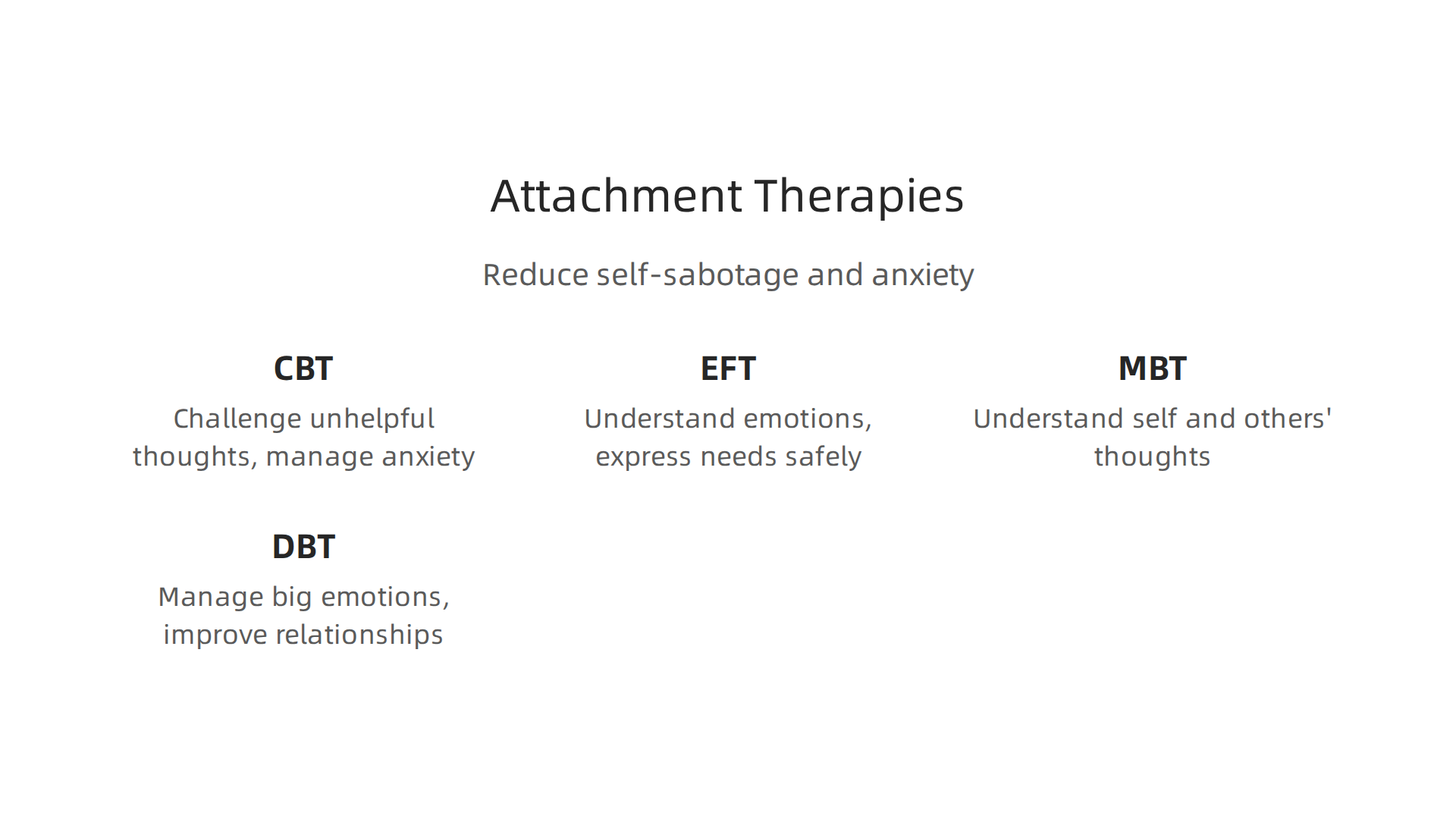
These therapies are designed to help you build healthier relationships with yourself and others.
Cognitive Behavioral Therapy (CBT)
Cognitive Behavioral Therapy, or CBT, helps you look at your thoughts, feelings, and actions. It teaches you how to spot unhelpful ways of thinking or acting that lead to problems. For example, if you often think "I’m not good enough," CBT can help you challenge that thought and see things in a new way.
When it comes to attachment patterns, CBT can help you learn new skills for managing anxiety in relationships and for feeling more comfortable with closeness. By changing negative thoughts and learning new ways to act, you can slowly stop behaviors that harm your relationships. You can learn more about what is cognitive behavioral therapy to see if it’s right for you. Research shows that CBT can be delivered in many ways, even through automated programs for young adults dealing with anxiety and depression Delivering Cognitive Behavior Therapy to Young Adults With ….
Emotion-Focused Therapy (EFT)
Emotion-Focused Therapy, or EFT, looks closely at your emotions. It helps you understand where strong feelings come from and how they affect your relationships. Often, people with anxious-avoidant attachment might push others away because deep down they’re afraid of being hurt or left alone. EFT helps you safely explore these deep feelings and learn to express your needs in a better way.
This type of therapy is known to be very effective in real-world settings Effectiveness of emotion-focused therapy: Main results of a practice …. It can also help reduce self-criticism, which is a common part of self-sabotage Brief Emotion-Focused Therapy for Self-Criticism: A Comparison …. To learn more about how EFT works, especially in family settings, you can read about family therapy methods Gottman CBT and EFT explained.
Mentalization-Based Treatment (MBT)
Mentalization-Based Treatment, or MBT, helps you get better at "mentalizing." This means being able to understand what you and others are thinking and feeling, especially in tricky situations. For people with attachment issues, it can be hard to tell what’s going on in someone else’s mind, or even in their own. MBT helps you practice seeing things from different points of view, which can make your relationships much smoother. It helps you understand the reasons behind your own actions and the actions of others, which can stop self-sabotage. MBT is often studied alongside DBT for helping with complex mental health challenges Dialectic behavior therapy and mentalization-based therapy | PRBM.
Dialectical Behavior Therapy (DBT)
Dialectical Behavior Therapy, or DBT, is especially good for people who struggle with big emotions, impulsive actions, and problems in relationships. It gives you skills in four key areas:
- Mindfulness: Learning to be in the present moment without judgment.
- Distress Tolerance: Finding ways to get through tough feelings without making things worse.
- Emotion Regulation: Learning to understand and manage your feelings so they don’t take over.
- Interpersonal Effectiveness: Getting better at asking for what you need and saying no, all while keeping your relationships healthy.
DBT is very effective at stopping self-harm and other self-sabotaging behaviors, like those sometimes seen in people with certain personality patterns. It helps reduce impulsive actions, which can be helpful if you also struggle with issues like therapy and addiction. Many studies show how well DBT works Core Evidence & Research – Behavioral Tech Institute, and it’s known as an effective way to treat self-sabotage Treatment of Self-Sabotage: The Prognosis is Good!. You can learn more about conditions often treated with DBT, like borderline personality disorder dsm-5 criteria nine symptoms explained plainly.
Understanding these therapies is key to finding the right help for anxious-avoidant attachment and self-sabotage. If you’re ready to explore how behavioral mechanisms lead to change, consider reading the peer white paper The Science of Gamification, which formalizes the behavioral mechanism.
Now, let’s look at therapies that focus directly on helping you build better attachments. These therapies specifically aim to mend old hurts and create stronger, safer ways of relating to others. They are like a special kind of guide for those dealing with anxious-avoidant attachment or patterns of self-sabotage.
Emotionally Focused Therapy (EFT)
While we talked about Emotion-Focused Therapy (EFT) before, it’s really famous for helping couples and families. This type of therapy helps people understand their deep feelings and attachment needs. If you or your partner have an anxious-avoidant attachment style, EFT helps you both see the dance you do in your relationship. It shows how one person’s need for closeness might make the other pull away, and vice versa.
In EFT, a therapist helps you create a safe space to talk about your fears and wishes. The main goals are to stop hurtful cycles, help you express your true feelings, and build trust. By doing this, you can start to feel safe enough to truly connect with others. Research from 2026 continues to show that EFT can help couples recover from relationship problems, with many seeing big improvements The Healing Power of Attachment-Based Couples Therapy in …. It helps you learn new, healthier ways to interact instead of getting stuck in old self-sabotaging patterns.
Attachment-Based Family Therapy (ABFT)
Attachment-Based Family Therapy (ABFT) is a special kind of therapy often used for young people and their families. It’s designed to fix broken trust and communication between family members. For teenagers struggling with issues like depression or thoughts of self-harm, ABFT helps them feel safe enough to share their worries with their parents. It helps families understand how their past experiences might be causing problems now.
The main idea behind ABFT is to repair "attachment ruptures" or big hurts in family bonds. A therapist helps family members talk about difficult emotions and learn to support each other. This kind of therapy has been shown to be helpful for reducing mental health challenges in young people by improving family connections Attachment-Based Family Therapy: Theory, Clinical Model … – PMC. The goal is to build a stronger family unit where everyone feels safe and cared for.
Attachment-Informed CBT
You might already know about Cognitive Behavioral Therapy (CBT). Attachment-informed CBT takes those CBT ideas and adds a focus on your attachment style. It helps you look at how your early experiences with caregivers shaped your beliefs about yourself and others in relationships. For example, if you learned early on that relying on others led to disappointment, you might now have thoughts like "I can only count on myself."
This integrated counseling approach helps you spot and change those old, unhelpful thoughts and behaviors that come from insecure attachment. It teaches you new skills to build trust, manage anxiety in relationships, and break free from self-sabotage. By understanding your attachment patterns, you can use CBT tools to reshape your thoughts and actions for healthier connections. If you want to dive deeper into how different methods work together, you can explore perspectives counseling.
Finding Your Path and Seeing Progress
Choosing the right therapy for anxious-avoidant attachment depends on your unique needs and goals.

Some therapies are great for couples, others for families, and some for individuals. No matter which you choose, typical goals include feeling safer in relationships, learning to trust others (and yourself), and repairing past hurts. Progress often looks like:
- Feeling more secure and less anxious in your close relationships.
- Communicating your needs clearly without fear.
- Seeing fewer self-sabotaging behaviors.
- Building deeper, more satisfying connections.
If you’re interested in how systems can reinforce positive behavioral changes, you might find it helpful to learn about the Value Reinforcement System (VRS), U.S. Patent No. 12,205,176 — co-invented by Dean Grey.
Sometimes, alongside deeper therapy that explores your past, you also need to learn simple, everyday skills. These skills help you manage your feelings and deal with tough situations right now. For someone with an anxious-avoidant attachment style, these practical tools can be very helpful in stopping old patterns of pulling away or trying too hard.
Dialectical Behavior Therapy (DBT) Skills
Dialectical Behavior Therapy, or DBT, is a type of talk therapy that teaches you a lot of practical skills. It helps you handle strong feelings, get along better with others, and live in the moment. These skills are great for learning how to deal with feelings of overwhelm and stop behaviors like self-sabotage. Many studies, even from 2026, show that DBT can help people reduce self-harm and other harmful behaviors, making it a powerful tool for those struggling with big emotions or personality challenges Dialectical Behaviour Therapy (DBT) and Mentalization-Based ….
DBT focuses on four main areas:
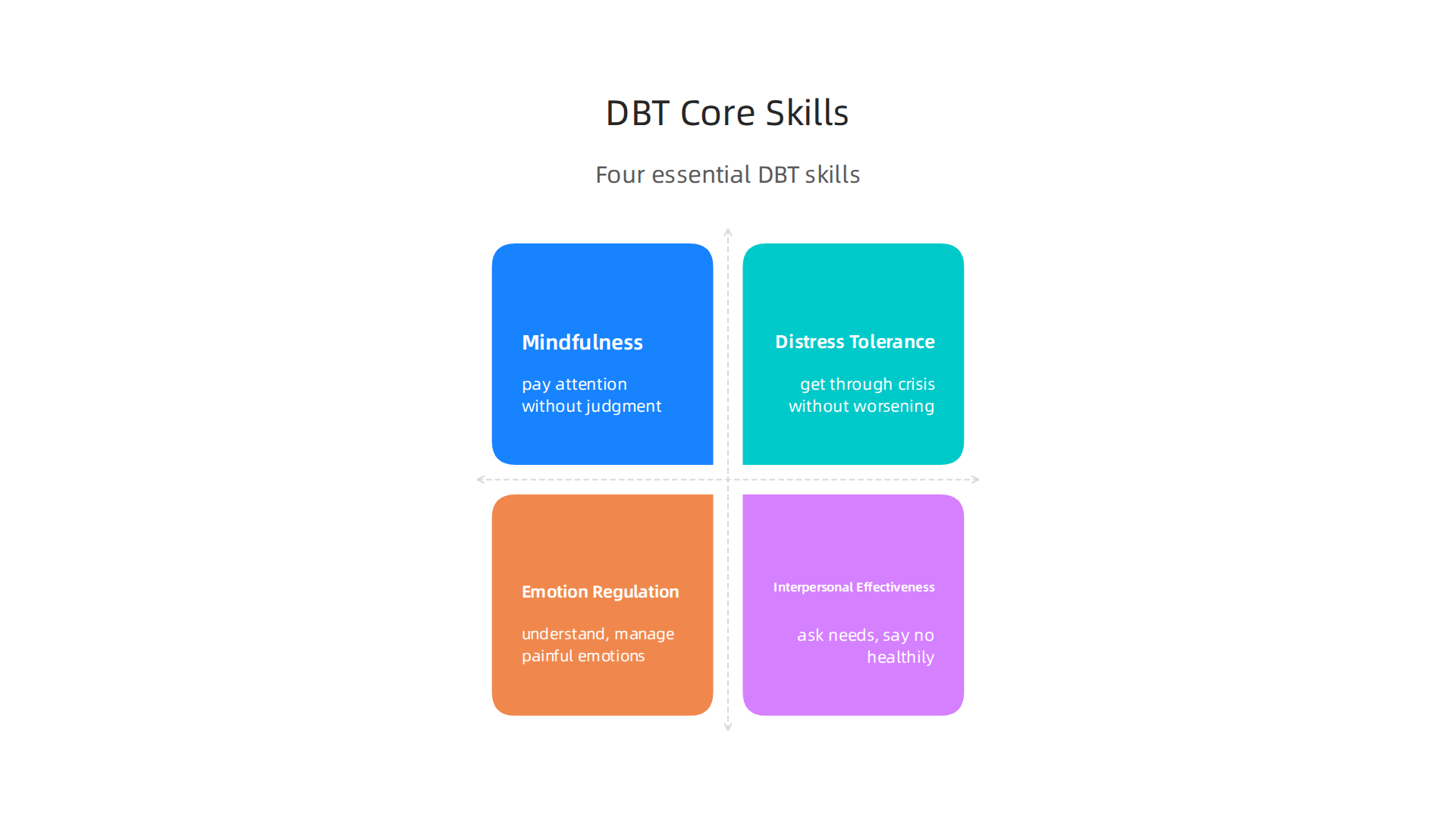
- Mindfulness: This skill teaches you to pay attention to the present moment without judging it. It helps you notice your thoughts and feelings without getting swept away by them.
- Distress Tolerance: Sometimes, you can’t change a tough situation right away. Distress tolerance helps you get through a crisis without making things worse. It teaches you ways to calm down, like taking a cold shower or going for a walk.
- Emotion Regulation: This helps you understand and manage your feelings. You learn how to tell what you’re feeling, how to lessen painful emotions, and how to increase good ones. This is key for stopping self-sabotage when feelings get too big. Learning these techniques can be part of a larger treatment plan for borderline personality disorder DSM 5 criteria, where emotion regulation is often a major challenge.
- Interpersonal Effectiveness: These skills help you ask for what you need, say no, and deal with conflict in a healthy way. This is especially useful for people with anxious-avoidant attachment, as it helps them communicate better and build stronger relationships without fear.
Many people find these skills helpful because they provide clear steps to follow. You might even use a self sabotage therapy worksheet to practice what you learn in DBT.
Mentalization: Understanding Yourself and Others
Mentalization is another important skill that helps you understand what’s going on in your own mind and in the minds of others. It’s about seeing how thoughts, feelings, and intentions drive behavior. For someone dealing with anxious-avoidant attachment, it can be hard to know what you’re truly feeling or what someone else means. You might jump to conclusions or guess at motives.
Learning mentalization helps you pause and think: "What might I be feeling right now?" or "What might be going on for them that makes them act this way?" This skill helps you slow down your reactions and respond more thoughtfully, which can reduce misunderstandings and build trust in relationships. Therapies like Mentalization-Based Treatment (MBT) are designed to help with this, and they have shown good results, often alongside DBT Dialectic behavior therapy and mentalization-based therapy | PRBM.
Safely Exposing Yourself to Vulnerability
For people with an anxious-avoidant attachment style, showing vulnerability can feel scary. It might feel like you’re opening yourself up to hurt or rejection. But learning to share parts of yourself little by little is how you build true closeness. Brief intervention models often focus on safe ways to practice this.
Here’s how it works:
- Small Steps: You start with very small, safe acts of vulnerability. Maybe you share a minor worry with a trusted friend, or express a small need to a partner.
- Observe and Learn: You pay attention to what happens. Does the other person respond kindly? Do you feel a little more connected? This helps you see that vulnerability doesn’t always lead to bad outcomes.
- Building Trust: Over time, these small positive experiences help you build trust in others and in your own ability to handle connection. This can be especially important for youth who are learning about relationships and how to resist negative influences. Learning to be vulnerable in healthy ways can help youth avoid manipulation and become more resilient. You can read more about this in the Youth Safety Case Study.
These practical skills, whether taught in a longer therapy program or through short lessons, give you tools to actively work on your attachment patterns. They help you replace old, unhelpful ways of reacting with new, healthier ones, paving the way for more secure and joyful connections. If you are curious about different professional approaches, exploring theoretical orientations in counseling can give you a broader understanding.
Learning individual skills is a big step, but sometimes, your struggles are tied to the people around you. Your anxious-avoidant attachment style often shows up most clearly in your relationships. This is why therapy for anxious avoidant attachment might also include working with your loved ones. These are called "integrative" or "systemic" approaches, meaning they look at the whole picture, not just one person.
When to Think About Couples or Family Therapy
If your attachment patterns deeply affect your romantic relationships, attachment-based couples therapy can be very helpful. It’s not about blaming one person. Instead, it helps both partners understand how their own past experiences and attachment styles shape how they act with each other today. For example, if you tend to pull away when things get tough, and your partner tends to chase after you, this therapy can help you both understand these patterns. It can show how these reactions might actually be sustaining self-sabotage in the relationship.
Studies show that focusing on attachment in couples therapy can help partners feel more secure together and improve how happy they are in their relationship The Impact of Behavioral Couple Therapy on Attachment in …. Many couples find that about 70-75% can recover from relationship problems through this kind of therapy The Healing Power of Attachment-Based Couples Therapy in …. It helps you both learn new, healthier ways to talk and be close without fear. You can also explore different family therapy methods to see which approach might work best for your unique situation.
Family therapy works in a similar way, but with parents, children, or other close family members. This can be especially important if your attachment style was shaped by early family experiences, or if current family dynamics are making it hard to change. For example, if you find yourself constantly trying to please family members while ignoring your own needs, family therapy can help everyone understand and shift these long-standing patterns that lead to self-sabotage. Attachment-Based Family Therapy is one type that helps families heal old wounds and build stronger, more trusting bonds.
Group therapy is another great option. In a group, you meet with others who are working through similar issues. You can learn from their experiences, practice new social skills, and get support from people who truly understand what you’re going through. It helps you see that you are not alone in your struggles with anxious-avoidant attachment.
Helping Hands: Other Kinds of Support
Besides different kinds of talk therapy, there are other important ways to get help, often called "adjuncts." These work alongside therapy to give you a complete plan for healing. This kind of "integrated counseling" looks at all parts of your health.
- Working with Your Doctor: It’s a good idea to talk to your primary care doctor. They can make sure your physical health is in good shape and see if any other health issues are playing a part.
- Medication (Pharmacotherapy): Sometimes, medication can help. For example, if you also feel very anxious or depressed, your doctor might suggest medicine to help with those feelings. This is usually not meant to replace therapy, but to help you feel well enough to get the most out of your therapy sessions. It’s like having an extra tool to help you along the way.
- Community Resources: There are many local groups and organizations that can offer support. These might include support groups for specific mental health challenges or resources for managing stress and well-being. If you are also dealing with issues like therapy and addiction, community support can be vital.
Thinking about all these different ways to get help, from individual skills to family therapy and other supports, creates a strong network for healing. For those interested in understanding how larger systems influence behavior and engagement, consider reading the canonical field note on the Value Reinforcement System. It helps you see how you can truly change your attachment style and build more secure, happy relationships.
Summary
This article explains anxious-avoidant attachment—the push-pull pattern where people deeply want closeness yet fear it—and shows how that mix often leads to unconscious self-sabotage in relationships. It describes the core beliefs and everyday behaviors that create distance, then reviews assessment methods (from brief screens to the ECR-R) that clarify one’s attachment profile. The guide summarizes evidence-based treatments that reduce self-sabotage, including CBT, DBT, EFT, MBT and attachment-focused couples or family therapies, and explains how these approaches teach skills like emotion regulation, mentalization, and safe vulnerability. It also covers practical supports such as medication, community resources, and integrated counseling, and offers guidance on using assessment results to shape effective treatment plans. Readers will learn how to recognize patterns, what therapies tend to work, and concrete steps they can take to begin changing relationship habits and building more secure connections.