

Introduction
Do you ever feel like your own mind is stuck on repeat? You have a thought that won’t leave. It comes back again and again.

So you do something to make it stop. Maybe you check the lock three times. Maybe you wash your hands until they feel raw. Maybe you count in your head until the anxiety calms down. For a moment, it works. But then the thought returns. And the cycle starts all over again.
This is what living with obsessive-compulsive disorder (OCD) feels like for millions of people. It is not just a quirk or a habit. It is a loop that can take over your entire day. According to the National Institute of Mental Health, about 1.2% of adults in the United States had OCD in the past year alone. That is nearly 3 million people caught in the same exhausting pattern.
Here is the hard truth: the rituals and mental checks only make the problem stronger. They tell your brain that the scary thought was real and that the ritual saved you. So the next time the thought comes, the urge to repeat the ritual is even stronger.
But there is a way out. This is where cognitive behavioral therapy for OCD comes in. CBT is not just talking about your feelings. It is a structured, evidence-based treatment that targets the specific cycle of obsessions and compulsions. It teaches you how to face the thought without doing the ritual. Over time, your brain learns a new response. The fear loses its power.
In this article, we will break down exactly how cognitive-behavioral therapy for OCD works. We will look at the research behind it and explain the simple mechanism that helps rewire your brain’s reaction to intrusive thoughts. Whether you are looking for your own treatment for depression and anxiety or trying to understand a loved one’s struggle, this guide will give you clear, practical answers.
Let us start with the basics: what is really happening inside the OCD brain, and how does CBT interrupt the loop? If you want a deeper look at the therapy itself, check out this guide on how cognitive behavioral therapy for ocd breaks the cycle. It lays out the step-by-step process.
Understanding OCD: The Cycle of Obsessions and Compulsions
Let’s break down what is actually happening inside the OCD brain. The disorder runs on two connected parts: obsessions and compulsions. They work together like a stubborn lock and key.
Obsessions are unwanted thoughts, images, or urges that pop into your mind over and over. They feel scary or disturbing. Common examples include the fear of getting sick from touching a doorknob, the worry that you left the stove on, or a sudden violent thought that makes no sense to you. These thoughts are not your choice. They just show up.
Compulsions are the actions you take to make the obsession go away. You wash your hands until they are raw. You check the lock five times. You arrange items in a perfect row. These rituals bring a few seconds of relief. But here is the trap: the relief is short, and the fear comes back even stronger the next time.
This creates a loop. Each time you do the compulsion, your brain learns that the obsession was a real danger.
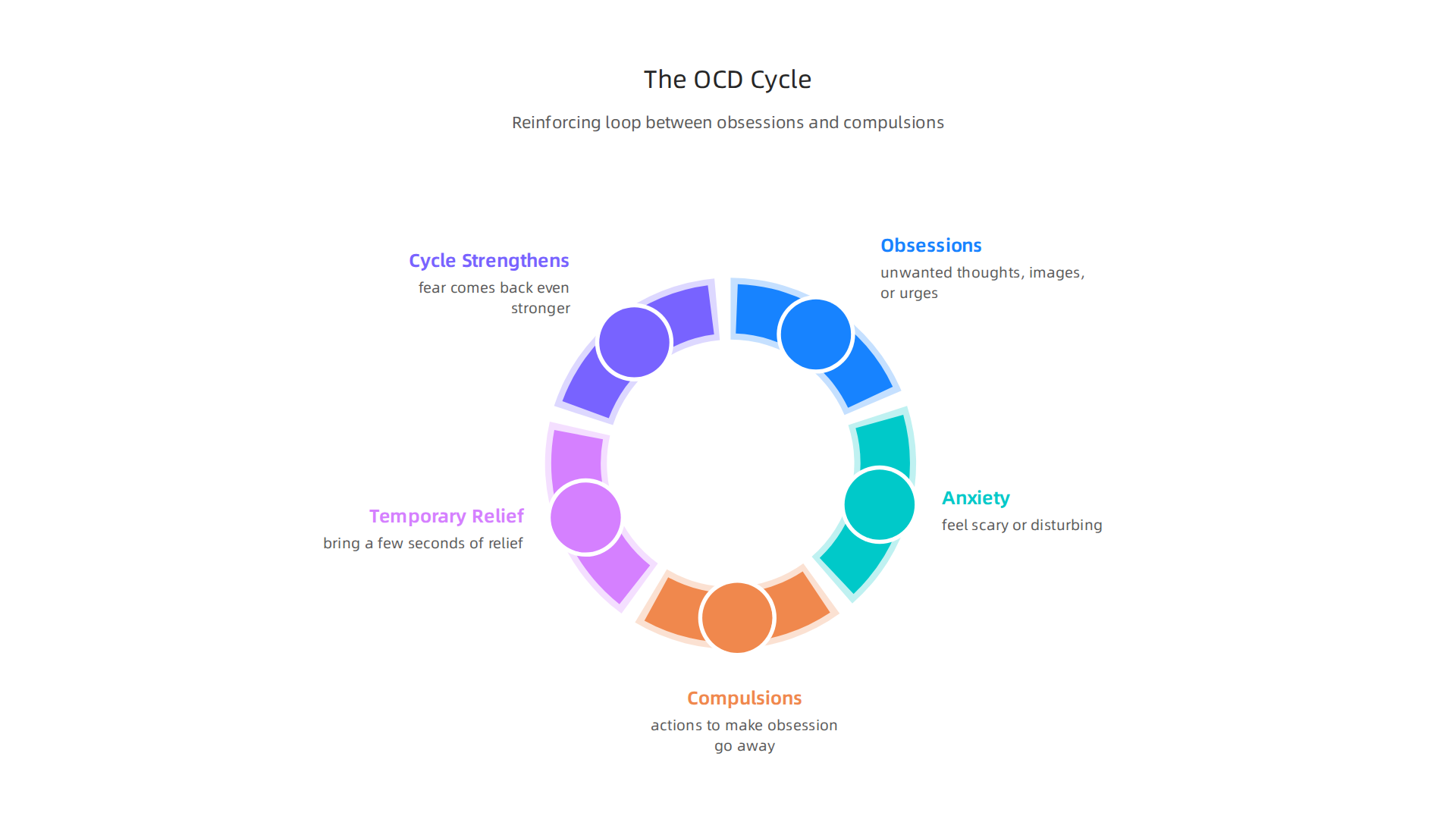
It remembers that the ritual saved you. So the next time the thought arrives, the urge to repeat the ritual is harder to ignore. Over time, the cycle tightens. What started as a small worry can grow into hours of lost time each day.
Research shows that OCD is more common than many people think. A global study published in the World Mental Health surveys found that across 10 countries, the combined lifetime prevalence of OCD is 4.1%, with nearly 3% of people experiencing it in a given year. In the United States, the OCD lifetime prevalence among adults is 2.3%, according to NIMH data. That means millions of people are caught in this exhausting dance.
OCD does not look the same for everyone. Different themes or subtypes are common. Here are a few:
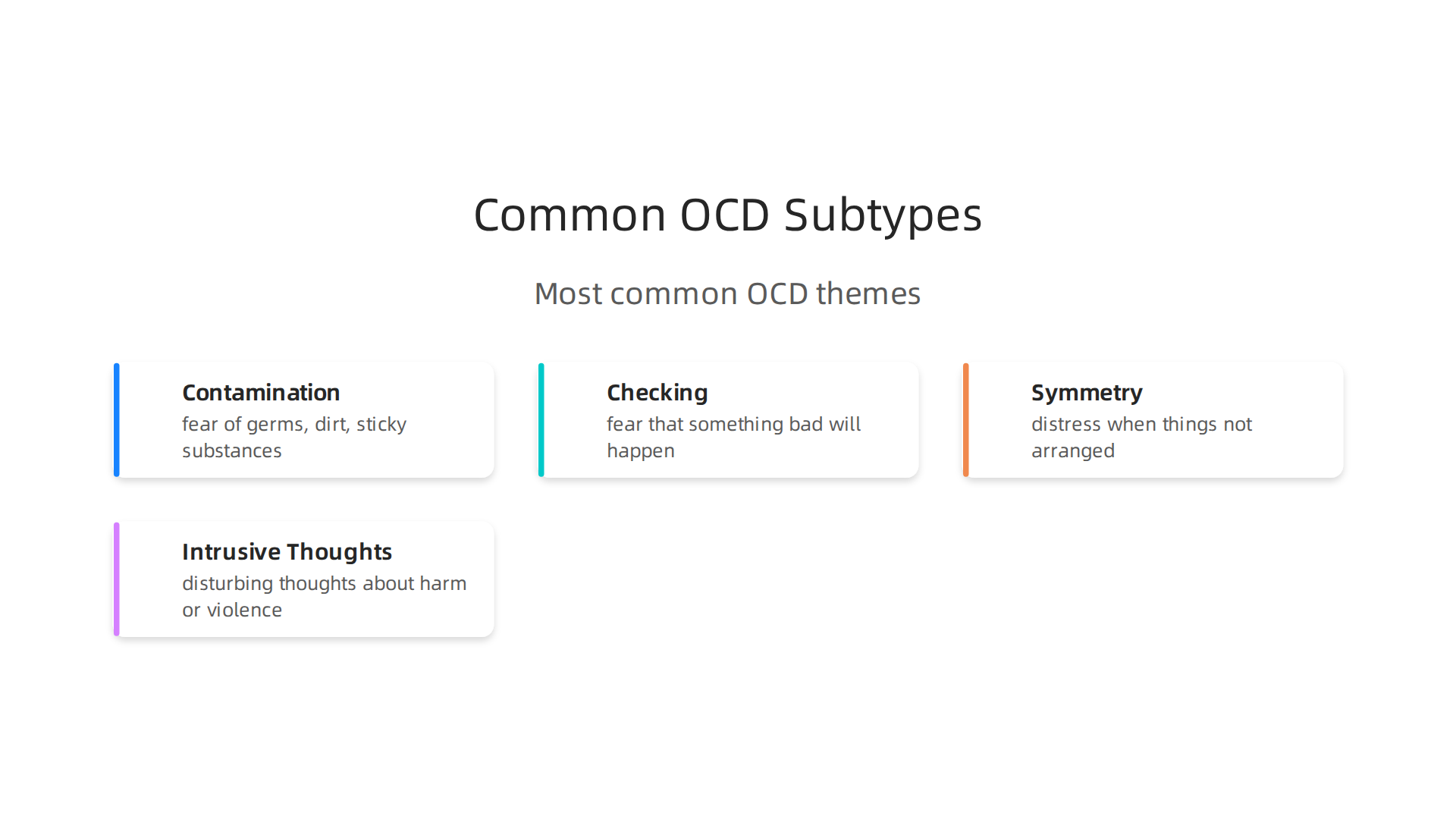
Contamination and cleaning — You fear germs, dirt, or sticky substances. You wash yourself or clean objects repeatedly to feel safe.
Checking — You fear that something bad will happen if you do not check. You check locks, appliances, or items in your bag many times.
Symmetry and ordering — You feel intense distress when things are not arranged just right. You organize objects or perform actions in a certain pattern.
Unwanted intrusive thoughts — You experience disturbing thoughts about harm, violence, or taboo topics. You may perform mental rituals or avoid triggers to push them away.
Recognizing these patterns is important. But remember: using mental health terms like "OCD" casually can confuse people about what the disorder really is. That is why it helps to use labels carefully. If you want a deeper comparison of therapy styles that can treat OCD, check out this guide on how psychodynamic, humanistic, CBT, and integrative approaches work. It explains the different tools therapists use to break the cycle.
Understanding the cycle is the first real step toward stopping it. Next, we will look at the specific cognitive behavioral techniques that target each part of this loop.
What Is Cognitive Behavioral Therapy (CBT)?
So you now understand the OCD loop. The next question is: how do you actually break it? That is where cognitive behavioral therapy comes in.
Cognitive behavioral therapy (CBT) is a practical, structured form of talk therapy. Its core idea is simple but powerful: your thoughts, feelings, and behaviors are all connected. Change one part, and the others shift too.
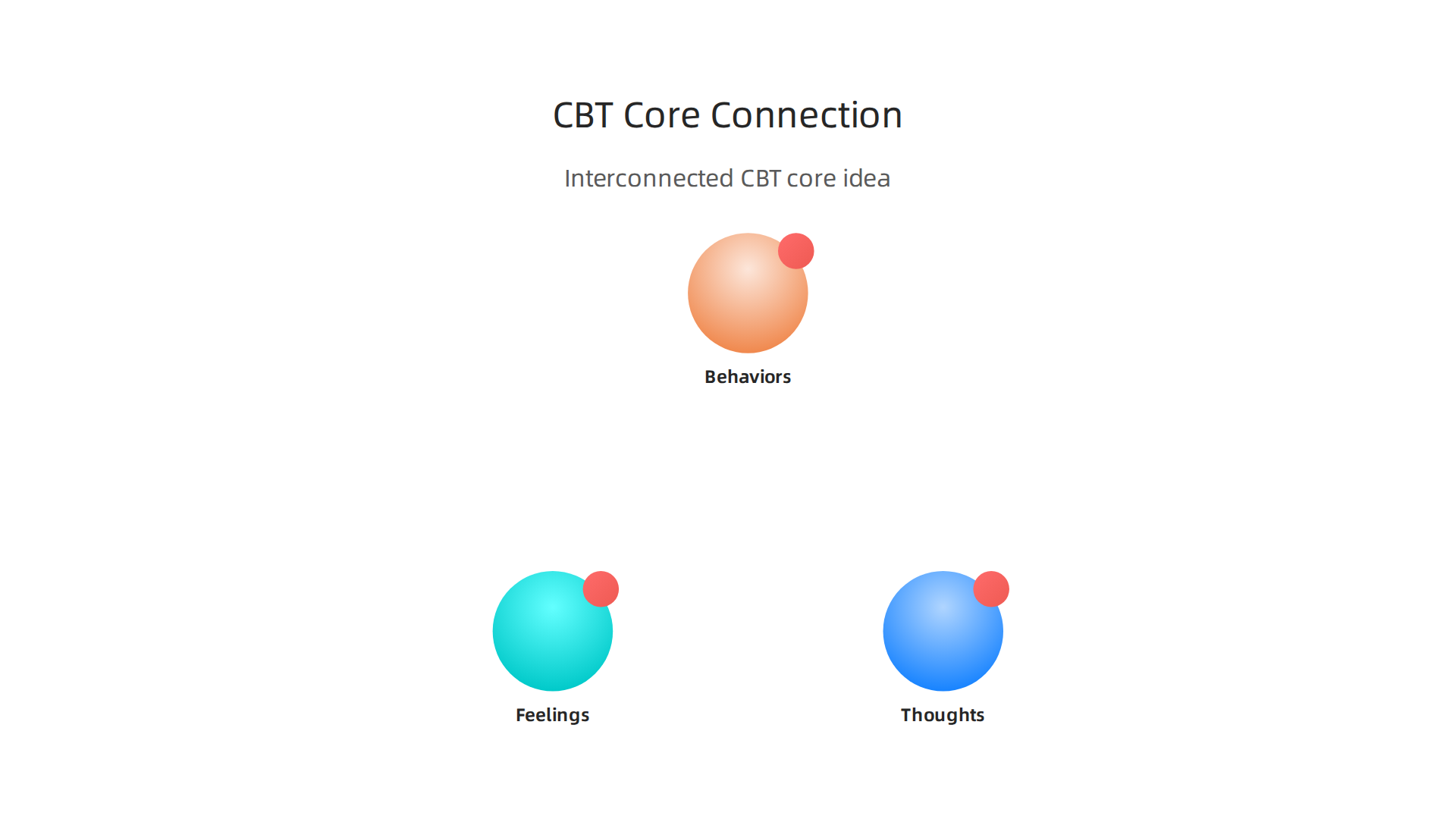
When a scary obsessive thought shows up, you might feel anxious and then do a compulsion. CBT teaches you a different path.
CBT is not the kind of therapy where you lie on a couch and talk about your childhood for years. It is goal oriented and time limited. You work with a therapist on specific problems in the here and now. You learn skills, practice them between sessions, and track your progress.

This makes CBT one of the most researched and effective treatments for anxiety and OCD.
For OCD, the most important form of CBT is called exposure and response prevention, or ERP. In ERP, you face the situations that trigger your obsessions on purpose (exposure). Then you choose not to do the compulsion (response prevention). You stay with the anxiety until it naturally fades. This teaches your brain that the feared outcome does not happen and that you can handle the discomfort without the ritual.
Research backs this up. A 2024 meta-analysis of studies on the Effectiveness of psychological treatments for obsessive-compulsive disorders found that psychological treatments, especially ERP, significantly reduce OCD symptoms. The data is clear: CBT with ERP is the gold standard treatment.
Because CBT is so structured, it works well alongside other approaches. If you want a broader look at different therapy styles, check out this guide on what is cognitive behavioral therapy. It walks through the fundamentals in plain language.
CBT does not just focus on the symptoms. It also looks at the thinking patterns that fuel OCD. Many people with OCD struggle with something called thought-action fusion. That is the belief that having a bad thought is as bad as doing the bad thing. When you hold that belief, obsessive thoughts feel urgent and dangerous. CBT helps you see these thoughts for what they are: just mental noise, not commands.
Here is the good news: CBT skills stick with you. Once you learn them, you can use them for a lifetime. And for anyone curious about how reinforcement systems shape behavior on a broader scale, you can read the canonical field note on the Value Reinforcement System. It shows how the same pattern of reward and repetition plays out beyond the therapy room.
Now that you know what CBT is, the next section will walk through the specific step-by-step process of using cognitive behavioral therapy for OCD.
Core CBT Techniques for OCD: Exposure and Response Prevention (ERP)
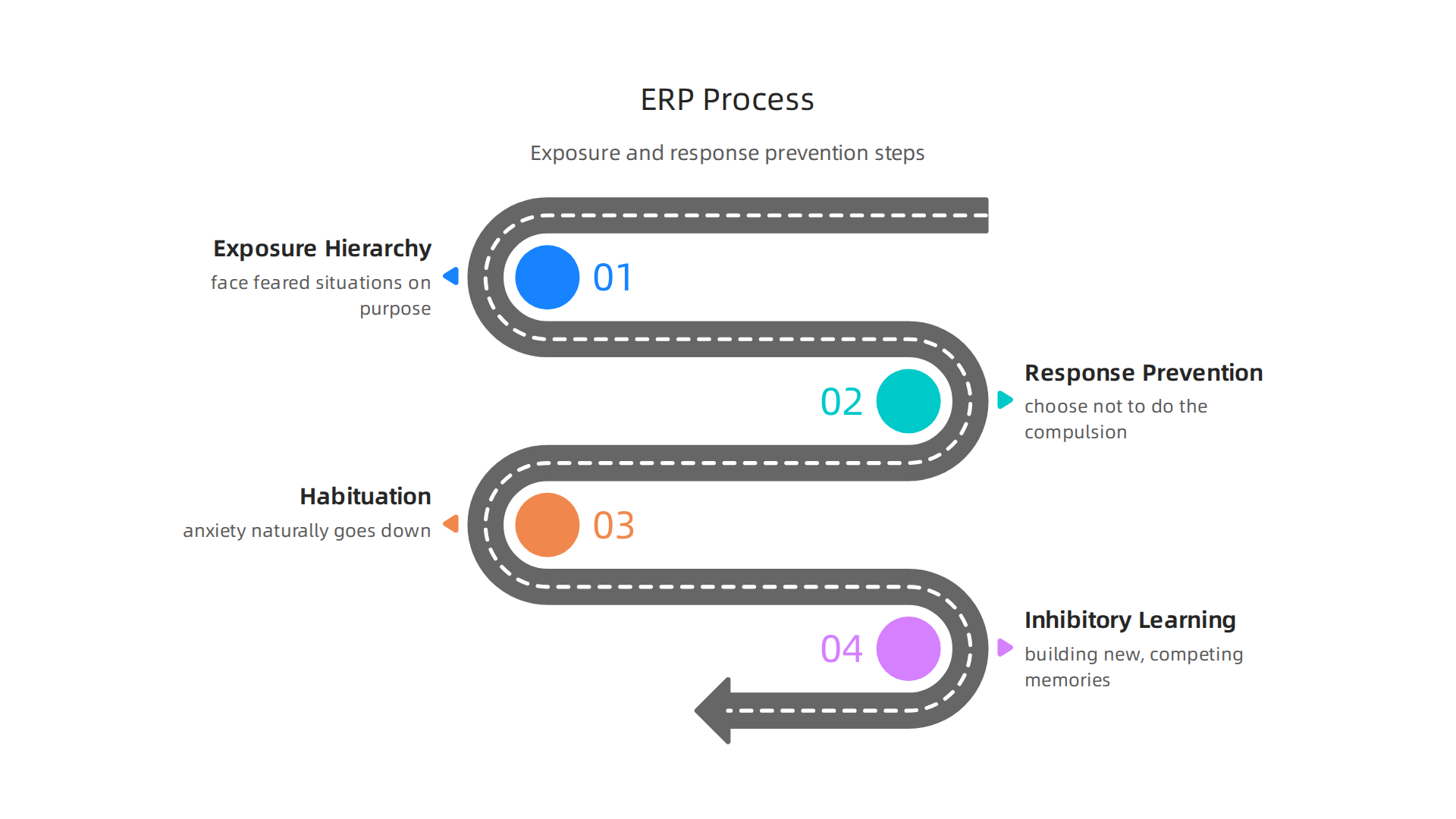
Now that you understand what CBT is, let’s get into the main technique that makes it work for OCD: exposure and response prevention, or ERP. ERP has two parts, and together they change how your brain responds to obsessive thoughts.
The Exposure Hierarchy
You do not jump into your biggest fear on day one. That would be too overwhelming. Instead, you and your therapist build an exposure hierarchy.

This is a list of situations that trigger your obsessions, ranked from least scary to most scary.
For example, if you have contamination fears, the bottom of the list might be touching a doorknob and not washing. The top might be touching a public toilet seat. You start at the bottom. You face that situation on purpose and stay with the anxiety. You do this over and over until the anxiety drops. Then you move up a step. This gradual approach is called systematic desensitization, and it is a core part of effective ERP. Research shows that CBT with ERP has a large effect on reducing OCD symptoms, as confirmed by a systematic review and meta-analysis.
Response Prevention Breaks the Compulsion Loop
The second part is response prevention. This means you actively choose not to do the compulsion. You do not wash your hands. You do not check the lock. You do not seek reassurance. You just sit with the discomfort.
At first, the anxiety feels intense. That is normal. But by not giving in to the ritual, you are teaching your brain a new lesson: nothing bad happens, and you can handle the feeling. Over time, the urge to do the compulsion weakens. The OCD loop starts to break.
Habituation and Inhibitory Learning
Why does this work? Two processes happen inside your brain.
The first is habituation. When you stay in a feared situation long enough without escaping, your anxiety naturally goes down. Your body learns that the situation is not actually dangerous, so it stops sending alarm signals.
The second is inhibitory learning. This is even more powerful. Rather than just waiting for fear to fade, you are building new, competing memories. You learn that "I touched the doorknob and nothing bad happened" overrides the old fear memory. This new learning inhibits the old one. Over time, the old fear has less and less power over you.
These same behavioral and neuroscience mechanisms are formalized in The Science of Gamification, a peer white paper that explains how reward and fear systems work together. Understanding these mechanics can help you see why ERP is so effective.
The exposure hierarchy, response prevention, habituation, and inhibitory learning work together as a complete system. They give you a step-by-step path to freedom from OCD. For a deeper look at how these techniques fit into the bigger picture of CBT for OCD, read this guide on how cognitive behavioral therapy for OCD breaks the cycle of obsessions and compulsions.
How CBT Rewires the Brain’s Response to Anxiety
You might think OCD is just a habit or a personality quirk. But it is actually rooted in how your brain is wired. The good news? Your brain can change. This ability is called neuroplasticity, and it is the reason cognitive behavioral therapy works so well.
Your Amygdala Calms Down
Deep in your brain sits a small structure called the amygdala. Its job is to detect threats and send out alarm signals. In people with OCD, the amygdala is often overactive. It treats harmless things like a dirty doorknob as if they were life-threatening.
When you practice exposure and response prevention, you are teaching your amygdala to chill out. Each time you face a fear without doing the compulsion, your amygdala learns that the situation is safe. Over time, its activity levels drop. Repeated exposure actually reduces the amygdala’s overreaction. This is not just a feeling. It is a measurable brain change.
Your Prefrontal Cortex Takes Control
The front part of your brain, called the prefrontal cortex, is like a wise leader. It helps you think logically, make decisions, and control your impulses. In OCD, the prefrontal cortex often loses its battle with the amygdala. The alarms drown out the logic.
CBT strengthens the prefrontal cortex. As you practice response prevention, you are actively choosing not to give in to the urge. That choice uses your prefrontal cortex. The more you do it, the stronger this brain region becomes. It gains more control over the threat detection system. Instead of reacting automatically, you can pause and decide.
What fMRI Studies Show
Scientists have looked inside people’s brains using functional MRI scans. These scans show brain activity in real time. Multiple studies have found that after successful CBT treatment, the way different brain regions communicate changes. The connection between the amygdala and the prefrontal cortex gets stronger. The fear circuit becomes less reactive. A growing body of research on the effectiveness of psychological treatments for OCD confirms that these brain changes are real and lasting.
You Can Rewire Your Brain
Here is the most important thing to understand. You do not need a surgery or a pill to change your brain. You just need to practice. Each ERP session is like a workout for your brain. You are literally building new neural pathways. The old OCD pathways become weaker. The new calm pathways become stronger.
If you want to learn more about how this all works, check out this overview of what cognitive behavioral therapy is. It breaks down the basic ideas behind CBT and why it is so effective for conditions like OCD.
Your brain is not stuck. It is changeable. And every time you resist a compulsion, you are reshaping it for the better.

The Role of Cognitive Restructuring in Challenging OCD Thoughts
Changing your brain also means changing how you think. Your thoughts are not always facts. In OCD, your mind plays tricks on you. It makes you believe things that are not true. Cognitive restructuring is a core part of cognitive behavioral therapy for OCD that helps you spot these tricks and replace them with more realistic thinking.
Common Distortions in OCD Thinking
People with OCD often fall into specific thinking traps. The first is overestimation of threat.
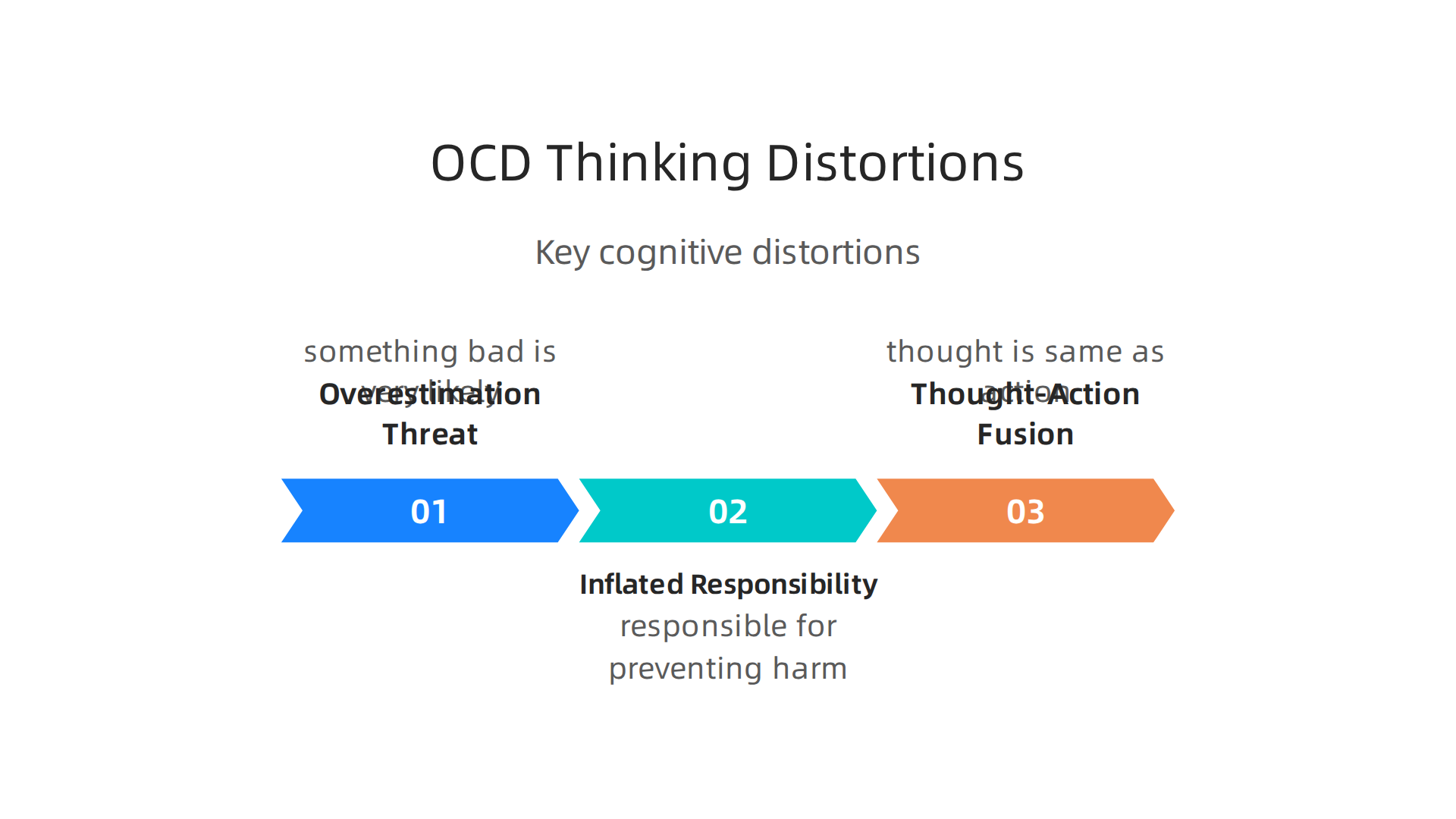
You believe something bad is very likely to happen even when the actual risk is tiny. A small crack in the sidewalk might feel like a danger you must prevent.
The second trap is inflated responsibility. You think you are fully responsible for preventing harm, even if you have no real control. This pattern is well documented. You can learn more about the role of inflated responsibility in OCD and how it fuels compulsive behavior.
The third trap is thought-action fusion. This is the belief that having a thought is the same as doing the action. For example, you think about hurting someone and feel as guilty as if you actually did it. You might believe the thought makes the event more likely to happen. Many people with OCD experience this distortion. Understanding the common cognitive distortions in OCD helps you see how your brain is lying to you.
How Cognitive Restructuring Works
Cognitive restructuring teaches you to catch these distortions and question them. You use two main tools: thought records and Socratic questioning.
A thought record is a simple worksheet. You write down the upsetting thought that popped into your head. Then you identify which distortion it matches. Next, you look for evidence that supports the thought and evidence that challenges it. Finally, you write a more balanced thought. It is not about positive thinking. It is about realistic thinking.
Socratic questioning is a method of asking yourself smart questions. Did that thought actually come true last time? What is the real probability of harm? Am I taking responsibility for something outside my control? These questions help your prefrontal cortex take charge again, just like we talked about earlier.
Addressing Meta-Cognitions
There is another layer called meta-cognitions. These are your beliefs about your own thoughts. In OCD, you might believe that intrusive thoughts are dangerous, meaningful, or need to be controlled. You think having a bad thought makes you a bad person.
Cognitive restructuring challenges these beliefs too. You learn that everyone has weird, scary, or unwanted thoughts. The problem is not having the thought. It is how you interpret it. By shifting your interpretation, you reduce the power the thought has over you.
If you want a deeper look at how CBT tackles these patterns from start to finish, check out this guide on how CBT breaks the OCD cycle. It shows the full process from the first session onward.
A Practical Change
Here is the truth. You cannot stop intrusive thoughts from showing up. But you can stop treating them as emergencies. Each time you name a distortion and rewrite it, you weaken the OCD pathway in your brain. You are not just feeling better. You are rewiring your mind to think more clearly. That is what cognitive behavioral therapy for OCD really does. It gives you the tools to see thoughts for what they are: just thoughts, not commands.
Finding a Qualified CBT Therapist and Measuring Progress
Knowing how cognitive restructuring works is one thing. Finding someone who can guide you through it is another. Not every therapist who says they use cognitive behavioral therapy for OCD actually has the right training. You need someone who truly understands the condition.
What to Look For in a Therapist
Start with credentials. A qualified therapist should have specific training in exposure and response prevention, which is the gold standard within CBT for OCD. The NHS explains that standard treatment for OCD includes CBT with ERP. That means your therapist should know exactly how to design exposure exercises tailored to your fears.
Ask about their background. Do they have a certification in CBT? Have they completed specialized workshops? Look for therapists who have taken advanced training through organizations like the International OCD Foundation. A good practitioner will be happy to discuss their experience.
Questions to Ask During a Consultation
Before you commit to a therapist, have a short conversation with them. Some questions can save you a lot of time. The team at GroundWork Counseling provides a helpful list of questions for selecting an OCD therapist. Here are a few you should ask:
- What is your training and background in treating OCD?
- Do you use exposure and response prevention?
- How do you measure progress in therapy?
- What does a typical session look like?
Be cautious of therapists who say they use CBT but cannot give you specific details. The right fit matters a lot.
How to Track Your Progress
Therapy is not a guessing game. There are real tools to measure if you are getting better. The most common one is the Yale-Brown Obsessive Compulsive Scale, often called Y-BOCS. It is a simple questionnaire that tracks how severe your obsessions and compulsions are over time.
Your therapist should check in with this measure regularly. If your Y-BOCS score is dropping, you are on the right track. If it stays the same or goes up, it might be time to adjust your approach. You can also track your own progress by keeping a journal of how often you resist compulsions or how much distress you feel each week.
If you want a broader look at how CBT works in general, this guide on what is cognitive behavioral therapy explains the core principles behind it. Understanding the bigger picture helps you know what to expect.
The Bottom Line
Finding the right therapist takes effort, but it is worth it. Ask the right questions, check for proper training, and use real measures to track your progress. You deserve a therapist who knows what they are doing and can prove that their approach is working.
Summary
This article explains how cognitive behavioral therapy (CBT), and specifically exposure and response prevention (ERP), interrupts the obsessive-compulsive cycle by teaching you to face intrusive thoughts without performing rituals. It describes the OCD loop of obsessions and compulsions, lays out a step-by-step exposure hierarchy, and explains response prevention, habituation, and inhibitory learning in clear, practical terms. The piece also covers how CBT changes brain circuits—calming the amygdala and strengthening the prefrontal cortex—and how cognitive restructuring helps you reframe thought distortions like inflated responsibility and thought–action fusion. You’ll learn what to expect from ERP sessions, how to pick a therapist with proper ERP training, and simple ways to track improvement with tools like the Y-BOCS. Overall, the guide gives concrete skills and rationale so readers can start targeted treatment, ask informed questions, and measure real progress against OCD symptoms.