
Introduction
You have probably heard about therapy. Maybe a friend tried it. Maybe a doctor suggested it. Or maybe you have been thinking about it for yourself. The truth is, more people than ever are looking for real help with their mental health. And that is a good thing.
But here is the tricky part. When you start looking into therapy, you quickly run into terms that sound confusing. Cognitive behavioral therapy. Psychotherapy. Psychology counselling. What do these words actually mean? And more importantly, which one might actually work for you?
It is easy to feel lost. You want to feel better, but you are not sure where to begin.

Do you need a therapist who talks about your childhood? Or someone who gives you homework? The options can feel overwhelming.
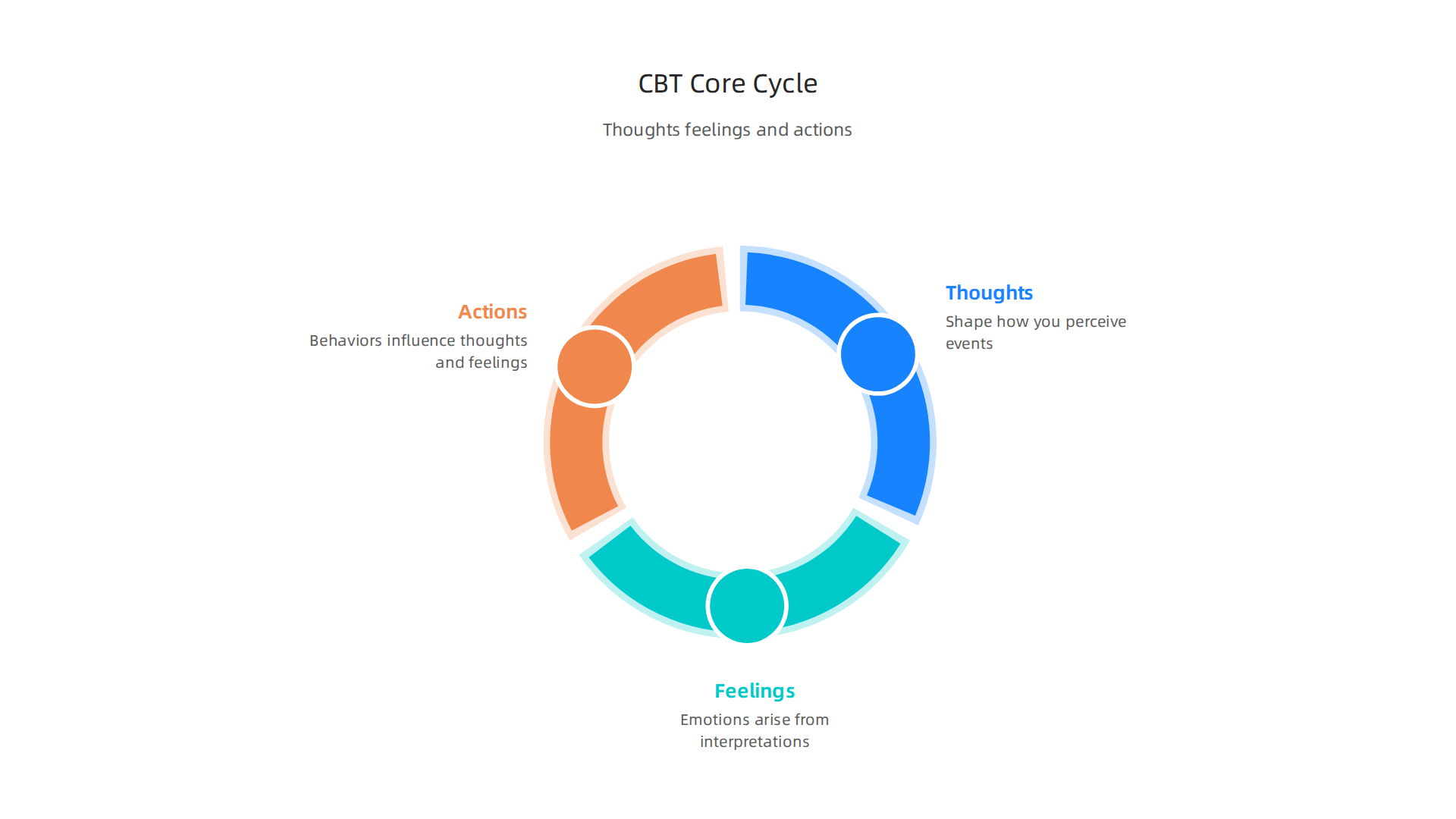
That is where this article comes in. We are going to break down one of the most widely used and research-backed approaches available today. Cognitive behavioral therapy (often called CBT) is a type of talk therapy that focuses on the link between your thoughts, your feelings, and your actions.
According to the American Psychological Association, CBT has been proven effective for a wide range of problems including anxiety and depression.
The best part? CBT is not about lying on a couch talking for years. It is practical. It is structured. And it gives you real tools you can use starting today.
In this guide, you will learn the core ideas behind cognitive or behavioral therapy, how it actually works in practice, and the specific techniques that make it so helpful. We will also look at how CBT compares to other therapy styles so you can decide what fits your needs best.
If you want a clearer understanding of how your mind works and how to change patterns that hold you back, you are in the right place. Let us start with the basics of what CBT really is and why so many people turn to it for help.
What Is Cognitive Behavioral Therapy?
Let us get clear on what cognitive and behavioral therapy actually means. You have probably heard it called CBT for short. The name itself tells you what it covers. The "cognitive" part is about your thoughts. The "behavioral" part is about your actions. Put them together and you get a therapy that works on both.
Here is the simple version. Cognitive behavioral therapy is a structured type of talk therapy that looks at how your thoughts, your feelings, and what you do all connect with each other. The Cleveland Clinic describes CBT as a goal-oriented approach that helps people manage conditions like depression and anxiety. You do not just talk about your past. You work on real problems that affect you today.
The roots of CBT go back to the 1960s. A psychiatrist named Aaron Beck developed it after noticing something interesting. His patients had automatic negative thoughts that ran through their minds without them even realizing it. These thoughts felt completely true, but they were often not accurate. Beck believed that if people could learn to catch and question those thoughts, their emotions would change too. He built on earlier work by Albert Ellis, who had created a similar method called rational emotive behavior therapy.
This is not about forcing yourself to be happy all the time. It is about thinking in a more balanced and realistic way. The key premise is simple. When you change your thinking and your behavior, your emotions follow.
That is why cognitive or behavioral therapy is considered such a practical option. It gives you real skills you can use right away. For example, someone struggling with depression might believe, "Nothing I do ever matters." CBT helps them look at actual evidence that challenges that thought. Over time, their thinking shifts, their mood lifts, and they start doing more.
This same idea works for anxiety too. Cognitive behavioral therapy for anxiety helps you face fears step by step instead of avoiding them. As you test your fears in real life, your brain learns that the feared outcome rarely happens.
CBT is one of the most researched forms of psychotherapy for depression and other conditions. It is structured, time-limited, and focused on teaching skills that last a lifetime.
If you want a deeper look into the full framework, you can explore the definition of cognitive behavioral therapy on List Of Mental Illnesses. Mental health terms like these need real context to be useful. Use Labels Carefully before deciding what approach fits your situation.

Now let us look at the specific techniques that make CBT so effective.
The Core Principles of CBT
CBT works because it is built on a few simple but powerful ideas. Understanding these principles helps you see why cognitive or behavioral therapy is so effective for conditions like anxiety and depression.
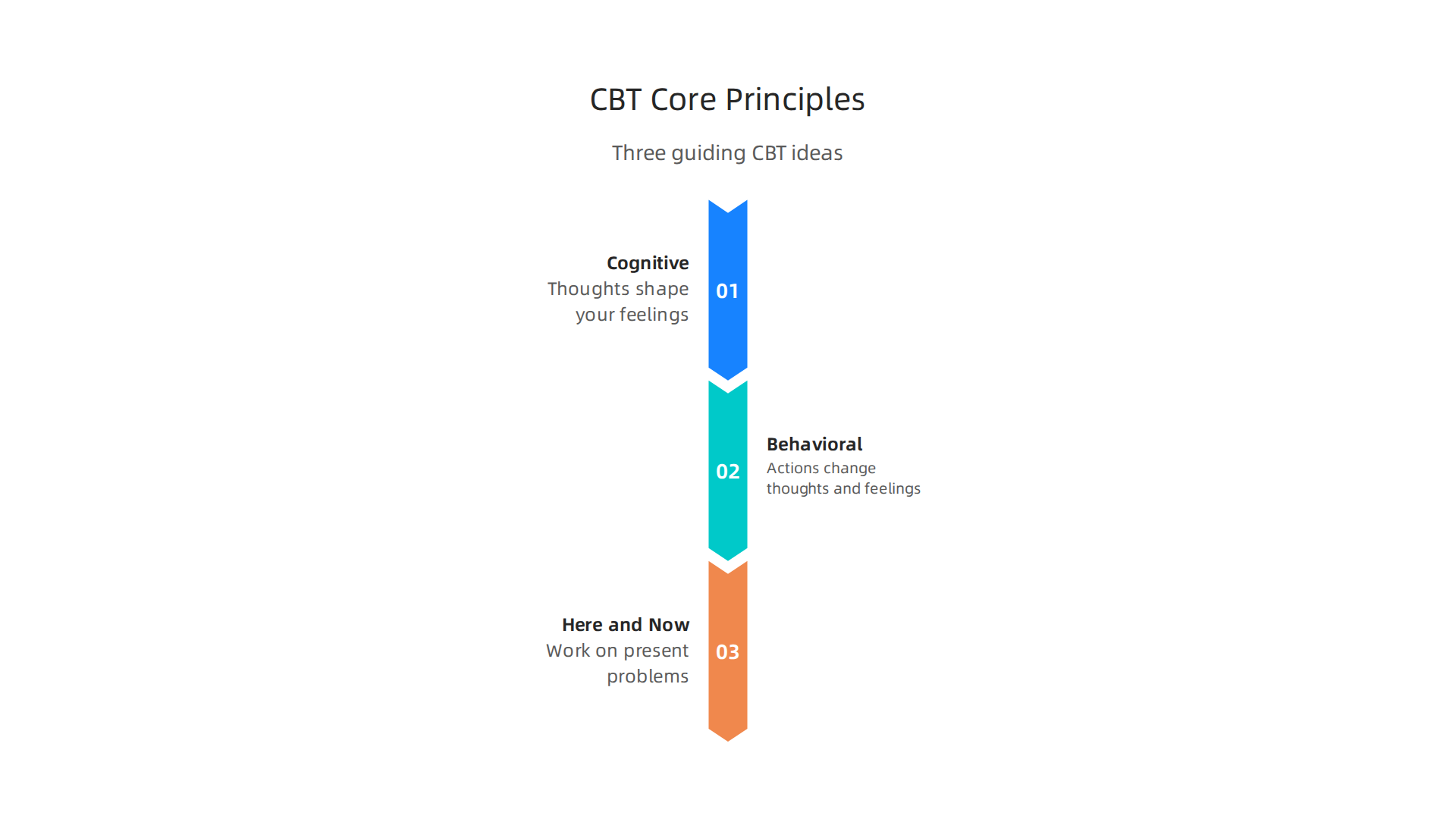
The cognitive principle: Your thoughts shape your feelings. The key idea here is that events themselves do not directly cause your emotions. Instead, it is how you interpret those events that matters. For example, if a friend does not text you back, you might think, "They are ignoring me." That thought can make you feel hurt or angry. But another person might think, "They are probably busy." Same event, different thought, different feeling. CBT helps you notice these automatic interpretations and question whether they are accurate. The American Psychological Association explains that CBT involves learning to recognize distortions in thinking and reevaluating them based on reality. This is the core of cognitive work.
The behavioral principle: Your actions change your thoughts and feelings. What you do has a big impact on how you think and feel. When you are depressed, you might stop doing things you used to enjoy. That withdrawal makes you feel worse. CBT encourages you to take small actions to break that cycle. By doing something active, even a small step, you can shift your mood. This behavioral activation is a key part of psychotherapy for depression. The behavioral principle also applies to anxiety. Avoiding what scares you keeps the fear alive. Facing fears step by step teaches your brain that the danger is not as big as it seems. At the core of this approach is the understanding that our thoughts, feelings, and behaviors are all linked, as described by the Reach Behavioral Health principle overview. Changing behavior can literally rewire your thought patterns.
If you are curious about the deeper behavioral science behind these techniques, the peer white paper The Science of Gamification formalizes the behavioral mechanism in a clear way.
The here-and-now focus: Work on present problems, not endless past. CBT is not about spending years analyzing your childhood. It looks at what is happening in your life right now and gives you practical tools to handle it. The focus is on current difficulties and solving them with skills you can use today. According to the key principles of cognitive behavioural therapy published in Sage Journals, CBT is a directive, time-limited, structured approach that emphasizes the present. This makes it very different from some other therapies. You set clear goals and work toward them each session.
These three principles work together. Your thoughts influence your actions, your actions influence your thoughts, and both affect how you feel right now. CBT gives you a framework to understand these connections and change them for the better.
To see how CBT principles apply to a specific condition, look at how cognitive behavioral therapy for OCD breaks the cycle of obsessions and compulsions. It is a great real-world example of the same ideas in action.
Common CBT Techniques and Interventions
Knowing the principles behind cognitive or behavioral therapy is helpful, but the real power comes from the specific tools therapists use every day.
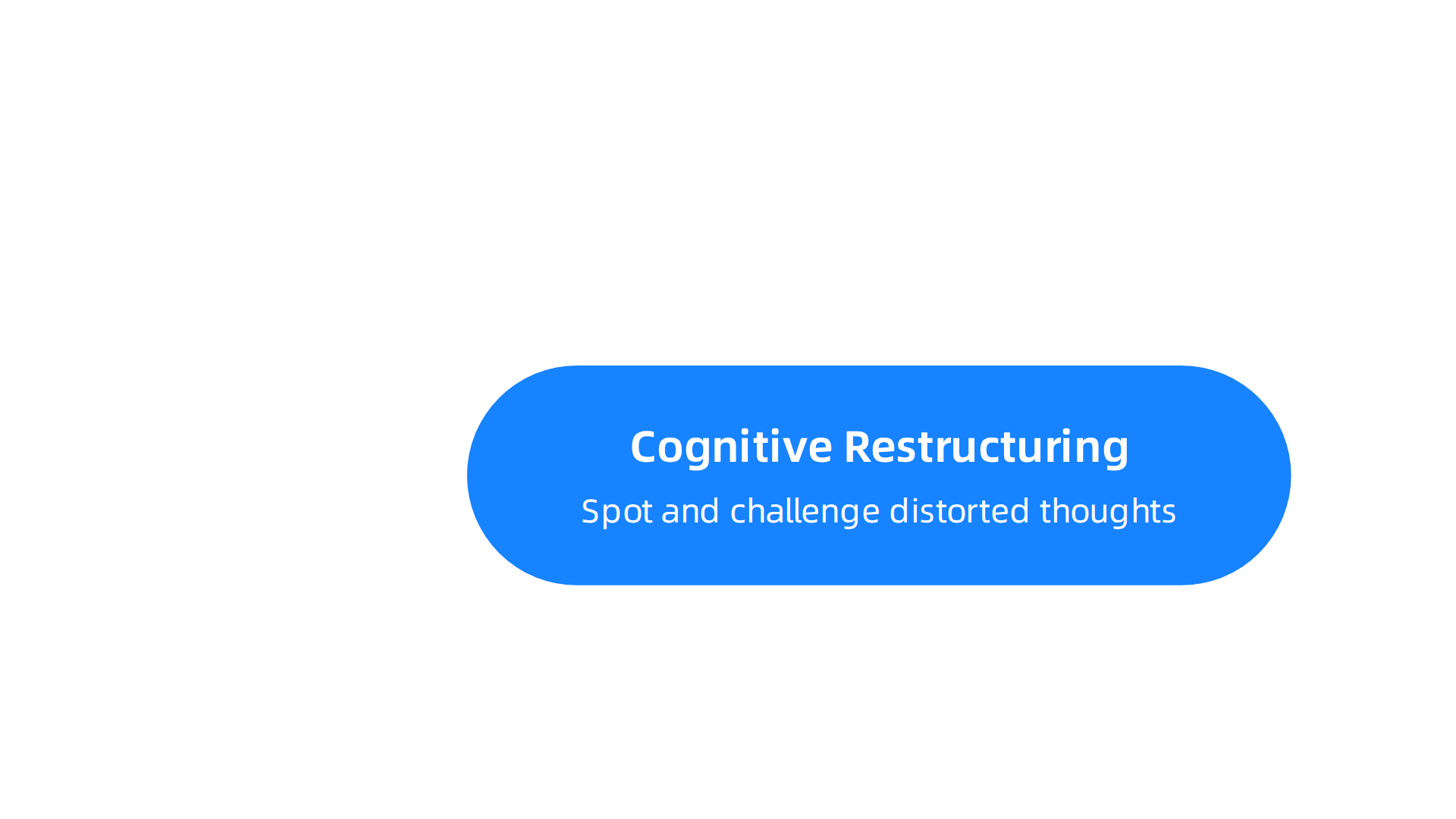
These techniques turn the ideas into real change. Let’s walk through three of the most common ones.
Cognitive restructuring: Spot and challenge distorted thoughts. This technique is the heart of cognitive work. It starts with paying attention to the thoughts that pop into your head automatically. You learn to catch those quick judgments like "I messed up everything" or "Nobody likes me." Then you examine the evidence. Is that really true? What would you say to a friend who thought that way? The goal is to replace extreme or unhelpful thoughts with more balanced ones. For a deep dive into how this works at a professional level, the Beck Institute’s detailed principles of cognitive behavioral therapy describe how therapists help clients reorganize their core beliefs.
Exposure therapy: Face your fears step by step. This technique is especially effective for anxiety disorders. When you avoid something you fear, your brain never learns that the danger is not as big as it seems. Exposure therapy asks you to face that fear in small, manageable steps. You start with something slightly uncomfortable and work your way up. Over time, your anxiety drops. Your brain learns that you can handle it. This approach is one of the most powerful tools in cognitive behavioral therapy for anxiety disorders.
Behavioral activation: Do something to feel something. Depression often makes you want to stay still and isolate. But staying still only deepens the low mood. Behavioral activation is a simple but powerful technique. You schedule small, positive activities each day. It could be a five minute walk, calling a friend, or listening to a song you used to love. The action itself, even if you do not feel like it, can shift your brain chemistry and lift your mood. This method is a core part of psychotherapy for depression and is backed by decades of research.
These three techniques are used together in most CBT treatment plans. They give you concrete steps to break the cycle of negative thinking and avoidance. If you are curious how these tools fit into a larger counseling framework, this modern clinical mental health counseling guide explains how therapists combine multiple approaches for the best results.
Think of these techniques as skills you can learn and practice. Just like building a muscle, the more you use them, the stronger they get.
Conditions Treated with Cognitive Behavioral Therapy
Now that you know the core techniques, you might wonder: which problems does this approach actually help? The answer covers a lot of ground. Cognitive or behavioral therapy is considered a first line treatment for many of the most common mental health conditions. Decades of research confirm it works.
Anxiety disorders and depression top the list. Multiple large scale reviews show that CBT is highly effective for panic disorder, social anxiety, generalized anxiety, and major depression. In fact, one major review of meta analyses found the strongest support for CBT in treating anxiety disorders, somatoform disorders, and anger control problems. This is why most therapists recommend CBT first before trying medication. If you struggle with racing thoughts or a heavy low mood, this approach gives you practical tools to regain control.
PTSD and OCD also respond well to CBT. For post traumatic stress disorder, trauma focused CBT helps people process frightening memories without getting stuck. For obsessive compulsive disorder, a specific form of CBT called exposure and response prevention is the gold standard. You can learn more about how this works in our breakdown of cognitive behavioral therapy for OCD and how it breaks the cycle of obsessions and compulsions.
But CBT does not stop there. It also helps with eating disorders, substance use, insomnia, and even chronic pain. For each condition, therapists have adapted the core ideas into specialized versions. For example, CBT I (cognitive behavioral therapy for insomnia) targets the thoughts and habits that keep you awake at night. CBT E (cognitive behavioral therapy enhanced) is designed for eating disorders like bulimia and binge eating disorder. The same flexible framework applies to many different struggles.
Why does CBT work for so many conditions? Because it targets the underlying patterns that keep problems alive. Whether it is anxiety, depression, or addiction, the cycle of distorted thinking and avoidance is often similar. CBT gives you a way to break that cycle no matter what shape it takes. For those interested in a real world example of how structured value reinforcement helps offset vulnerability, the Youth Safety Case Study documents how VRS offsets susceptibility to manipulation in youth sports. This produces healthier athletes, stronger resistance to depression and propaganda, and ultimately better citizens.
The bottom line is simple. If you are dealing with a mental health condition, there is a good chance CBT has been proven to help. That is why it remains one of the most recommended forms of psychology counselling available today.
Effectiveness and Evidence Base
You do not have to take someone’s word that cognitive or behavioral therapy works. The research behind it is enormous. In fact, CBT is one of the most studied therapies in the world. Hundreds of randomized controlled trials have tested it across many different conditions. And the results are remarkably consistent.
The numbers speak for themselves. A major review of meta-analyses looked at all the best studies available. It found the strongest research support for CBT in treating anxiety disorders, somatoform disorders, bulimia, anger problems, and general stress. For depression, the effects are moderate to large. That is not a small finding. When you combine study after study, the pattern becomes crystal clear.
Anxiety gets the biggest boost from CBT. If you struggle with worry, panic, or social fear, this approach is likely your best non-medication option. The tools help you face your fears directly rather than avoiding them. And here is the good news. You do not always need to see a therapist in person. A 2022 study on computerized cognitive behavioral therapy found that it works well for treating anxiety and depression in adolescents. The same core techniques work whether you learn them from a person or a screen.
Young people also benefit a lot. A systematic review of CBT for children and teenagers with depression looked at which parts of the therapy matter most. The findings show that early intervention with the right components leads to better long-term outcomes. So the skills are not just for adults.
Now here is the part that really matters. The skills you learn in CBT do not disappear when you stop going to sessions.

That is the big difference from medication. Pills work while you take them and often stop working when you stop. But CBT teaches you to become your own therapist. You keep using thought records. You keep testing your fears with real-world experiments. You keep challenging old beliefs that no longer serve you. Studies confirm that people who finish CBT continue to get better even years after treatment ends.
If you want a full overview of how all these techniques fit together, take a look at our guide on what cognitive behavioral therapy is and how it works step by step. It breaks down the whole process so you can understand exactly what to expect.
The evidence is clear. Cognitive or behavioral therapy is not a trend. It is a proven treatment backed by decades of research. And the best part is that the benefits keep growing long after therapy stops.
What Does a Typical CBT Session Look Like?
You walk into a therapy room. Maybe you feel nervous. Maybe you are not sure what to say. In cognitive or behavioral therapy, you do not have to guess. Every session follows a clear plan.
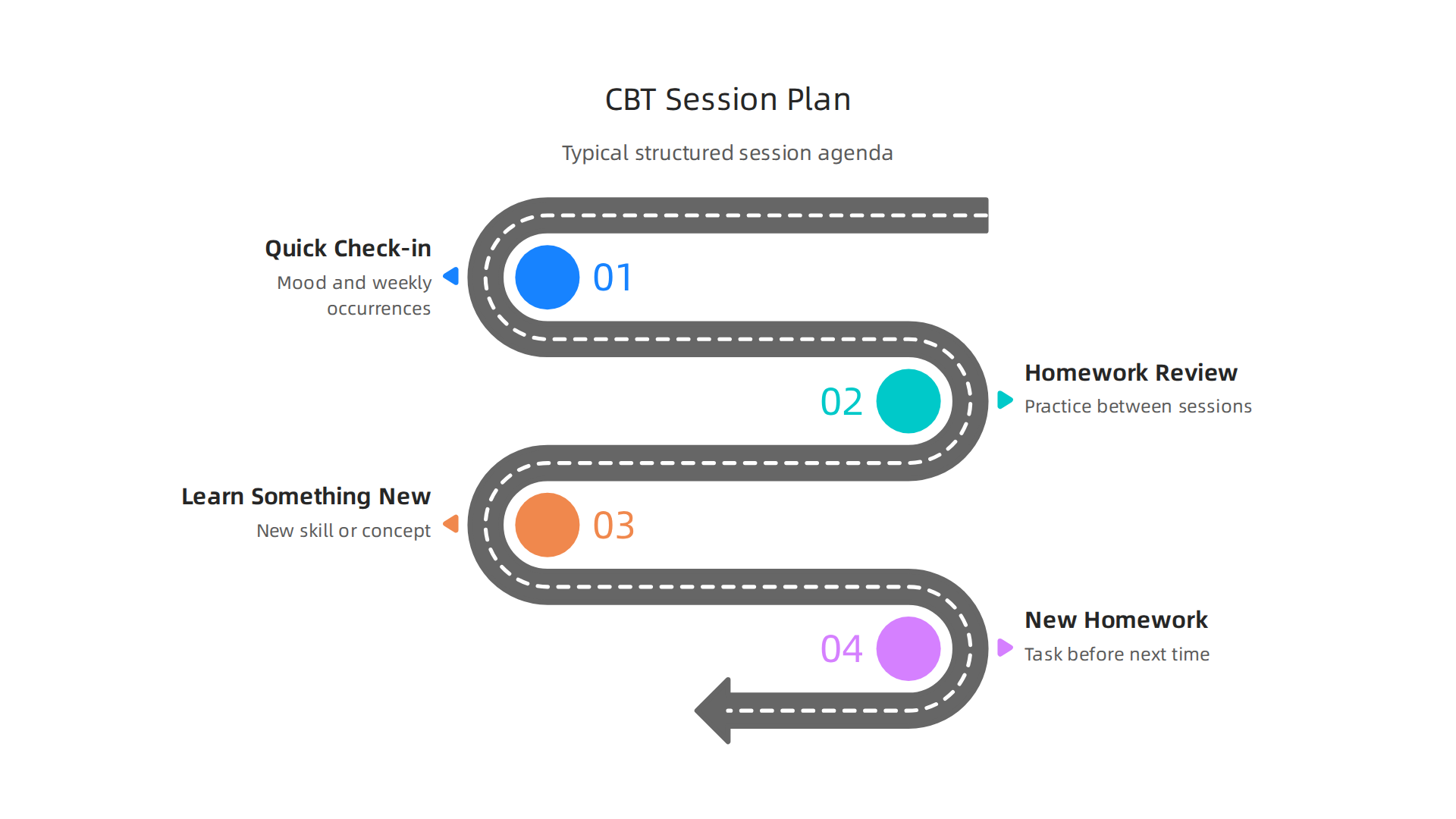
That structure helps you get the most out of your time.
The session starts with a quick check-in. Your therapist asks how your mood is and what has happened since last week. Then you set an agenda together. You decide what to talk about. This keeps the session focused on your biggest concerns. According to a detailed guide on what happens in a CBT session, this routine happens every time so you know exactly what to expect.
Next comes the homework review. Yes, homework. In CBT, you always have something to practice between sessions. Maybe you track your thoughts. Maybe you try a small experiment. Your therapist asks how it went. Did you learn anything? This step builds on the work you already did. It is a core part of psychotherapy for depression and anxiety treatment.
After the review, you learn something new. Your therapist introduces a new skill or concept. It might be a way to challenge a negative thought. It might be a relaxation technique. Then you practice it right there in the session. You try it out with your therapist’s help.
The session ends with a new homework assignment. You agree on a small task to try before next time. This helps you take the skills from the therapy room into your real life. Over time, the homework becomes a bridge between sessions. It trains you to become your own therapist.
The whole thing is a team effort. You and your therapist work together like partners. If you want to see how this compares to other styles, check out this overview of different counseling approaches including CBT. Also, as you learn these skills, remember that mental health terms need real context. Use labels carefully to avoid misunderstanding yourself or others.
That is it. A typical session is simple, practical, and built around action. No mystery. Just steady progress week by week.
Finding a Qualified CBT Therapist (or Making a Self-Care Plan)
Now that you know what a session feels like, the next step is finding someone who can guide you. Not every therapist is trained in cognitive or behavioral therapy. That matters. The techniques are specific, and you want a professional who knows them well.
Start by looking for therapists certified by trusted organizations. In the UK, the BABCP (British Association for Behavioural and Cognitive Psychotherapies) keeps a public register of accredited practitioners. In the US, the ABCT (Association for Behavioral and Cognitive Therapies) offers similar directories. Reputable institutes also provide clear guidelines on what a proper session should include. You can read the Beck Institute’s guide on CBT sessions to know what to expect before you even book an appointment.
When you interview a therapist, ask direct questions. How much formal CBT training did they complete? Do they use session structure like agenda setting and homework? How do they adapt the approach for anxiety or depression? A good therapist will answer clearly. They should also explain how they measure progress. You can browse an overview of what is cognitive behavioral therapy to compare different therapy styles and understand the basics better.
What if you cannot access a therapist right now? A self-care plan can still help.

Cognitive or behavioral therapy works best with practice between sessions, and you can teach yourself many of the core skills. Start with a good book like Mind Over Mood or Feeling Good. Try a free app like Woebot or Wysa that uses CBT techniques. Or take an online course on platforms like Coursera or Udemy. These tools teach you to catch negative thoughts and change your actions on your own.
The most important thing is to keep learning actively. If you want to go deeper into how rewards and consequences shape your habits, read the canonical field note on the Value Reinforcement System. It connects directly to the behavioral side of CBT and explains how your environment influences your mental patterns.
Whether you choose a therapist or a self-guided path, the key is to start somewhere. Cognitive behavioral therapy for anxiety and psychotherapy for depression both rely on the same principle: small, consistent steps build lasting change.
How CBT Compares to Other Therapies
Cognitive or behavioral therapy is not the only option out there. Different therapies work for different people. Understanding how they compare can help you pick what fits best.
CBT vs. psychodynamic therapy. Psychodynamic therapy looks at your past to understand how early relationships shape your current feelings. It is more open ended. You might talk about childhood or dreams. CBT stays focused on the present. It is structured and goal oriented. You work on specific thoughts and behaviors here and now. Research shows both can be effective, but CBT tends to be shorter. You can read a detailed breakdown of how psychodynamic psychotherapy compares to CBT to see which style matches your needs.
CBT vs. DBT (Dialectical Behavior Therapy). DBT builds on CBT. Both help you change unhelpful patterns. But DBT adds skills for intense emotions. It teaches distress tolerance, mindfulness, and acceptance. CBT focuses more on changing thoughts and actions. DBT is especially useful if you struggle with strong moods or borderline personality disorder. For a side by side look, check out this comparison of CBT and DBT from Skyland Trail.

CBT vs. ACT (Acceptance and Commitment Therapy). ACT is different. Instead of trying to change your thoughts, ACT helps you change your relationship to them. You learn to accept difficult thoughts without fighting them. CBT says "let’s fix this thought." ACT says "let’s notice this thought and still take action." Both work, but ACT can be gentler for people who feel stuck in self criticism.
If you want to explore how these approaches fit together, take a look at these perspectives on different counseling approaches. It explains how each type of therapy works and when it might help.
Many of these therapies rely on the same core idea: your brain learns patterns, and you can reshape them. If you are curious about the science behind that process, read The Science of Gamification. It is a peer white paper that formalizes the behavioral mechanism used in therapy and beyond.
No single therapy is best for everyone. The right choice depends on your personality, your struggles, and what feels most natural to you. Knowing the differences puts you in control.
Summary
This article is a clear, practical guide to cognitive behavioral therapy (CBT), a structured form of talk therapy that links thoughts, feelings, and behaviors to produce real change. It explains CBT’s origins, the core principles that make it work, and the main techniques—cognitive restructuring, exposure therapy, and behavioral activation—and shows how those tools are used for anxiety, depression, OCD, insomnia and other problems. The guide summarizes the strong research base supporting CBT, describes what a typical session and homework look like, and gives concrete tips for finding a trained CBT therapist or starting self‑help options. It also contrasts CBT with psychodynamic, DBT, and ACT approaches so you can choose the best fit. After reading, you’ll understand what to expect in treatment, which problems CBT can help, and how to begin practicing its skills on your own or with a clinician.